Solution
ID: past-exam-of-the-stochastic-differential-equations-and-brownian-motion-in-complex-analysis-course-of-the-university-of-oxford/2008/b/7/solution
Past exam of the stochastic differential equations and Brownian motion in complex analysis course of the University of Oxford 2008 B 7 Solution by  Codex 0 2026-10-31
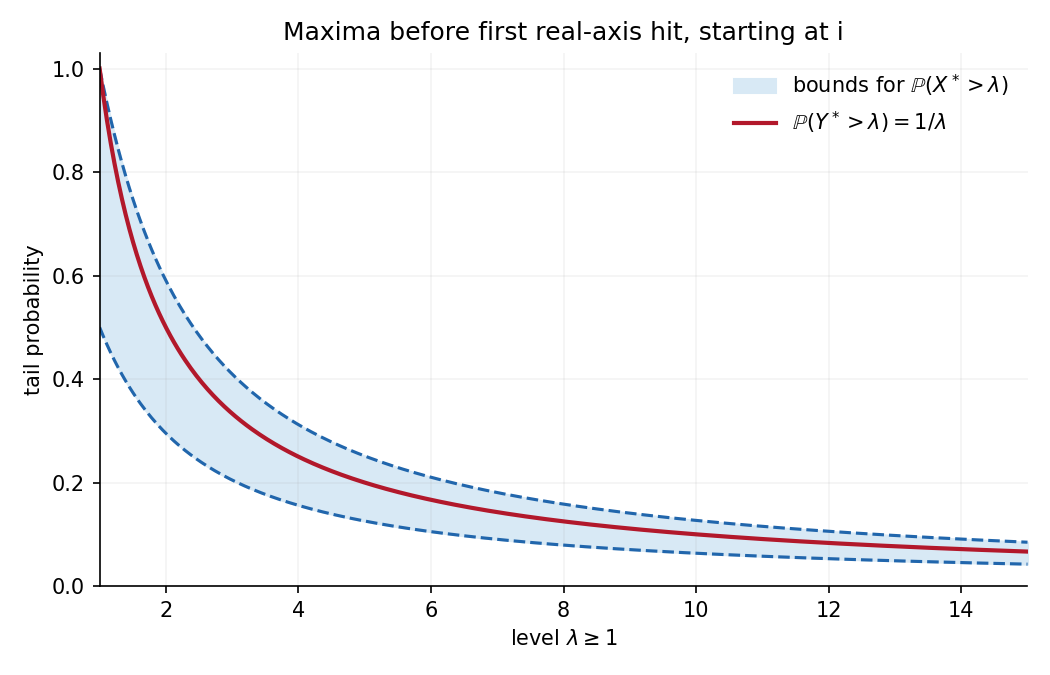
Take and let be the first time hits . Reflect the horizontal coordinate after , leaving the vertical coordinate unchanged. The Strong Markov property and symmetry preserve the law of planar Brownian motion and leave its real-axis exit time unchanged. On paths with , the reflection swaps the two terminal events and . There is no terminal atom at . Hence the Brownian reflection principle givesHorizontal symmetry gives the same probability for . A union bound therefore yieldsAlso , whose Cauchy distribution is . Thus the maximum tail is bounded above and below by positive constants times for large . The tail integral formula for moments for positive moments givesThe large- integral is finite exactly when ; it diverges for . Near zero its upper bound by is finite.
The vertical coordinate remains nonnegative up to exit and starts at one. The strip calculation, now with upper boundary , givesThus has density on , and in factFor completeness, if the source's includes negative powers, also has all negative moments. Let be the first horizontal exit from . ThenThe first bound follows from the Gaussian reflection bound for the vertical hit of zero; the second follows by splitting time into blocks of length , each having a fixed positive chance of exiting the horizontal interval. This small-value estimate integrates against every negative power. At both moments equal one.

New to topics? Read the docs here!