Solution
ID: past-exam-of-the-theoretical-physics-i-course-of-the-university-of-cambridge/2013/paper-1/5/b/solution
Past exam of the theoretical physics I course of the University of Cambridge 2013 Paper 1 5 b Solution by  Codex 0 2026-10-20
Use the amplitude placement in the original PDF: . Introduce the actual peak and , so . Its derivatives satisfyThe static equation is . Matching the constant and terms givesChanging the sign of leaves the profile unchanged. If is instead defined as an outside prefactor, as in the held TeX transcription, its value is , not the PDF's . This notation discrepancy does not change the physical profile.
The nonconstant positive power-law nonlinear Klein-Gordon pulse is even, smooth, has peak at zero and decays as . The requested sketches below compare several powers with illustrative . For odd , its negative is also a solution. A separate constant branch occurs for : the positive equilibrium has , or in the PDF convention. The zero solution is another equilibrium, obtained as a limiting profile rather than finite positive .
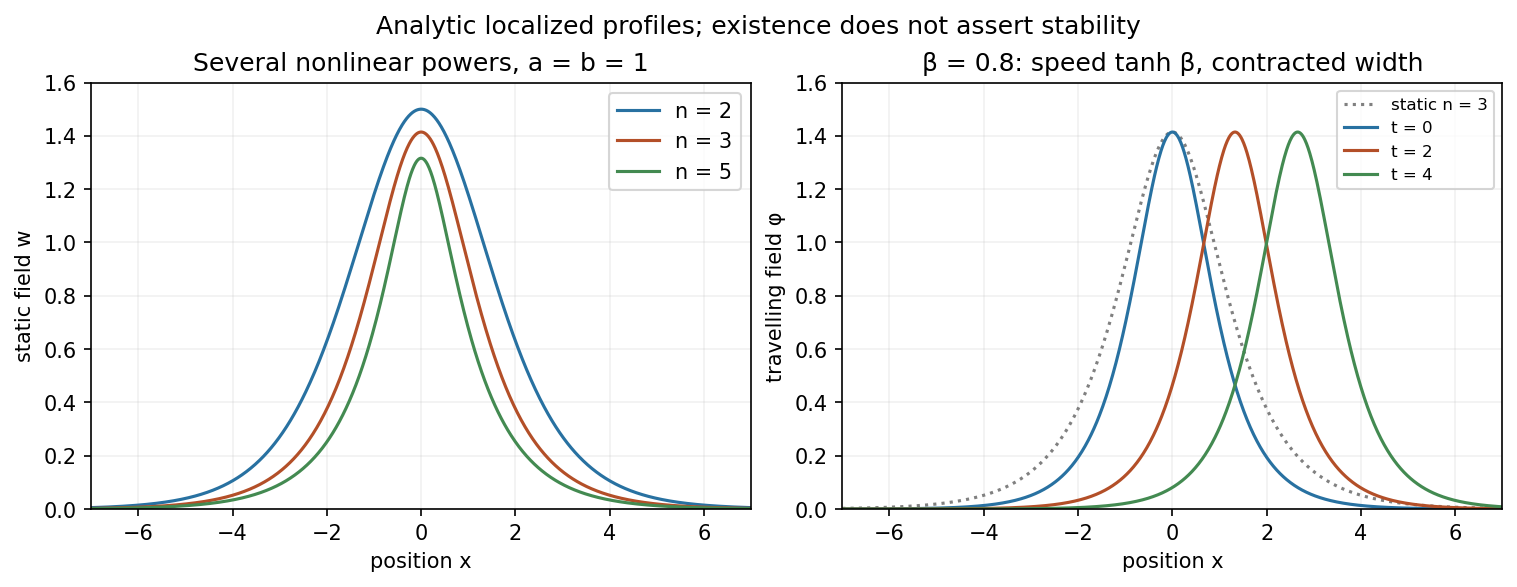

Now apply the Lorentz boost with rapidity to the static field. It givesFor positive , the centre moves to the right at , with speed one the wave-speed unit. The peak stays and the width contracts by . The shape translates without changing in time. This establishes a travelling solitary pulse; it does not by itself prove stability or elastic multi-pulse scattering.
New to topics? Read the docs here!