Rapidity is a dimensionless parameter for a signed collinear velocity with , defined using the inverse hyperbolic functions byHere is the speed of light, and is the hyperbolic tangent. Zero velocity has zero rapidity; negative velocity has negative rapidity. Every finite real rapidity gives , while requires . Thus a light ray has no finite rapidity in this parametrization. The header's formula uses natural units : its is the numerical velocity .
For the inertial frames in the velocity-addition formula, moves at signed velocity along the -axis of . Set . Re-expressing the same particle in the moving inertial frame givesThe subtraction is a passive change of reference frame; the inverse adds the particle's rapidity in to the frame's rapidity relative to . For example, and give , so and , exactly as in the velocity-addition formula.
For a massive particle of rest mass moving in one spatial dimension, its energy and signed momentum areThe hyperbolic cosine is the particle's Lorentz factor, and the hyperbolic sine is . The hyperbolic Pythagorean identity immediately gives the relativistic energy-momentum relation . In the older notation, writing the rest mass as recovers , , and . These expressions use natural units in which the factors of are numerically one; the preceding formulas restore those factors explicitly. [ref]
https://davidtong.org/pdfs/teaching/dynamics-and-relativity/dynrel7.pdf. David Tong, Dynamics and Relativity, §7.3.2: rapidity; §7.4.3: energy and momentum
.The useful simplification follows from the hyperbolic-function identity : the nonlinear velocity-addition formula becomes ordinary addition of rapidities. See iterated collinear boosts with equal rapidity for a plotted example. A common collinear Lorentz boost shifts every rapidity by the same constant, so a rapidity difference is invariant. This makes rapidity useful for relativistic factorized scattering in one spatial dimension, where two-body S-matrices depend on the difference of the incoming rapidities, with particle species fixed.
Starting from rest, compose positive collinear Lorentz boosts, each with the same finite rapidity . Each step has relative velocity , measured in the preceding rest inertial frame. The relativistic velocity-addition formula givesThese are equal increments of rapidity, not equal increments of velocity measured in the original inertial frame. They can describe a chain of relatively moving inertial frames or successive idealized changes of a massive particle's motion; no particular acceleration schedule is assumed. [ref]
https://davidtong.org/teaching/general-relativity/grhtml/S1. David Tong, General Relativity, §1.2.4: collinear boost composition and rapidity
.For a relative velocity at each step,The first four velocities are , , , and . At step eight, . The rapidities grow by the same amount at each step, while the successive velocity increments become smaller.
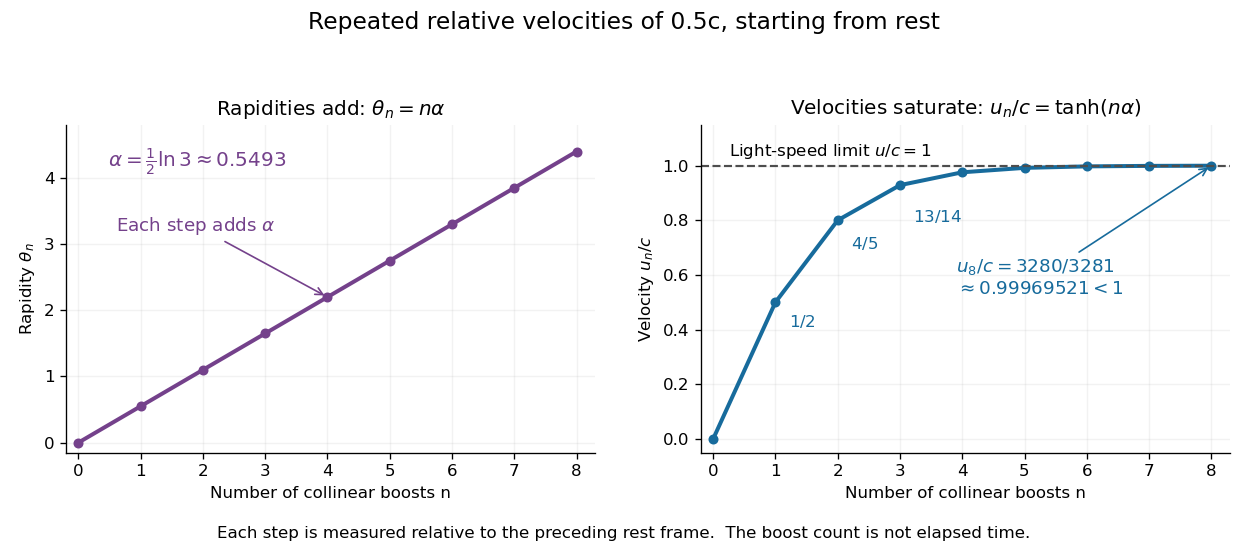
Equal collinear boosts add rapidities linearly while their composed velocities approach the speed of light
. The illustrative sequence uses relative velocity per step and . The horizontal coordinate counts boosts, rather than elapsed time. The line at marks the speed of light; every plotted velocity is strictly below it. Details.
A short derivation applies the hyperbolic-function identity for to the recurrence, giving . Substituting and gives the displayed closed expression. In particular,for every finite nonnegative integer . The limit is as , but no finite sequence reaches the speed of light. This illustrates the beauty of rapidity: unbounded additive parameters coexist with bounded physical velocities. Replacing every step by a negative rapidity gives the corresponding approach to .
Articles by others on the same topic
There are currently no matching articles.