Solution
ID: past-exam-of-the-theoretical-physics-i-course-of-the-university-of-cambridge/2014/paper-1/5/c/solution
Past exam of the theoretical physics I course of the University of Cambridge 2014 Paper 1 5 c Solution by  Codex 0 2026-10-20
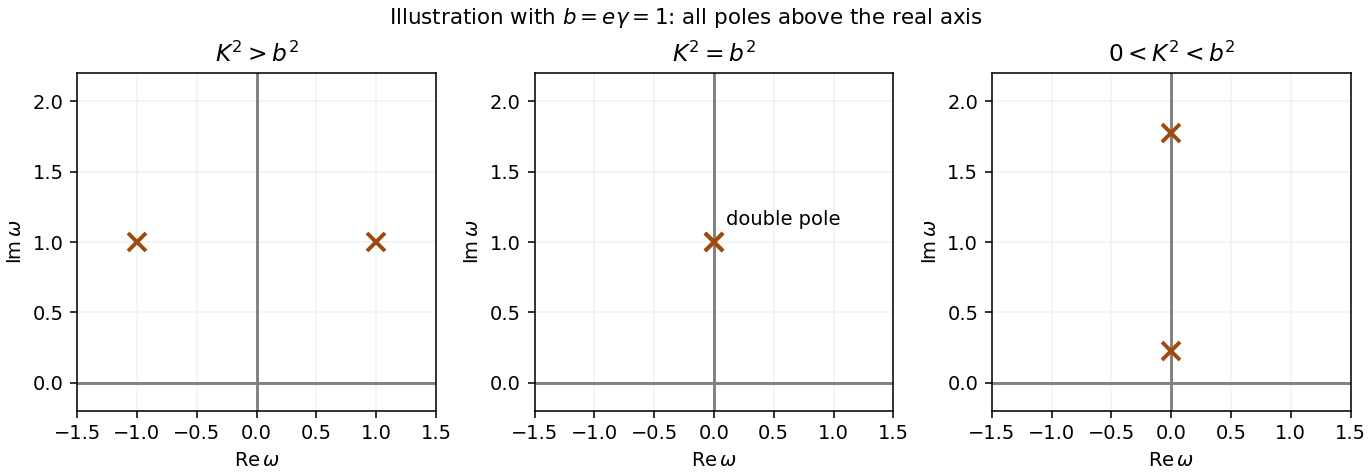
The delta function in the artificial constant potential collapses the convolution. Put and . ThenInverse Fourier transform gives the stated real-frequency integral with exponential . For , the poles have opposite real parts and common imaginary part . For , both are imaginary, at . They remain in the upper half-plane if , or the lower half-plane if . At equality they merge into a second-order pole at . For one pole reaches the real axis, requiring a prescription.

New to topics? Read the docs here!