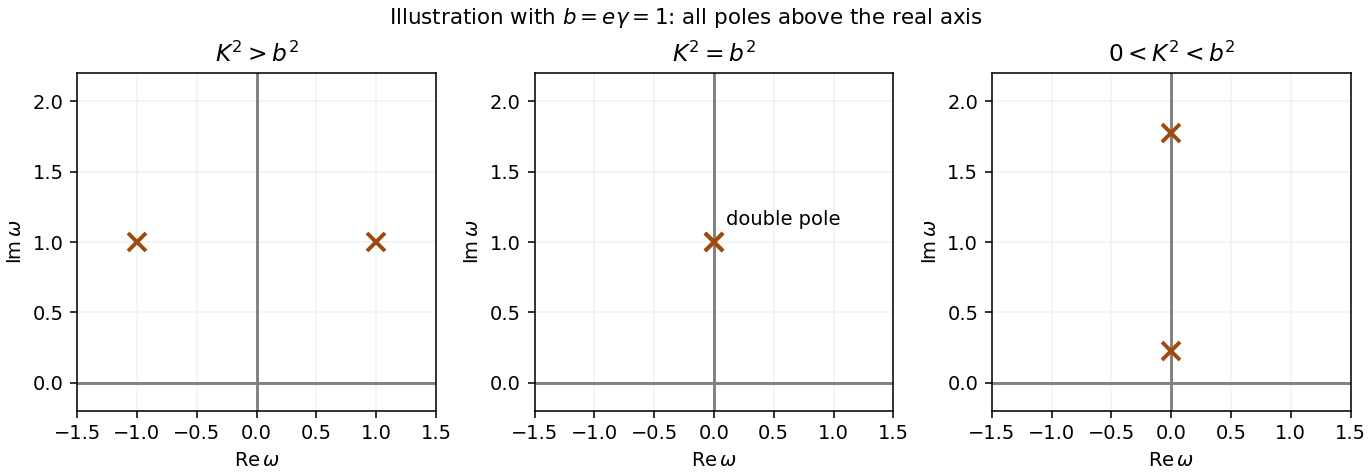
The delta function in the artificial constant potential collapses the convolution. Put and . ThenInverse Fourier transform gives the stated real-frequency integral with exponential . For , the poles have opposite real parts and common imaginary part . For , both are imaginary, at . They remain in the upper half-plane if , or the lower half-plane if . At equality they merge into a second-order pole at . For one pole reaches the real axis, requiring a prescription.

Articles by others on the same topic
There are currently no matching articles.