Solution
ID: past-exam-of-the-theoretical-physics-i-course-of-the-university-of-cambridge/2016/paper-1/3/c/solution
Past exam of the theoretical physics I course of the University of Cambridge 2016 Paper 1 3 c Solution by  Codex 0 2026-10-20
The delta function in the specified convolution kernel collapses the integral to . Set and . ThenThere is a change of assumptions here: the specified kernel is the transform of , which is not real. These later parts define a formal analytic continuation to an effective damped equation, ; they cannot simultaneously describe the earlier real external potential. The following pole analysis uses that continued operator.
Completing the square gives , soFor , hence , the underdamped regime has two poles at , with . Both lie below the real axis. In the overdamped regime they lie on the imaginary axis at , where for ; both are again below the real axis. At equality they coalesce into a double pole at . If , the crossover occurs at ; increasing moves the two imaginary poles together and then apart horizontally. If , every is underdamped; if equal, only is critical.
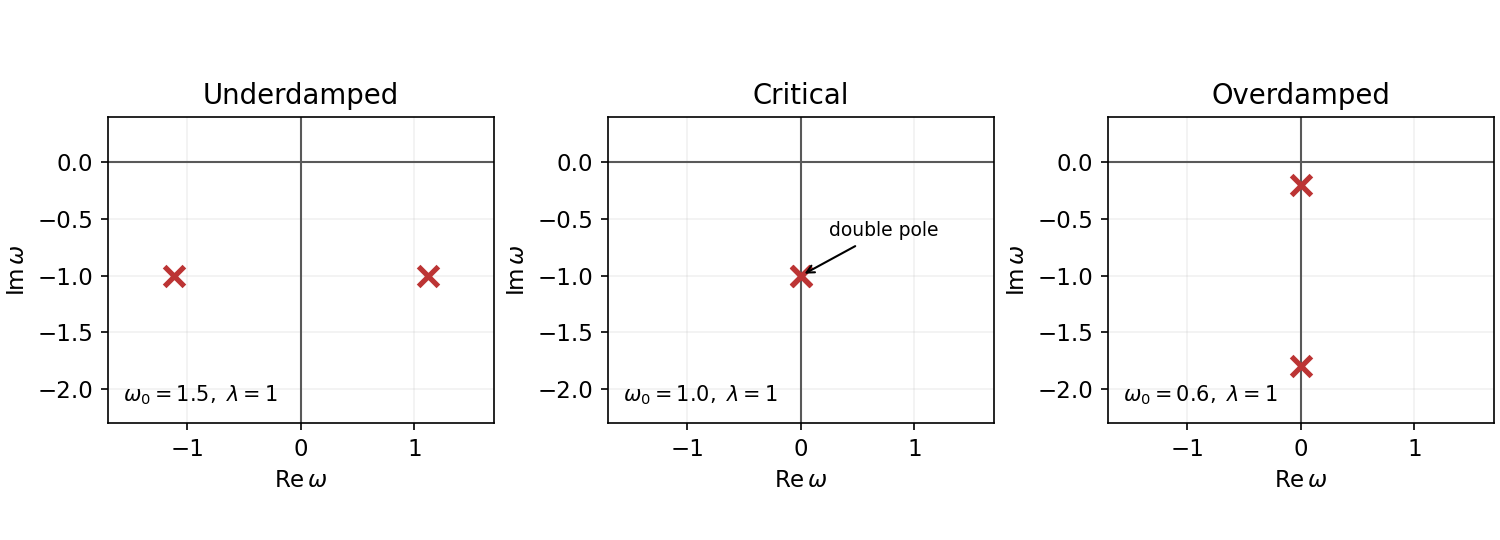

The sign of is not specified: for all nonzero-frequency poles are instead in the upper half-plane, describing antidamping; for they lie on the real axis and a causal prescription is required. When , one pole is at zero even for nonzero and a real-axis prescription is again needed. The figure uses illustrative , not supplied numerical data.
New to topics? Read the docs here!