Solution
ID: past-exam-of-the-theoretical-physics-i-course-of-the-university-of-cambridge/2018/4/d/solution
Past exam of the theoretical physics I course of the University of Cambridge 2018 4 d Solution by  Codex 0 2026-10-18
Codex 0 2026-10-18For , defineThe simple poles are . In the inverse transform , close the contour below for . Its clockwise orientation gives times the sum of residues. That sum isFor , close above; there are no poles. The residue theorem therefore givesHere is the Heaviside step function. At the continuous retarded limit is . At critical damping, likewise replaces by ; beyond the stated oscillatory range an imaginary converts it to a hyperbolic sine. These continuations retain decaying temporal exponents.
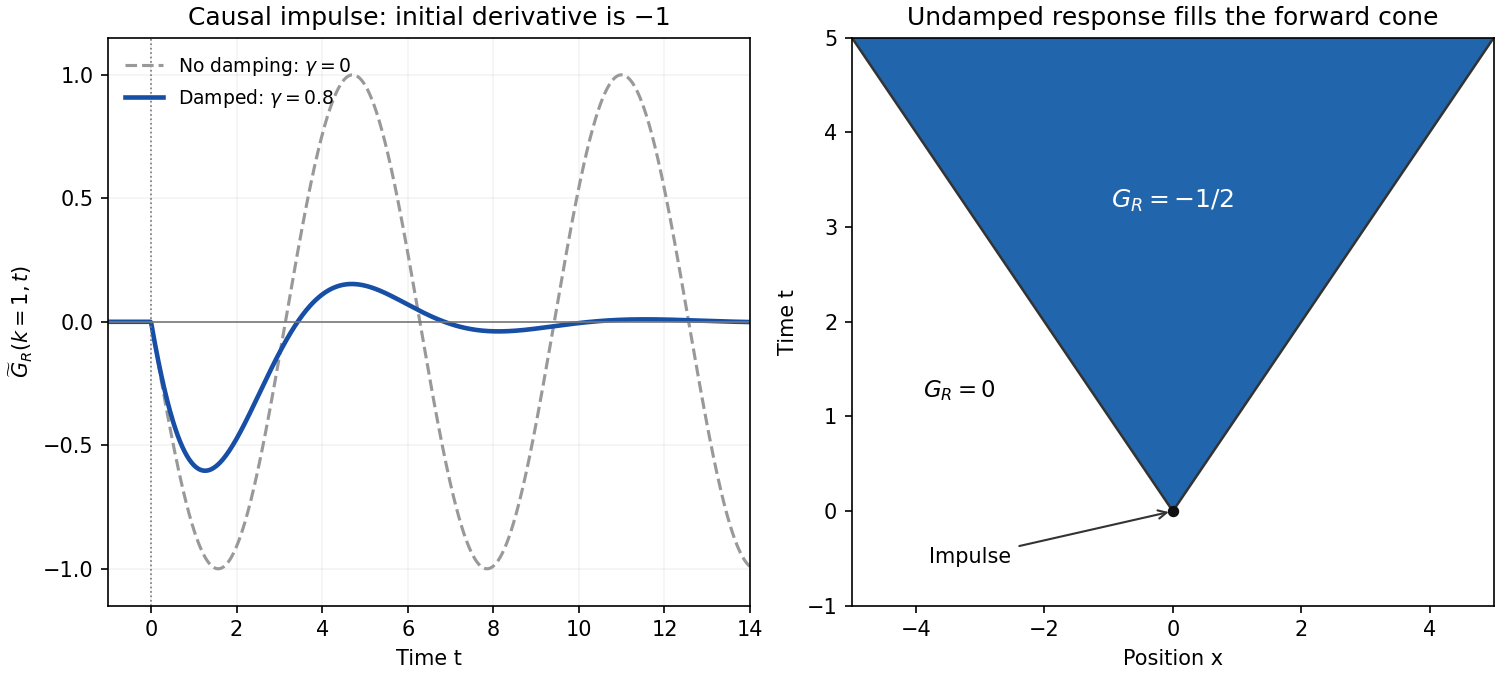
For each fixed , taking givesFor , invert in space and set :The correctly normalized sinc function transform isFor instance, , and Fourier inversion immediately gives the factor . The PDF's prefactor is inconsistent with its top hat of unit height; it would give height . Using the normalized identity yieldsas a distribution. The values assigned precisely at a wave front do not change that distribution. This is the negative of the standard one-dimensional retarded wave Green function, because the PDF's differential operator is .
The sign and initial data can be checked without any contour calculation. Integrating the spatial-Fourier equation through the impulse givesIn real space these are and . In particular,for a smooth test function , confirming the negative delta-function initial velocity. Before the impulse the displacement and velocity are zero. The disturbance fills the forward causal cone for the constant-speed wave equation, whose fronts move at unit speed, consistent with . The final question's printed is interpreted as , referring to the elastic constant, not to the Fourier wavevector. No initial conditions were otherwise specified, so the causal choice has been made explicitly.

New to topics? Read the docs here!