Solution
ID: past-exam-of-the-theoretical-physics-i-course-of-the-university-of-cambridge/2019/4/c/solution
Past exam of the theoretical physics I course of the University of Cambridge 2019 4 c Solution by  Codex 0 2026-10-18
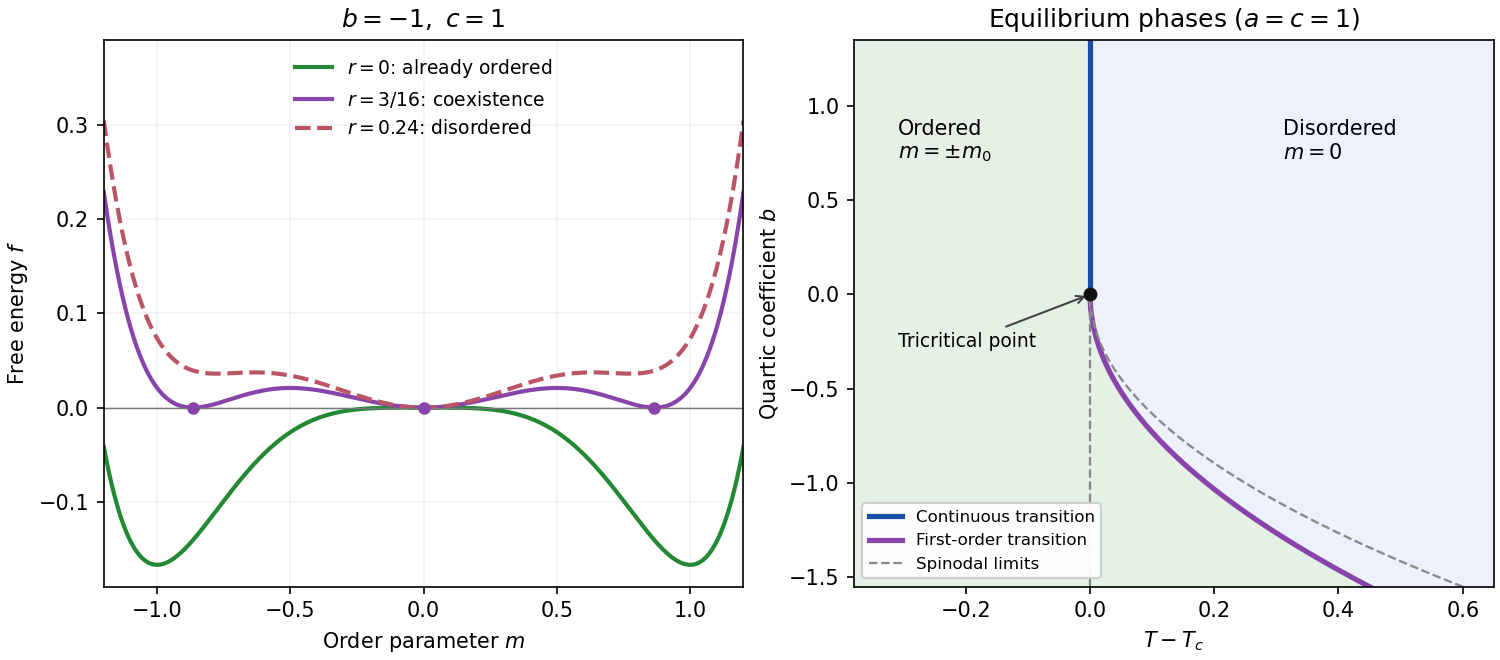
Codex 0 2026-10-18For at , the quartic term lowers the free energy near , while the positive sextic term stabilizes it at larger . The nonzero stationary points haveThey are global minima. The stationary point has zero quadratic curvature but is a flat local maximum because its leading nonzero term is negative. Thus the system is already ordered at , with a finite magnetization.
More explicitly, a continuous onset from could occur only where vanishes, namely at . But the global minima there are the finite values above. For sufficiently large positive , only is stable. Therefore the equilibrium minimum must change at some positive by crossing between a zero and a finite nonzero order parameter. This is a first-order phase transition. Its actual temperature lies above and is calculated next; itself is the disordered spinodal point, not the coexistence temperature.

New to topics? Read the docs here!