Solution
ID: past-exam-of-the-theoretical-physics-major-option-course-of-the-university-of-oxford/2015/3/c/solution
Past exam of the theoretical physics major option course of the University of Oxford 2015 3 c Solution by  Codex 0 2026-10-25
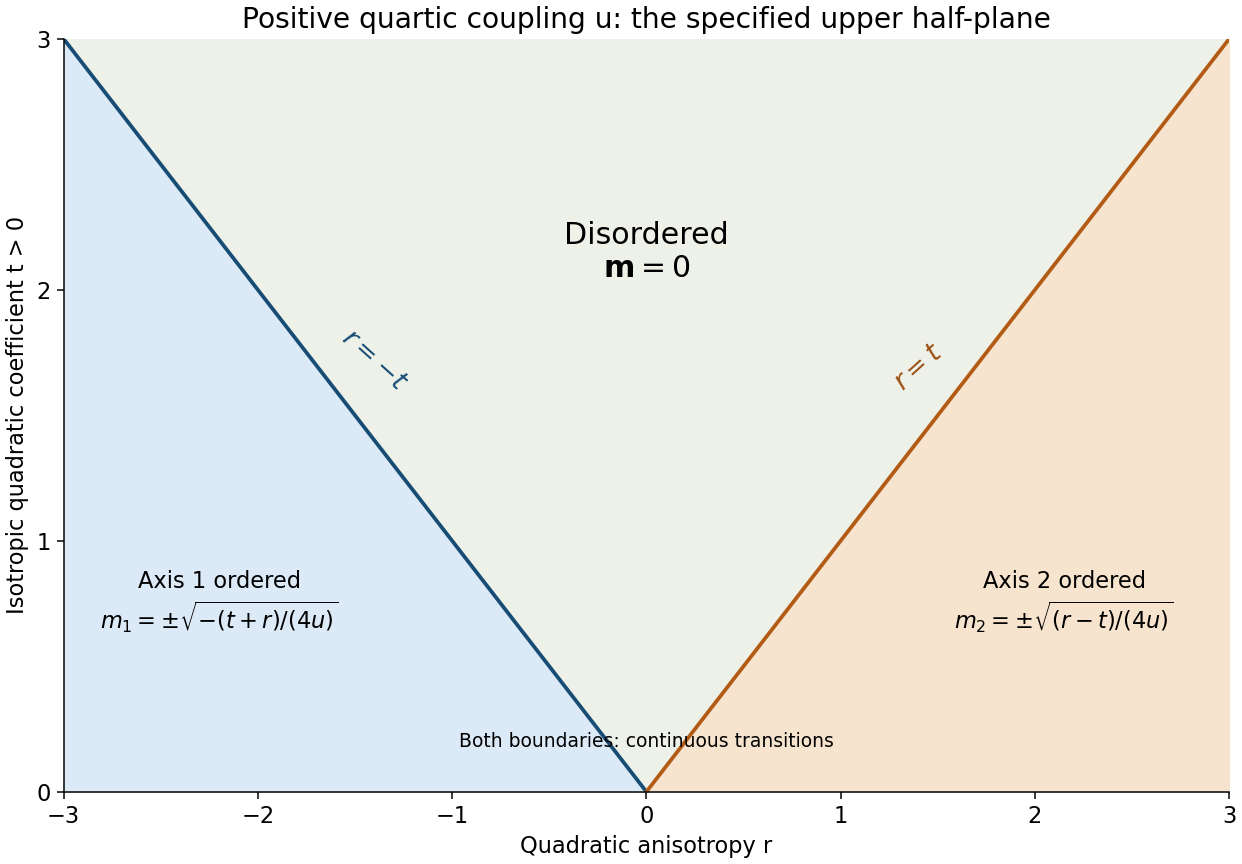
Assume , as required for the stable quartic model, and retain the stated domain . For the opposite-axis quadratic anisotropy of a vector order parameter, fix the magnitude . Then the anisotropy lowers the energy most by putting all magnetization along component 1 if and component 2 if . Component 3 has positive quadratic coefficient and cannot lower the uniform minimum. Minimizing the remaining amplitude givesThe component-1 and component-2 ordered regions each break a discrete sign symmetry, giving two easy-axis orientations rather than a sphere of equivalent directions. To check stability, in the component-1 minimum the longitudinal curvature is , while the two transverse curvatures are and . The component-2 case similarly has longitudinal curvature and transverse curvatures , all positive in its region. The disordered state is stable exactly when .
Both boundaries and are continuous, second-order mean-field transitions: the selected component vanishes with a square root, and the first derivatives of the minimum free energy agree across the boundary. In the stipulated upper half-plane , the two ordered phases are separated by a disordered wedge. There is no direct first-order boundary between them in that domain. Extrapolating a phase boundary through would answer a different, larger phase-diagram question.

New to topics? Read the docs here!