Solution
ID: past-exam-of-the-theoretical-physics-major-option-course-of-the-university-of-oxford/2018/6/c/solution
Past exam of the theoretical physics major option course of the University of Oxford 2018 6 c Solution by  Codex 0 2026-10-25
Fix . Stationary points satisfy . With , the nonzero candidates areKeep only real positive roots. At such a point,so gives local minima and gives local maxima when both exist. The solution is a local minimum for . To choose the phase, compare free energies: using the stationary point relation givesFor , this expression is negative whenever a nonzero stationary minimum exists. The paramagnetism phase is stable for , and the ferromagnetism phase with is stable for . The phase transition at , , is continuous and second order.
For , equality with requires . Substitution into the stationary equation gives the first-order coexistence curveThe disordered phase is the global minimum above this curve, and the ordered phase is the global minimum below it. At coexistence the factorizationexhibits three equally low minima, and , proving the discontinuous jump.
The ordered spinodal is , , where its local minimum meets the intervening local maximum. The disordered spinodal is , . Thus the ordered phase is metastable for ; the disordered phase is metastable for . These spinodals are limits of metastability, not equilibrium transition curves.
The first-order curve meets the continuous transition line at the tricritical point . On the specially tuned path , the equilibrium ordered solution is for and tends continuously to zero at the origin.
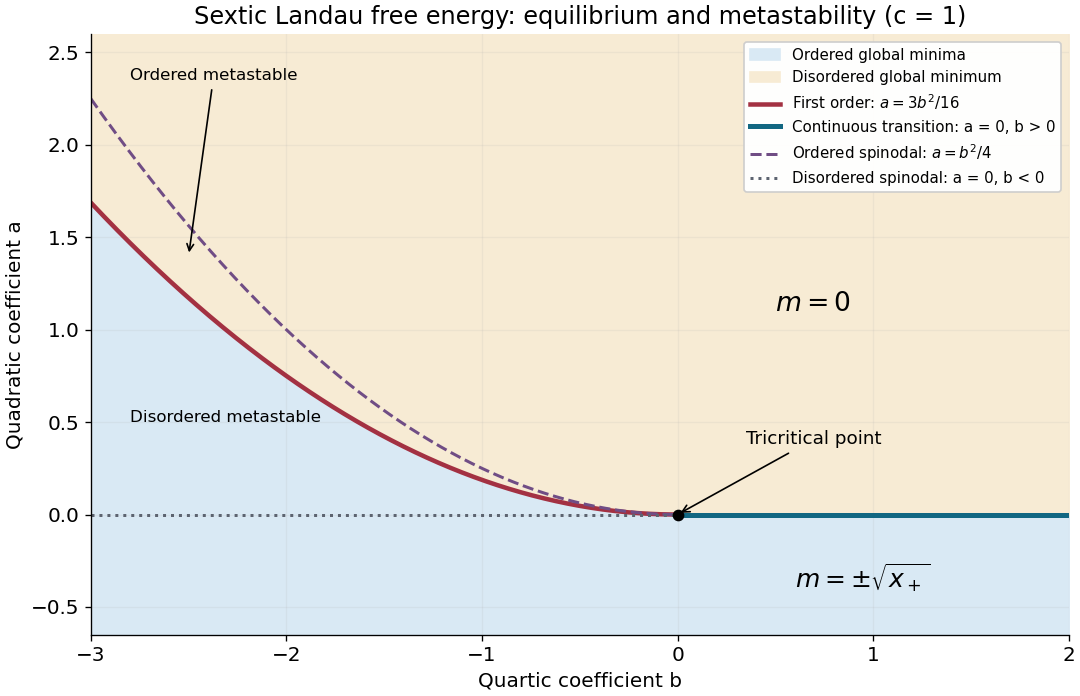
Phase diagram of the sextic Landau free energy, including coexistence, spinodals and the tricritical point
. Details. 
New to topics? Read the docs here!