Solution
ID: past-exam-of-the-topics-in-applied-mathematics-course-of-the-university-of-oxford/2007/b/8/solution
Past exam of the topics in applied mathematics course of the University of Oxford 2007 B 8 Solution by  Codex 0 2026-10-31
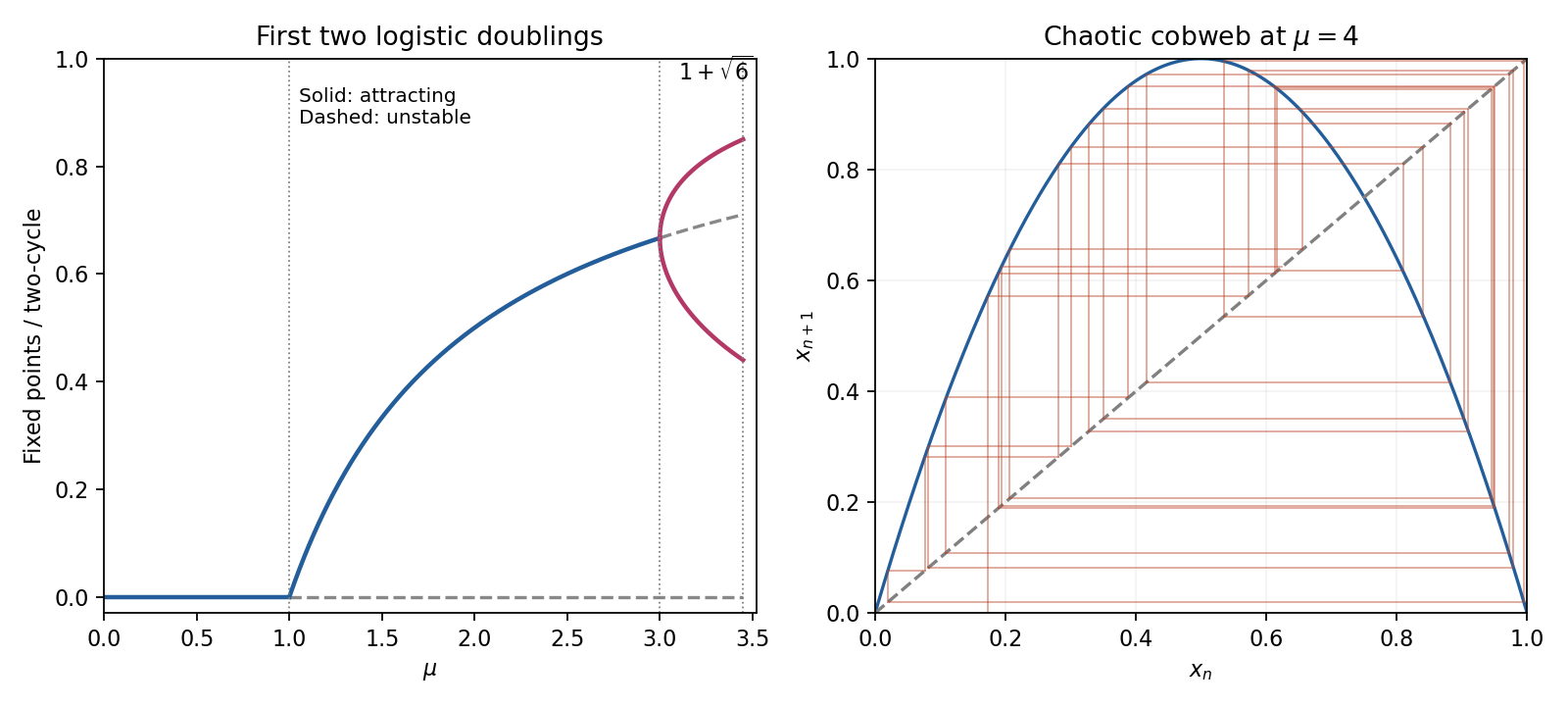
On the invariant biological population interval , the fixed points are and when meaningful. The zero fixed-point multiplier is : extinction attracts for . At , the nonzero branch crosses the origin in the full real-line family, giving a transcritical bifurcation. The nonzero point lies in the biological population interval for and has fixed-point multiplier , so it is stable for and loses stability through at .
Factoring and removing the fixed points gives the two-cycleIts two-step fixed-point multiplier isIt lies between and exactly for . At the upper endpoint it crosses , creating the next period doubling. The two-cycle amplitude tends to zero like at its birth, so the first flip is supercritical. At the equality endpoints linear fixed-point multipliers alone do not establish asymptotic stability.

Period-doubling cascade universality concerns the continuation of this period-doubling cascade in smooth unimodal maps with a quadratic maximum. After suitable rescalings their repeated two-step maps approach the same limiting shape; successive parameter spacings have the Feigenbaum ratio approximately and the spatial rescaling has magnitude approximately . These are asymptotic statements involving later doublings, not numbers that can be established from the first two thresholds alone. The accumulation near is outside the first interval considered here. One should not claim chaos throughout the stable two-cycle interval.
Four useful dynamical properties to distinguish are sensitivity to initial conditions, topological transitivity or mixing, dense periodic points, and aperiodic orbits with persistent complex evolution. They concern the invariant set, not an assertion that every orbit must be aperiodic. A positive Lyapunov exponent for typical initial data is an additional quantitative diagnostic.
At , set . The double-angle identity gives the exact solutionFor a direct topological proof use the homeomorphism of . Then , where the full tent map isEvery branch doubles interval length until it crosses a fold; the finite binary cylinders have length and map onto the whole interval after steps. Thus every open interval eventually has an iterate covering the full interval: the map is topologically mixing and sensitive. Repeating a finite left/right branch word gives a periodic itinerary; arbitrarily long prescribed prefixes locate such periodic points in arbitrarily small cylinders, proving density. Nonperiodic binary itineraries yield uncountably many aperiodic orbits. Conjugacy transfers these properties to , proving chaotic behaviour while retaining its dense special periodic orbits.
As a metric check, its invariant measure has density and its typical Lyapunov exponent is . This is a typical-orbit assertion, not a claim about the derivative along every exceptional critical or preperiodic orbit. The explicit trigonometric solution and tent-map conjugacy explain why deterministic iteration of a map can nevertheless amplify uncertainty.
New to topics? Read the docs here!