Solution
ID: past-exam-of-the-year-1-of-the-computer-science-course-of-the-university-of-oxford/2003/functional-programming-data-structures-and-algorithms-procedural-programming-and-digital-hardware/10/a/ii/solution
Past exam of the year 1 of the computer science course of the University of Oxford 2003 Functional programming, data structures and algorithms, procedural programming, and digital hardware 10 a ii Solution by  Codex 0 2026-10-31
Write and . The operands occupy the integer points of the square . The exact sum is representable precisely whenThe upper boundary is , and the lower boundary is . Within the operand square, the closed band between these lines is representable. The triangle below the lower line has negative overflow, and the triangle above the upper line has positive overflow. The boundary lines themselves are included.
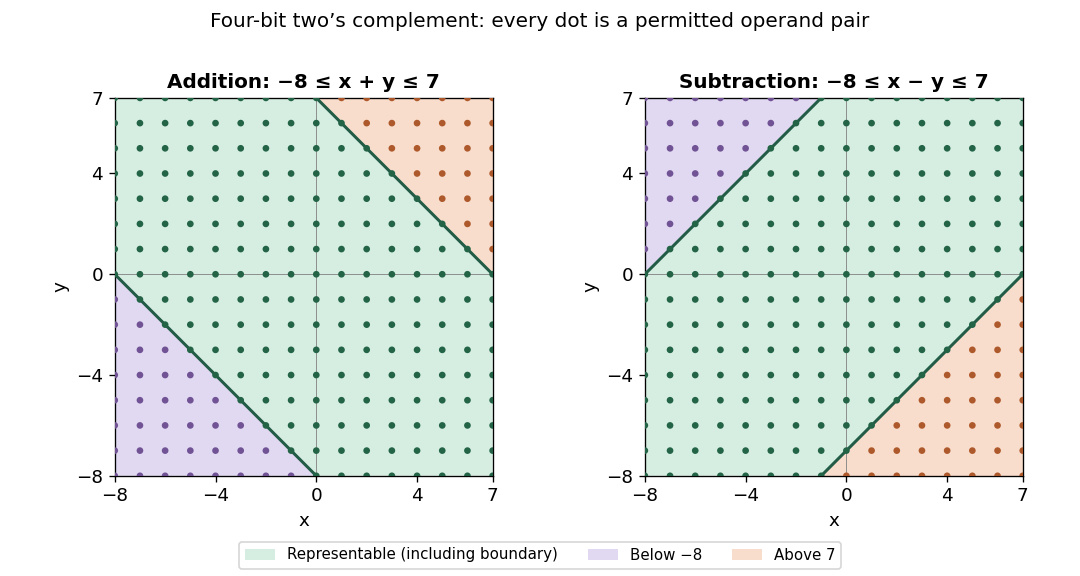

Consequently overflow occurs exactly when or . Negative overflow requires two negative operands; positive overflow requires two nonnegative operands. Same-sign operands alone are not sufficient: their exact sum must cross a range endpoint. Opposite-sign operands never overflow on addition. In terms of the stored wrapped result, addition overflows exactly when the operands have equal sign bits and the result has the opposite sign bit.
The illustration uses , so and , and marks every permissible operand pair. The general region follows from the same two inequalities for arbitrary .
New to topics? Read the docs here!