Solution
ID: past-exam-of-the-year-2-of-the-earth-sciences-geology-course-of-the-university-of-oxford/2023/paper-1/5/e/solution
Past exam of the year 2 of the earth sciences (geology) course of the University of Oxford 2023 Paper 1 5 e Solution by  Codex 0 2026-10-25
Assume the greenstone belt is more magnetically susceptible than the host rocks and granite, its magnetization is mainly induced magnetization, and the body is roughly east–west elongated so that the south–north line crosses it. At southern magnetic latitudes the main field has negative magnetic inclination in a north-and-down coordinate convention. The total-field magnetic anomaly is then generally asymmetric: the principal negative lobe is on the southern side and the positive lobe is displaced northward for the simple induced source illustrated here. The exact lobe sizes and peak positions depend on body geometry and the actual magnetic inclination.[ref]
Magnetic line profiles by UBC Geophysical Inversion Facility. Examples 1–2: the low lies north at northern inclination and south at southern inclination
An explicit sketching model is an induced magnetic dipole at depth . With northward coordinate , and unit field direction , its normalized total-field magnetic anomaly isThe plot uses only as an illustrative dipole-field inclination for a latitude near south, not a measured modern field at the site. A wide greenstone belt would broaden the response and can produce prominent edge anomalies. Remanent magnetization or a magnetic granite could change the sketch substantially; gravity alone cannot identify the magnetic source.
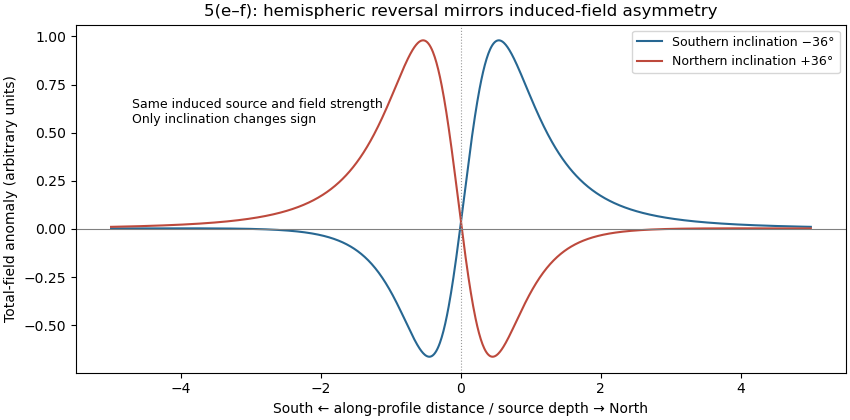
Induced-source magnetic anomalies for opposite inclinations on a south–north profile
. Details. 
New to topics? Read the docs here!