Solution
ID: past-exam-of-the-year-2-of-the-earth-sciences-geology-course-of-the-university-of-oxford/2025/paper-3/3/a/solution
Past exam of the year 2 of the earth sciences (geology) course of the University of Oxford 2025 Paper 3 3 a Solution by  Codex 0 2026-10-25
Use compression-positive principal stresses . The two-dimensional Mohr's circle shown is the – circle: its horizontal axis is compressive normal stress , its vertical axis signed shear stress , its centre is , and its radius is . The intercepts and represent principal stress planes, on which shear stress vanishes. The top and bottom points have , the maximum shear stress.
In the rock sketch, is the counterclockwise angle from the direction to the plane's unit normal vector . Choose the clockwise unit tangent and define , with compression positive. Thus a positive produces a positive rotation on the plotted circle. The actual traction on the positive-normal face is . Reversing the tangent convention reverses the plotted shear sign, not the physical prediction.
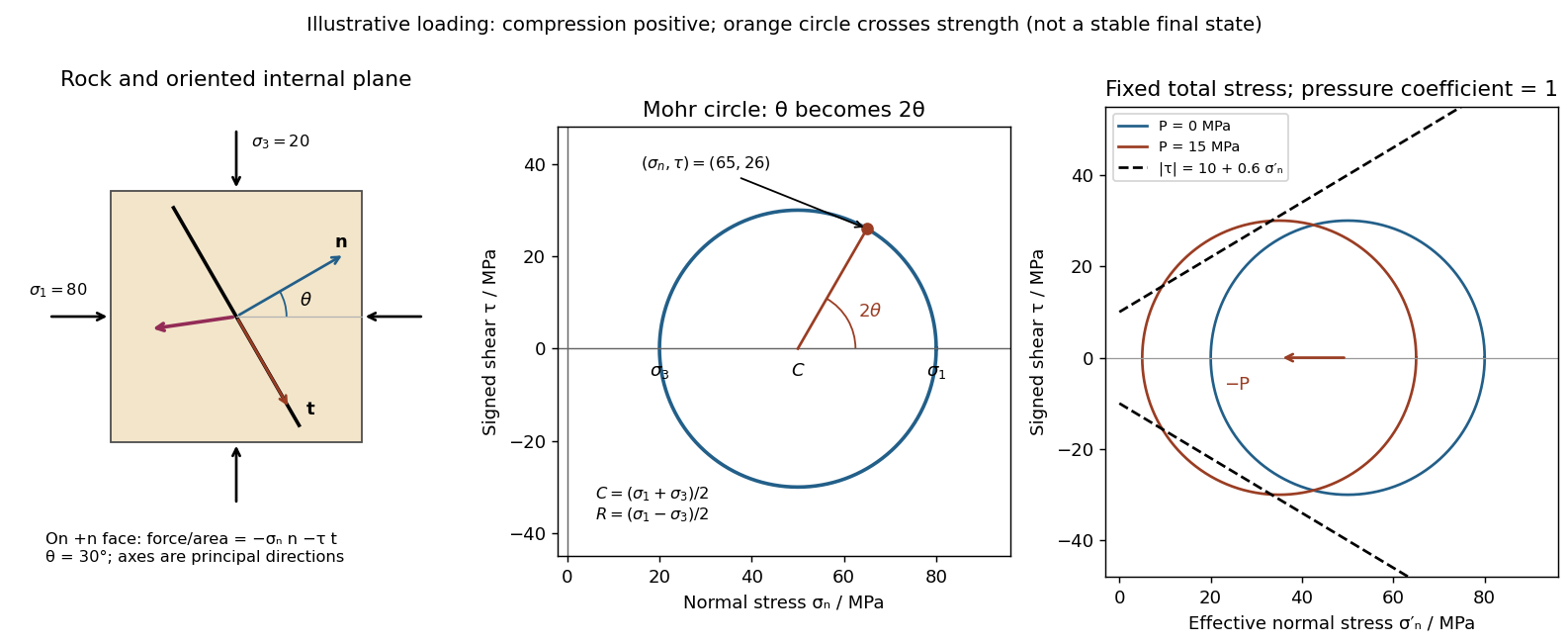
Stressed rock, Mohr circle, and the effect of pore pressure
. Original illustrative construction with principal compressions 80 and 20 MPa and a plane normal 30 degrees from the maximum compression. The circle point is approximately (65,26) MPa at twice that angle. A separate panel translates the circle left by 15 MPa pore pressure at fixed total stress, bringing it to a frictional failure envelope. Details.
In three dimensions there are circles for each pair of principal stresses. The largest is the – circle; a general three-dimensional plane requires all three principal stresses and its normal, rather than a single angle on this circle.
New to topics? Read the docs here!