Rotational energy ellipsoid
ID: rotational-energy-ellipsoid

For strictly positive principal moments of inertia and a fixed rotational kinetic energy , the allowed angular velocity components form an ellipsoid:Its semiaxis lengths have units of angular speed. The longest semiaxis corresponds to the smallest principal moment of inertia: that direction permits the greatest angular speed for the same rotational kinetic energy. This is a surface in angular velocity space, not the physical outline of the body. If one principal moment of inertia vanishes in an ideal line-mass model, this constant-energy surface is unbounded in that direction and is no longer an ellipsoid.
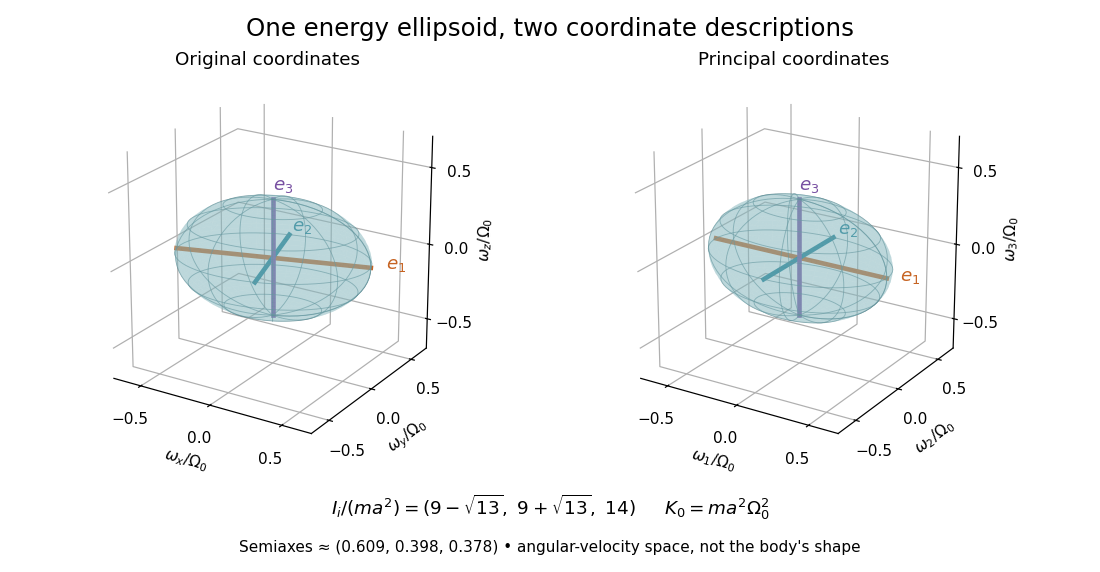

The rotational energy ellipsoid gives the geometry behind Poinsot's ellipsoid, but a constant-energy surface alone does not determine a free-rotation trajectory. A torque-free trajectory must also satisfy the conserved angular momentum constraint and the Euler equations for a torque-free rigid body.
New to topics? Read the docs here!