An exact planar example makes the off-diagonal entries tangible. Join four equal point masses with negligible-mass rigid connectors at , , and , where is a length. Their centre of mass is . Summing , and gives , and , respectively, soThe axis is a principal axis, and illustrates the perpendicular axis theorem. The axis is not a principal axis: angular velocity gives angular momentum , which points in a different direction. A bearing can enforce fixed-axis rotation despite this difference, supplying the necessary transverse torque.
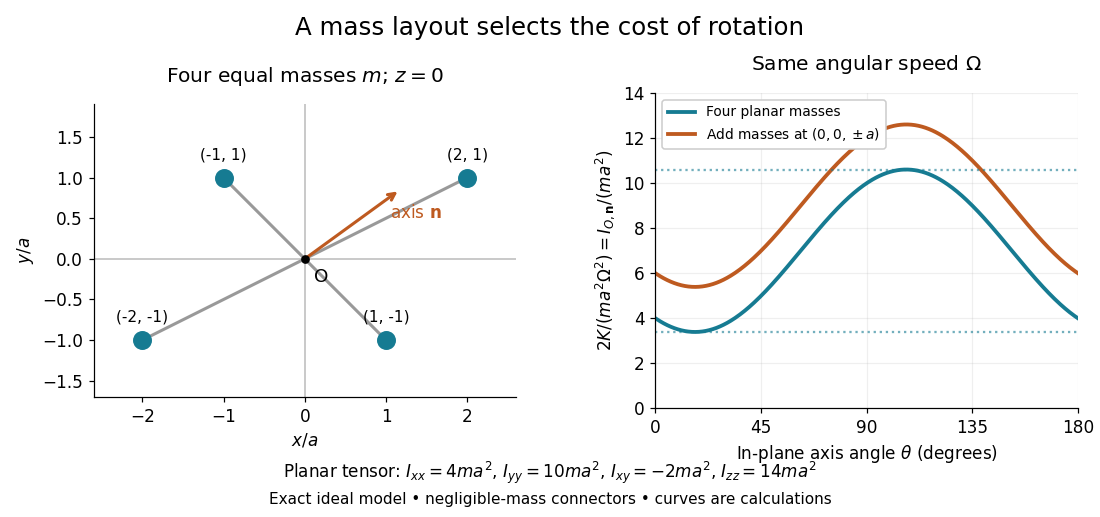
Paired point masses and direction-dependent rotational kinetic energy
. Original exact model. Four equal point masses lie in the plane with negligible-mass connectors. The curves use angular velocity and plot . Adding two more equal point masses at raises this curve by two. Markers depict ideal point masses, not finite-sized weights; no experimental data are plotted. Details.
For an in-plane unit vector , the planar model hasIts extrema are the principal moments of inertia and ; the remaining principal moment of inertia is . These values follow from the two-by-two characteristic polynomial , so they can be checked without trusting a numerical eigenvalue routine. At a stipulated angular speed , with and , rotation about , or has rotational kinetic energy , or , respectively.
A truly three-dimensional example adds two more equal point masses at and . Each contributes to the inertia tensor, givingThe in-plane principal axes stay the same while their principal moments of inertia each increase by . The moment of inertia stays unchanged because the added point masses lie on that axis. This comparison changes the total mass from to ; it holds the original four point masses fixed rather than redistributing a fixed total mass.
Articles by others on the same topic
There are currently no matching articles.