Spatial resolution of surface-pressure measurements
ID: spatial-resolution-of-surface-pressure-measurements

Spatial resolution of surface-pressure measurements describes which spatial variations of surface pressure can be distinguished by the measurement arrangement. Tap spacing, opening size and the reconstruction model matter separately from uncertainty in each measured pressure. Repeatedly measuring the same taps more precisely does not supply the missing values between them.
A primary wind tunnel experiment by Robert M. Pinkerton sampled a NACA4412 airfoil with 54 pressure orifices and compared measured distributions with theoretical calculations.[ref]
Calculated and Measured Pressure Distributions over the Midspan Section of the NACA 4412 Airfoil by Robert M. Pinkerton. NACA-TR-563, NTRS abstract: pressure-orifice apparatus and distribution comparison
The observations constrain pressures at the instrumented sites. Interpolation and surface pressure integration for airfoil lift require assumptions about the field between those sites.An original sampling counterexample makes the limitation exact. On a chordwise coordinate , place five taps at . Compare two candidate pressure differences,Both give zero at every tap, butAt and chord , the integrals differ by in a simplified force-per-span calculation on a flat strip. The geometry and candidate fields are constructed examples, not solutions for a measured airfoil. They prove that these five readings alone do not determine an arbitrary continuous field or its integral.
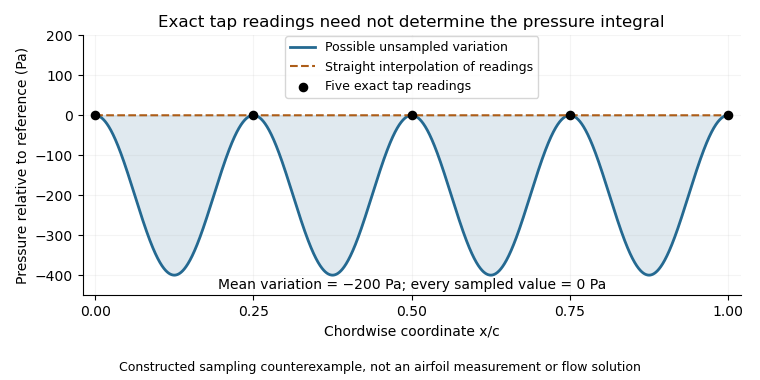

This is spatial aliasing: distinct fields produce the same samples. Additional smoothness or spatial-bandwidth assumptions can constrain reconstruction, but must be stated and tested. The pressure-tap spatial footprint adds another consideration: a finite opening can respond differently from an ideal point measurement. Increasing sampling density, characterizing the probe and checking an independent integrated force address different parts of the inference.
New to topics? Read the docs here!