Surface pressure integration for airfoil lift reconstructs the pressure contribution to lift by summing the local surface pressure loads with their directions. With pointing from a two-dimensional body into the fluid, the force per unit span from its closed contour isThe uniform reference pressure cancels on the closed contour. This is a vector line integral, not the sum of positive pressure magnitudes.[ref]
Aerodynamic Forces by NASA Glenn Research Center. Variation in Pressure and Definitions of Lift and Drag
For upper and lower surfaces that are graphs over , their pressure contribution perpendicular to the chord isVertical end closures have no chord-normal pressure contribution. The pressure force parallel to the chord, , still matters when resolving flow-relative lift. With flow direction in aft/chord-normal axes, . Equating with lift needs a suitable angle of attack approximation. Pressure integration also omits the viscous stress contribution.
Finite pressure tappings require numerical integration. A composite trapezoidal rule integrates the linearly interpolated samples exactly; it need not integrate the actual unsampled distribution exactly. For an original example, let and place taps at . A second invented profile agrees at every tap but has an additional on and zero addition elsewhere. Both reconstructions give , while the second true integral is .
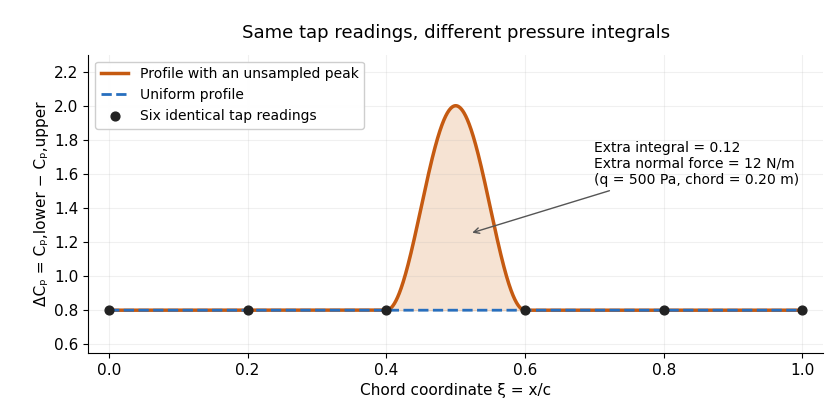
Two invented pressure-difference profiles agree at every tap but have different chord integrals. Equal readings alone do not bound an unsampled peak.
Details. 
At and , the two stipulated normal pressure forces are and , although the six samples are identical. This quadrature ambiguity of pressure-tap data is an instance of how finite samples do not certify quadrature accuracy. Additional geometric or regularity information is needed to bound the missed contribution.
A motivating experimental comparison uses a force balance independently of the pressure reconstruction. Robert M. Pinkerton's 54-orifice distribution measurements provide a historical example of resolving the shape of a pressure field.[ref]
Calculated and Measured Pressure Distributions over the Midspan Section of the NACA 4412 Airfoil by Robert M. Pinkerton. Abstract, apparatus and measured/theoretical distributions
A modern proposed test repeats both readings at controlled Reynolds number and angle of attack, checks tap coordinates and pressure-channel response, and refines sampling near sharp features. Agreement in a single integrated load does not prove agreement in the entire pressure distribution or pitching moment.Quadrature ambiguity of pressure-tap data means that the same finite set of measured surface pressure values can be consistent with different integrated forces. A chosen quadrature rule fixes an estimate from those readings; it does not, by itself, establish the unsampled distribution. This is an instance of how finite samples do not certify quadrature accuracy.
For an original smooth example, use the normalized airfoil chord coordinate and let be the lower-minus-upper pressure coefficient difference. Put three sample locations at , and , and considerThese polynomials agree at all three taps. Both the composite trapezoidal rule and any other deterministic rule using only these same values produce identical answers for them. Nevertheless,The discrepancy is not caused by a discontinuity or mislocated tap: both profiles are smooth at every sample. At stipulated dynamic pressure and airfoil chord , the chord-normal pressure loads are and . Their relation to flow-relative lift still requires the geometric resolution explained in surface pressure integration for airfoil lift.
Additional assumptions can make an error bound possible. If a twice differentiable has a known bound over the entire chord, the local linear-interpolation remainder gives an integral error at most on an interval of width . Summing givesFor uniform spacing on this unit interval it becomes . A value of inferred only from the same sparse readings is not an independently established bound. Conversely, a justified polynomial model of fixed degree would supply different information and could remove the ambiguity.
A proposed experiment compares the pressure reconstruction with an independently corrected force-balance measurement at matched angle of attack and Reynolds number, then adds taps near suspected sharp features. Pressure-tap position calibration and repeated pressure readings address other error sources. Agreement of two sparse-data rules is a check on their chosen interpolants, not proof that an unresolved contribution is absent.
Articles by others on the same topic
There are currently no matching articles.