Stoichiometric imbalance in step growth
ID: stoichiometric-imbalance-in-step-growth

For a strictly bifunctional feed, label the limiting functional groups , set , and define as in functional-group conversion in step growth. The initial molecule count is , and each intermolecular join consumes one and one . ThusThis version of the Carothers equation uses limiting-group conversion, not the fraction of all groups reacted.[ref]
As an original finite example, mix monomer molecules with monomer molecules. Then and . At , joins leave molecules, giving . At , joins leave five chains and ten unreacted groups; every chain has two ends, and . Continuing to wait cannot remove the missing- constraint within this model.
For , complete limiting-group conversion gives the ceiling . Reaching a target therefore requires , even before considering incomplete conversion. For , . Equality requires ; any lower conversion demands closer balance. The imbalance is measured relative to the initial number of groups, not relative to the total number of groups. A monofunctional impurity changes the initial groups-per-molecule count, so it cannot be inserted into this strictly bifunctional formula by retaining an unexamined .
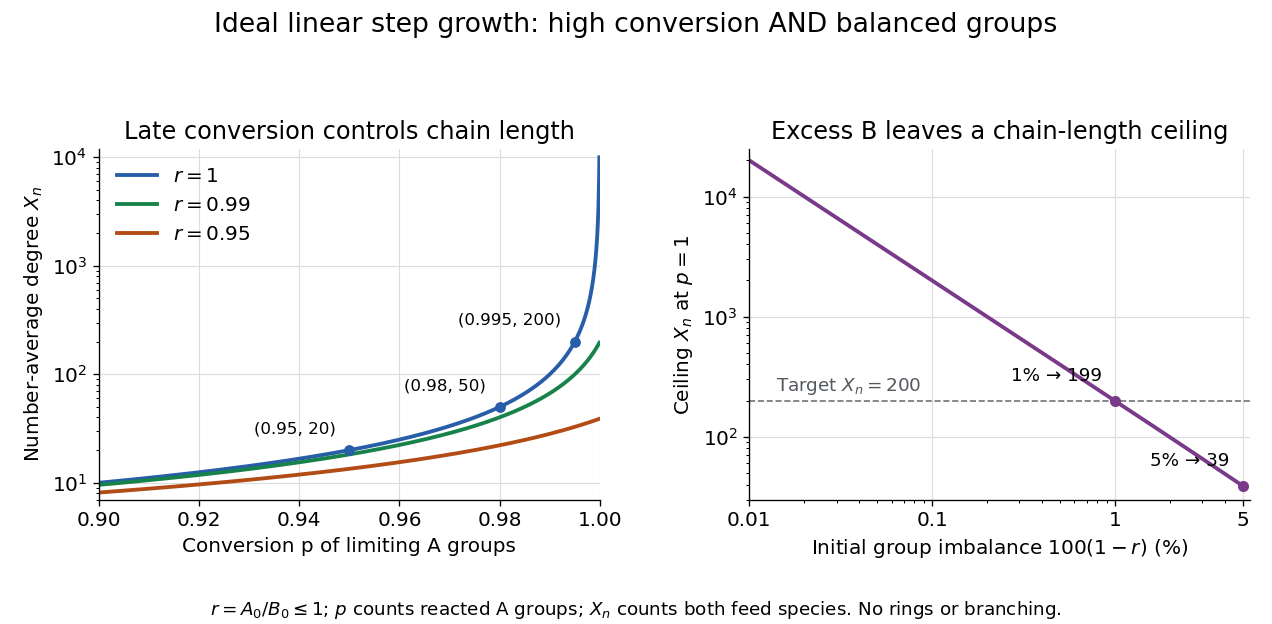
Carothers equation sensitivity to limiting-group conversion and initial stoichiometric imbalance in step growth
. Original analytic model curves with logarithmic vertical axes. Left: and the balanced example points. Right: versus , the initial excess- fraction relative to . These are ideal linear no-ring calculations, not fits to the polyurethane study. Details.
New to topics? Read the docs here!