A molecule, using the International Union of Pure and Applied Chemistry (IUPAC) convention, is an electrically neutral entity containing two or more chemical atoms. Its constituents form a bound unit through chemical bonds; merely drawing a boundary around neighboring particles does not make a molecule. The neutrality requirement concerns total electric charge, not the absence of internal charge separation: water is a polar molecule with zero total electric charge.[ref]
One water molecule, , contains two hydrogen and one oxygen chemical atom. One molecular oxygen molecule, , contains two oxygen chemical atoms; a molecule need not contain different chemical elements. One carbon dioxide molecule, , contains one carbon and two oxygen chemical atoms. The molecular formula records these inventories, while molecular geometry describes their arrangement. Water and carbon dioxide are chemical compounds; molecular oxygen is a form of one chemical element.
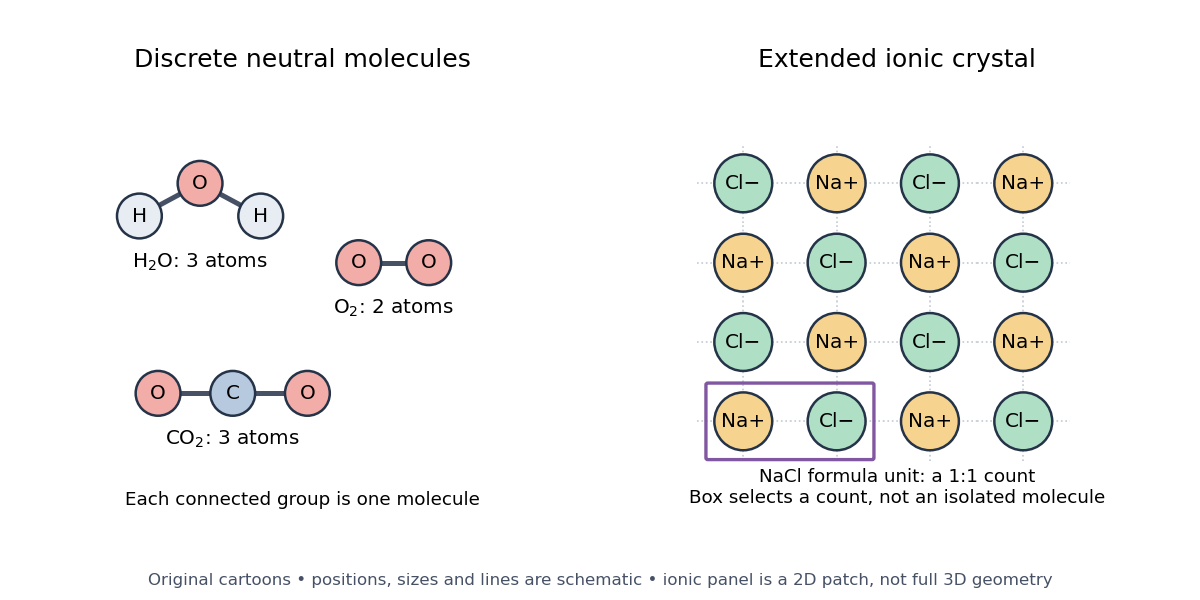
Ordinary crystalline sodium chloride, , contains an extended arrangement of sodium cations and chlorine anions . Its formula unit specifies one of each for compositional accounting, without selecting a unique isolated pair. Bulk neutrality therefore does not imply a material consists of neutral molecules. This statement concerns the ionic crystal; the physical state and conditions matter when deciding what particles a chemical formula represents.[ref]
2.6 Ionic and Molecular Compounds. Ionic Compounds: NaCl composition and the absence of discrete molecules in the ordinary crystal
A polyatomic ion is a charged bound group of chemical atoms, such as hydronium, . A molecular ion formed by removing an electron from intact water, , retains the same atom inventory but has net electric charge . Neither satisfies the neutral-molecule definition. Distinguishing these entities makes molecular count and amount of substance and mass spectrometry interpretable: say whether the count is of chemical atoms, neutral molecules, ions, or formula units.
The useful surprise is that a molecule can be treated as one particle for motion and counting while retaining internal structure. Its molar mass connects a particle inventory to bulk mass; molecular rotation and molecular vibration reveal internal organization. The continuum approximation uses bulk fields in place of individual molecular positions and motions.
The part of a molecule responsible for absorption in a specified spectral region. Its electronic excited states and local environment influence the optical response.
A light-absorbing aldehyde related to vitamin A, used as a chromophore in rhodopsin-family proteins. Its local packing and bonding connect light absorption to structural changes.
An assembly of two molecular subunits.
A pyridine bearing an amino substituent; its NH donors and ring-N acceptor permit complementary hydrogen bonding.
A fused benzene–pyrrole heteroaromatic ring system. Electrophilic substitution normally favours C3; when that position is occupied, C2 substitution can retain the pyrrolic nitrogen–hydrogen bond.
A compound containing two joined pyridine rings; 2,2′-bipyridine is a common bidentate nitrogen ligand.
Assembly of a pyrrole by carbon-nucleophile addition of an isocyanoacetate to an activated unsaturated partner, ring closure at isocyanide carbon and aromatization.
Replacement of the ring oxygen of an activated pyrone by nitrogen through nucleophilic addition, ring opening and reclosure. Atom mapping distinguishes it from simple side-chain amidation.
A five-membered aromatic ring with one oxygen and two adjacent nitrogens. Cyclodehydration of a diacylhydrazine is a useful synthesis.
A mesoionic five-membered heterocycle that can undergo cycloaddition and carbon-dioxide extrusion to form a pyrazole.
A saturated three-membered ring containing sulfur and two carbons. Its strained carbon–sulfur bonds can undergo nucleophilic opening.
Sequential ring opening, five-membered cyclic imidodithiocarbonate formation, cleavage and reclosure can exchange the thiirane sulfur with the thiocyanate sulfur. Backside substitution at both ring carbons reverses the thiirane face while leaving remote stereocentres intact.
A six-membered oxygen heterocycle containing an exocyclic carbonyl. A charge-separated contributor with carbonyl oxygen negative and a pyrylium-like ring clarifies why aromatic character is weaker and more polarized than in benzene.
1,3-Dioxane is a six-membered ring with oxygen at positions 1 and 3. It commonly adopts chair conformations. Axial substituent penalties differ sharply between C2 and C5 because the relevant 1,3 contacts involve different ring atoms.
A 2-Oxazoline has the five-membered ring . A substituent at its imine carbon can be introduced by aromatic capture of an activated cyclic carbamate.
Aromaticity describes the distinctive stability and associated electronic properties of suitable cyclic delocalized systems. In simple planar conjugated rings, orbital occupancy determines whether delocalization is stabilizing; merely drawing a ring is insufficient.
An aromatic hydrocarbon; the term is also commonly used for the carbocyclic aromatic donor portion of an organometallic arene complex.
A monocyclic, approximately planar, continuously conjugated pi system with pi electrons has a closed-shell aromatic configuration in the elementary Hückel model, where is a nonnegative integer. Fused systems and heterocycles require a specified orbital and resonance description rather than counting every drawn double bond in each polygon.
An assembly containing iron and sulfur, incorporated into some proteins as a functional cofactor. Its synthesis and insertion can require dedicated maturation machinery.
Reactive oxygen species include oxygen-derived reactive species with different chemical and electronic properties. Their generation, detoxification and damage pathways should not be treated as one universal reaction.
The radical anion . Its production, reactivity and localization differ from those of hydrogen peroxide; the two should not be treated as an interchangeable oxidant measurement.
A sulfur-containing uridine analogue used in metabolic RNA labelling. Its incorporation and chemical conversion allow labelled molecules to be distinguished from older RNA.
An adenosine modification bearing a methyl group on the exocyclic N6 nitrogen. Its presence can alter recognition by an RNA-binding protein directly or through RNA secondary structure.
molecular dynamics simulates time evolution of a molecular system using a chosen interaction model. Simulated pathways and state populations require adequate sampling and validation against measured observables; a plausible trajectory alone does not establish a biological mechanism.
A molecule with a high relative molecular mass, typically built from many smaller units joined by covalent bonds. Proteins and nucleic acids are examples. In dialysis, a semipermeable membrane can retain these large molecules while smaller solutes diffuse through.
Four water molecules contain eight hydrogen and four oxygen chemical atoms, twelve constituent chemical atoms altogether. Counting the constituents does not mean they have been separated by breaking chemical bonds. The same sample has different counts because the specified entities differ.
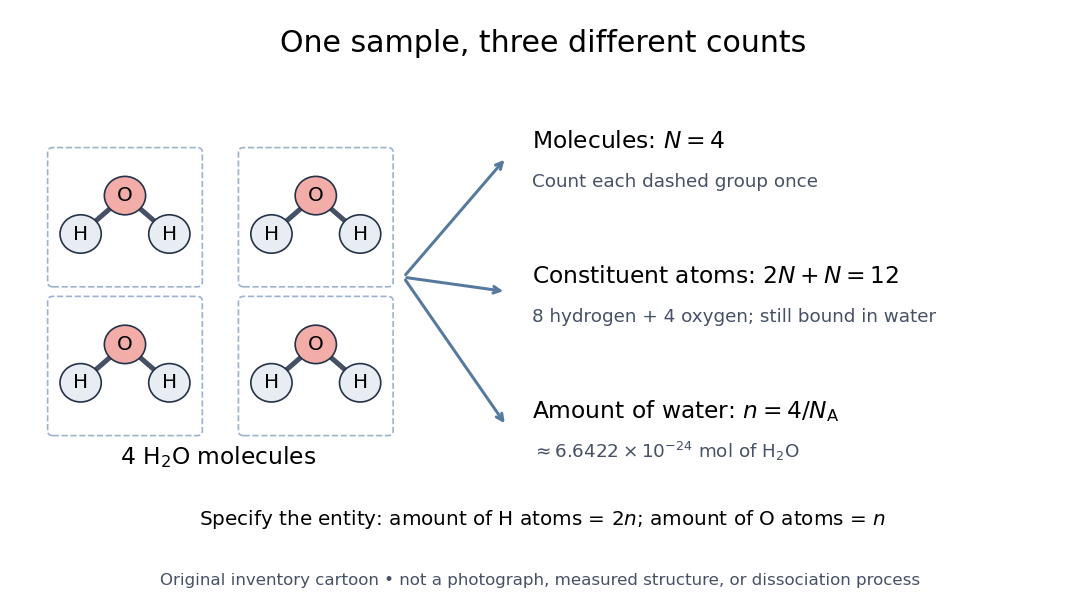
For water molecules, their amount of substance is , while the constituent hydrogen and oxygen inventories correspond to and respectively. The exact Avogadro constant is . The mole applies to specified entities, including chemical atoms, molecules, and ions.[ref]
SI base unit: mole by Bureau International des Poids et Mesures. SI base unit: mole, definition and the requirement to specify the elementary entity
Thus four water molecules correspond to approximately of water, but twice that amount of substance of constituent hydrogen chemical atoms. A macroscopic conversion through measured mass additionally needs the relevant molar mass, as in water mass to molecular count.A single-molecule experiment resolves a response attributable to an individual molecule, rather than only an average over many molecules. Optical detection need not resolve its constituent chemical atoms in an image: repeated photon absorption by the same molecule can produce a measurable response. One detected photon is not automatically one different molecule.
The measured channel matters. Direct photon absorption detection measures a change in transmitted light. Fluorescence detection collects photons emitted after excitation; a fluorescence excitation spectrum varies the illuminating frequency while observing that emission. Both can probe excitation, but their backgrounds and readouts differ. A labeled particle cartoon explains the interpretation; it supplies no experimental evidence by itself.
Such measurements expose differences that a population average can conceal. Suppose two groups of molecules switch between different internal quantum states. Their average response could vary smoothly even though each molecule changes in discrete steps. Resolving an individual response tests that interpretation directly, subject to the measurement's time resolution, sensitivity, and particle assignment. The following experiment makes that assignment through spectral selection and controlled perturbations.
Measure the force and extension of an individual molecular tether under controlled displacement or load. A calibrated cantilever or optical trap converts deflection to force. Synthetic polymer stretching provides a nonbiological application; the observed curve also contains instrument and attachment compliance, and its loading-rate dependence can distinguish equilibrium elasticity from activated events.
Force peaks in membrane-protein extraction can reflect steric barriers, membrane anchoring and electrostatic interactions. Changing ionic strength changes screening and possibly specific ion binding; it need not weaken every barrier in the same direction. The rising branch of an exposed chain and rupture of a remaining structural barrier are different physical processes.
A measurement protocol that holds applied force approximately constant while allowing displacement to vary. Feedback can adjust an actuator in response to a calibrated load signal; alternatively, a passive field gradient can be sufficiently uniform over the displacement range. Finite feedback bandwidth, drift and spatial force variation limit the approximation. This differs from fixing actuator position or prescribing a force ramp.
For a simple single-tether geometry, imposed displacement divides into cantilever deflection and molecular extension . Applying the displayed correction prevents attributing the instrument's stretch to the molecule. Geometric offsets, handles and substrate compliance require additional calibrated terms.
In 1989, William E. Moerner and Lothar Kador reported individual pentacene absorbers in para-terphenyl in Optical detection and spectroscopy of single molecules in a solid by W. E. Moerner and L. Kador (pp. 2535–2538). Different local environments spread photon absorption frequencies; tuning into the sparse wings selected few resonant molecules despite many molecules in the illuminated volume.
Their tunable dye laser focused through a numerical aperture lens onto a – crystal immersed in superfluid helium at . Frequency modulation accompanied either a electric field between coated sapphire disks, detected at , or a quartz shear transducer. An avalanche photodiode measured transmitted-light photon absorption, not fluorescence. Double modulation suppressed residual laser amplitude background.[ref]
Optical detection and spectroscopy of single molecules in a solid by W. E. Moerner and L. Kador. pp. 2535–2537: sample, lens, dye laser, FM/Stark and FM/ultrasound apparatus and detection
Repeated scans gave the predicted modulated line shape. Blank crystals and off-resonance scans gave background; changing modulation frequency expanded and contracted the feature as predicted. Agreement between both perturbation methods supported the individual-absorber inference. The authors acknowledged out-of-focus molecules and the unlikely alternative of multiple absorbers with exactly coincident frequencies.[ref]
Optical detection and spectroscopy of single molecules in a solid by W. E. Moerner and L. Kador. Fig. 1(d–g), Fig. 2(b–g), and pp. 2537–2538: blanks, modulation-frequency changes, background and coincident-absorber qualification
This is evidence for a selected absorber in a prepared, known chemical substance and host. It does not establish arbitrary unknown molecule identity from one spectral feature, provide an atom-resolved photograph, or count every molecule in the crystal. A measurement sensitive to only a narrow excitation range cannot detect a molecule whose transition lies outside that range. This distinction separates the total particle inventory from the number responding to a particular probe.
Molecular rotation changes a molecule's orientation. Its rotational kinetic energy depends on the arrangement and masses of its chemical atoms. A rigid rotor freezes internal distances to isolate this motion; rotational spectroscopy tests the resulting energy eigenvalues through transitions between quantum states. The molecular beam electric resonance experiment provides a complementary probe of the coupling to an electric field.
The dependence of rotational energy on the vibrational state. For a diatomic molecule a common leading approximation is , so vibrational satellites can have different rotational line spacings.
The first-order dependence of a polyatomic rotational constant on vibrational occupations , where is the degeneracy of normal mode . The factor accounts for all of that mode's zero-point energy. A single band's change in rotational constant generally determines one , rather than every zero-point correction needed for .
A rigid rotor models rotational motion with fixed internal separations. Its use in the synthetic Stark effect figure omits vibrational motion and additional interactions in real molecules.
Rigidity fixes the molecular geometry, not the orientation, and does not require a spherical mass distribution. Remove motion of the centre of mass, choose principal axes of the inertia tensor, and write the classical rotational kinetic energy asHere are the principal moments of inertia, components of angular velocity, and components of angular momentum. Quantization replaces these last components by angular momentum operators. Different principal moments of inertia produce different spectra: the single-constant linear rigid rotor is a special case, not a formula for every molecule.[ref]
Lecture 24 Supplement: Energy levels of a Rigid Rotor by Dudley Herschbach. printed p. 1: principal-axis energy and classification; pp. 4–5: asymmetric rotors
For a rigid heteronuclear diatomic rotor, and electric-dipole absorption has . Therefore the line frequency is and adjacent absorption lines are spaced by . With reduced mass , the bond-length estimate is . The conversion assumes frequency rather than angular frequency; centrifugal distortion makes real high-J spacings imperfectly uniform.
A rigid rotor restricted to one angular coordinate . Single-valued spatial states have and energy , with moment of inertia . The zero-angular-momentum level has state degeneracy one; every nonzero has two directions. For labelled molecular ends its high-temperature rotational partition function is , where . Equivalent orientations and nuclear spin statistics require a further molecular counting convention. One quadratic angular momentum gives rotational heat capacity per molecule, rather than for an unrestricted linear rigid rotor.
For a linear rigid rotor with moment of inertia , the energy eigenvalue at angular momentum quantum number is . Each level has statistical weight before additional symmetry or nuclear-spin restrictions.
The angular momentum associated with end-over-end molecular rotation. In an open-shell diatomic molecule it is useful to distinguish from the total , which also contains the electronic spin angular momentum.
The rotational symmetry number corrects a rotational phase-space count for indistinguishable molecular orientations. A linear molecule with identical ends, such as carbon dioxide with identical oxygen isotopes, has ; making its ends isotopically distinct gives . In the high-temperature linear rigid rotor approximation, . Holding the spectrum otherwise fixed, doubling lowers molar rotational entropy by .
For a diatomic molecule, let be the two masses and their fixed separation. The distances from the centre of mass are and . A perpendicular axis through the centre of mass therefore has moment of inertiaThe reduced mass here is not the electric dipole moment, for which we use . For a longer linear molecule, replace by , where is each distance along the axis from the centre of mass. In the point-mass idealization, the axial moment of inertia is zero; turning about that axis changes no nuclear positions, so no independent axial rotational degree of freedom is included.
For the field-free linear rigid rotor, assume a fixed internal quantum state with no electronic angular momentum or electronic spin, and omit couplings to nuclear spin. The rotational Hamiltonian is . Its orientation wavefunctions are spherical harmonics , and its angular momentum eigenstates satisfywhere and . Each belongs to angular momentum eigenstates distinguished by the magnetic quantum number , an instance of degenerate energy levels. The Planck constant is ; is the frequency-valued rotational constant. Notice that the energy eigenvalues scale as , not .
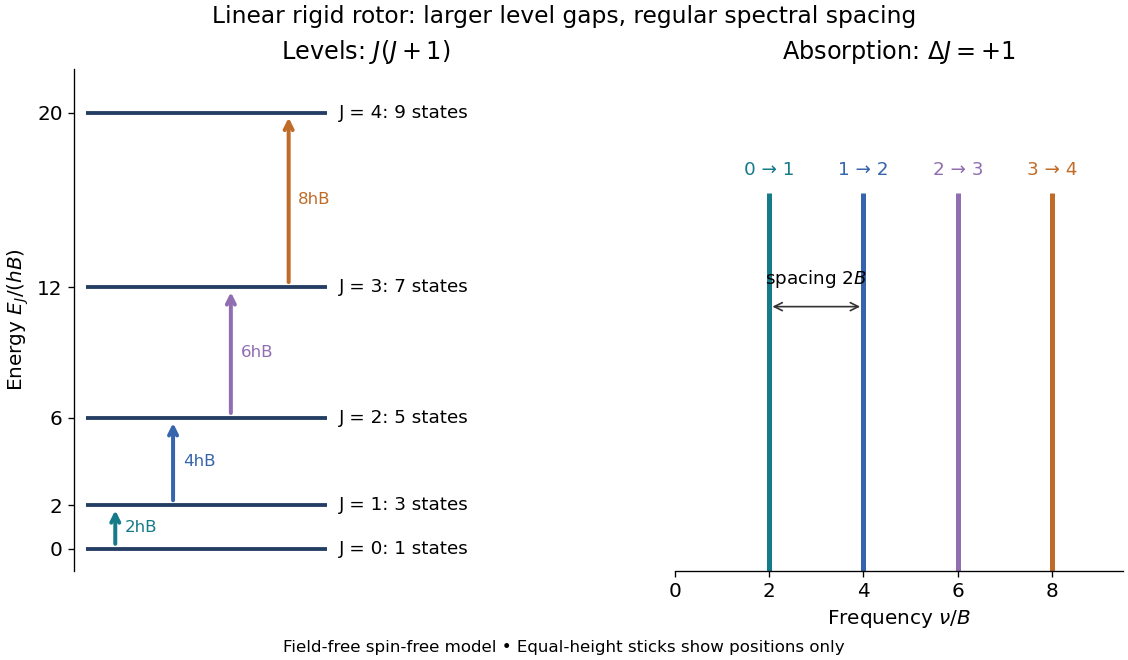
Linear rigid rotor: increasing gaps between energy eigenvalues and equally spaced transition frequencies
. Original dimensionless model: . Upward arrows show photon absorption with ; the sticks show positions only, not measured or predicted intensities. The states at each energy eigenvalue are represented by one horizontal line. Details.Subtracting consecutive energy eigenvalues givesThus increasing level gaps produce a regularly spaced series of lines at , with spacing . Allowed positions do not guarantee that every line is visible: electric-dipole selection rules, occupation of the initial quantum state, and instrument response also matter.
For a linear rigid rotor, rotational temperature expresses the rotational energy constant in kelvins: , where is the perpendicular moment of inertia. With all integer allowed and degeneracies , its rotational canonical partition function is . It approaches at low temperature and at high temperature. The latter limit gives mean rotational energy and heat capacity per rotor.
In this article the rotational constant is a frequency,Its dimensions are , since the Planck constant has dimensions and a moment of inertia has dimensions . Some authors instead call the energy-valued rotational constant; this is the convention in the earlier synthetic molecular beam electric resonance diagram. A third convention uses the spectroscopic wavenumber , with the speed of light. Always check units before using .
If is known and the two masses are specified, the rigid two-atom model gives the bond length . This is why rotational spectroscopy can constrain molecular geometry. A real fitted constant can depend on molecular vibration, so this inference alone does not establish an equilibrium bond length.
For the field-free, spin-free linear rigid rotor in one fixed internal quantum state, the electric-dipole interaction is . A nonzero permanent electric dipole moment along the molecular axis allows pure rotational photon absorption with and photon emission with . The matrix element between initial and final quantum states must be nonzero: the existence of an energy gap alone is insufficient. Relative to a chosen axis, polarization of an electromagnetic wave along selects ; transverse polarization of an electromagnetic wave permits .[ref]
Lecture 24 Supplement: Energy levels of a Rigid Rotor by Dudley Herschbach. printed pp. 2–3: dipole transition integrals, polarization and selection rules
Hydrogen chloride and carbon monoxide are examples with a permanent electric dipole moment. By symmetry, molecular hydrogen and carbon dioxide have no permanent electric dipole moment in the ideal symmetric internal state. They still rotate and have rotational energy eigenvalues, but the simple permanent-electric dipole spectrum described here is absent. This restriction concerns this interaction and these assumptions, not every possible way of detecting molecular rotation.
Changing an isotope changes a mass and therefore the moment of inertia. If the bond length is held fixed, and every corresponding transition shifts by the same fractional amount. This leading inverse-reduced mass scaling is also used in the more complete diatomic formulation.[ref]
1Σ-Ground State Molecules. §2a, equations (4)–(5): isotope dependence of rotational constants and reduced mass
For a deliberately stipulated carbon monoxide example, take , , , , for both isotopic forms, and . The integer masses are simplifying inputs, not accurate isotopic atomic masses; the shared bond length is an imposed model assumption. Calculation givesIn particular,The heavier form's calculated line is rather than , a decrease of about . These are model predictions from the stated inputs, not published measured frequencies. An isotope changes the spacing as well as the first line; the shift is not a fixed additive offset for the whole spectrum.
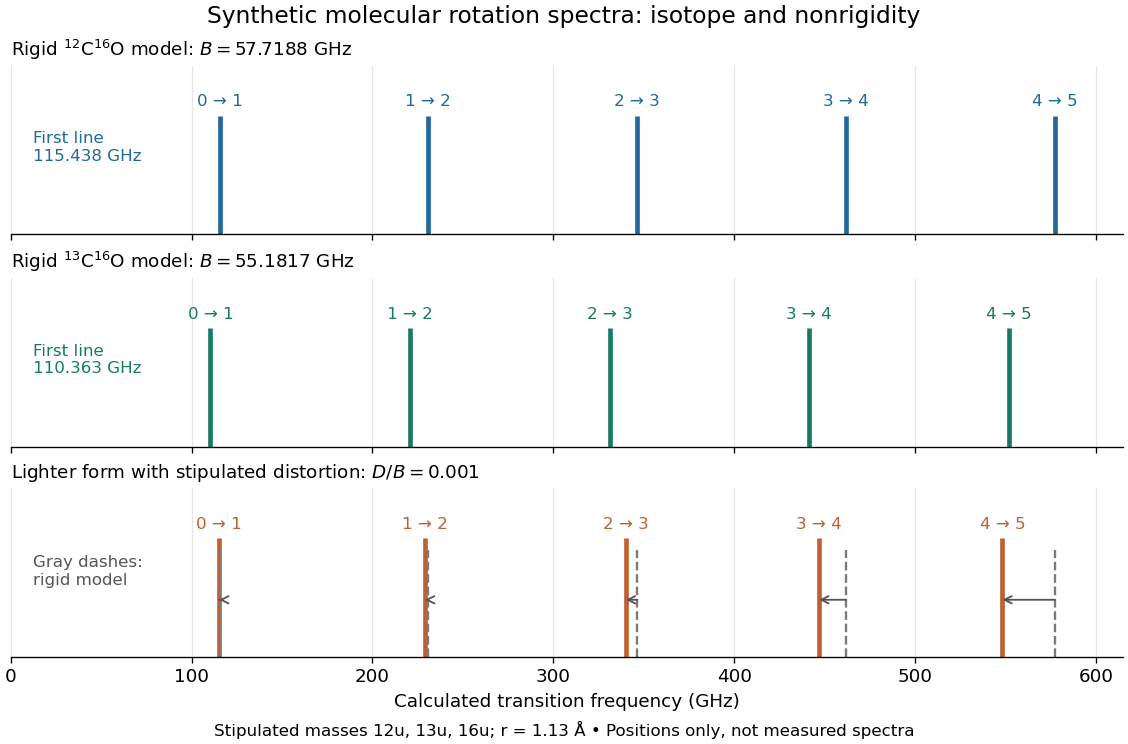
Synthetic rotational spectroscopy comparison: a heavier isotope compresses the rigid spectrum, while centrifugal distortion bends the spacing pattern
. Original equal-height sticks for through , using only the stipulated masses and bond length above. The lower panel additionally stipulates for the lighter form and compares with dashed rigid positions. Neither heights, distortion constant nor line frequencies are measured data; no thermal-population or instrument model is included. Details.Real chemical bonds can stretch as molecular rotation increases. The resulting larger moment of inertia lowers the energy eigenvalues relative to a rigid rotor. Within one vibrational quantum state, a leading effective correction isBoth and are in frequency units here; labels the vibrational quantum state. For positive , the adjacent-line spacing becomesso the departures grow with . Molecular vibration also changes the effective rotational constant: even the lowest vibrational quantum state does not have motionless atomic nuclei.[ref]
The quartic correction is a limited expansion, not a model to extrapolate to arbitrary . It is small relative to the rigid contribution only while ; eventually higher terms, changed internal motion, or chemical bond breaking matter. In the synthetic plot, the largest upper-state label is , giving a stipulated correction ratio of . No universal maximum valid follows without a particular molecule and precision target.
The quantum numbers also have limits of meaning. Here describes spin-free rotation. In a molecule with electronic spin, rotation alone is commonly labelled , while includes electronic angular momentum; including nuclear spin introduces additional total-angular momentum labels and resolved splittings. An applied electric field can mix different field-free states through the Stark effect. For identical atomic nuclei, the Pauli exclusion principle can restrict combinations of rotational and nuclear-spin states. The simple degeneracy and every-integer- ladder therefore describe the stated idealization, not all observed sublevels.[ref]
Rotational spectroscopy measures transitions between molecular rotation quantum states, usually in low-pressure gaseous molecules. The measured spectral lines become a molecular fingerprint only after rotational spectral line assignment: identify which transitions belong together, determine their quantum numbers, fit a rotational Hamiltonian, and test additional predictions. Line positions constrain moments of inertia, while rotational state populations and transition coupling determine which lines can be detected.
The simplest ordinary microwave absorption ladder belongs to a polar linear molecule obeying pure rotational electric-dipole selection rules. A homonuclear diatomic molecule has no permanent electric dipole moment in its symmetric internal state, but rotational Raman spectroscopy can probe its rotation through anisotropic electric polarizability. The coupling mechanism must therefore be specified before interpreting a missing spectrum.
The existing linear rigid rotor, rotational constant, isotope shift of a linear rotor, and centrifugal distortion explain the forward model. Molecular structure from rotational constants asks the reverse question: which arrangements of chemical atoms could produce the fitted constants? The NIST trace-gas FTMW validation experiment makes the measurement chain concrete and separates identifying a species from measuring its concentration.
A set of spectral lines associated with transitions between molecular rotational energy levels. A polar linear rigid rotor has electric-dipole transitions with ; in the ideal model adjacent absorption frequencies are separated by twice the rotational constant in frequency units.
For a polar rigid symmetric top with its permanent dipole on the symmetry axis, electric-dipole pure rotation has , . The term cancels within each transition; centrifugal distortion can lift the rigid-model coincidence of different K components.
A rotational spectral line assignment associates a measured spectral line with a molecule, an internal quantum state, and an initial and final set of quantum numbers. For the spin-free linear rigid rotor, absorption is labelled . A regularly spaced group suggests a candidate rotational constant, but the lowest line inside a scanned band need not be . Several molecules can contribute to the same spectrum, and an apparent missing member can lie outside the band or below the detection threshold.
First determine line centers and their uncertainties from the instrument's readout, accounting for resolved Doppler shifts or hyperfine structure rather than treating every peak as a separate rotational transition. Then propose integer assignments, fit a rotational Hamiltonian, and predict additional spectral lines. For a weakly distorted linear molecule within one vibrational quantum state, the centrifugal distortion model gives the useful diagnosticHere are all frequencies in . Correct assignments make the second expression a straight line against , with intercept and slope . This follows by division of the transition formula; no additional model of molecular geometry is required. A direct weighted least squares fit of to uses the measured uncertainties. If instead the transformed values are fitted, their uncertainties must also be divided by .[ref]
For an original example, stipulate and , and suppose a scan covers –. The model places four consecutive transitions at , , , and . Their assignments are , hence . An extra stipulated line at is unrelated to this series. All these frequencies are calculated example inputs, not measured OCS data.
At and , the transformed values are and . Their straight line has slope , recovering and . Both intermediate transitions satisfy the same line exactly. Merely relabelling the first visible transition fails this diagnostic. The model predicts a withheld transition at : an additional measurement there would test the assignment rather than merely refit the original four lines.
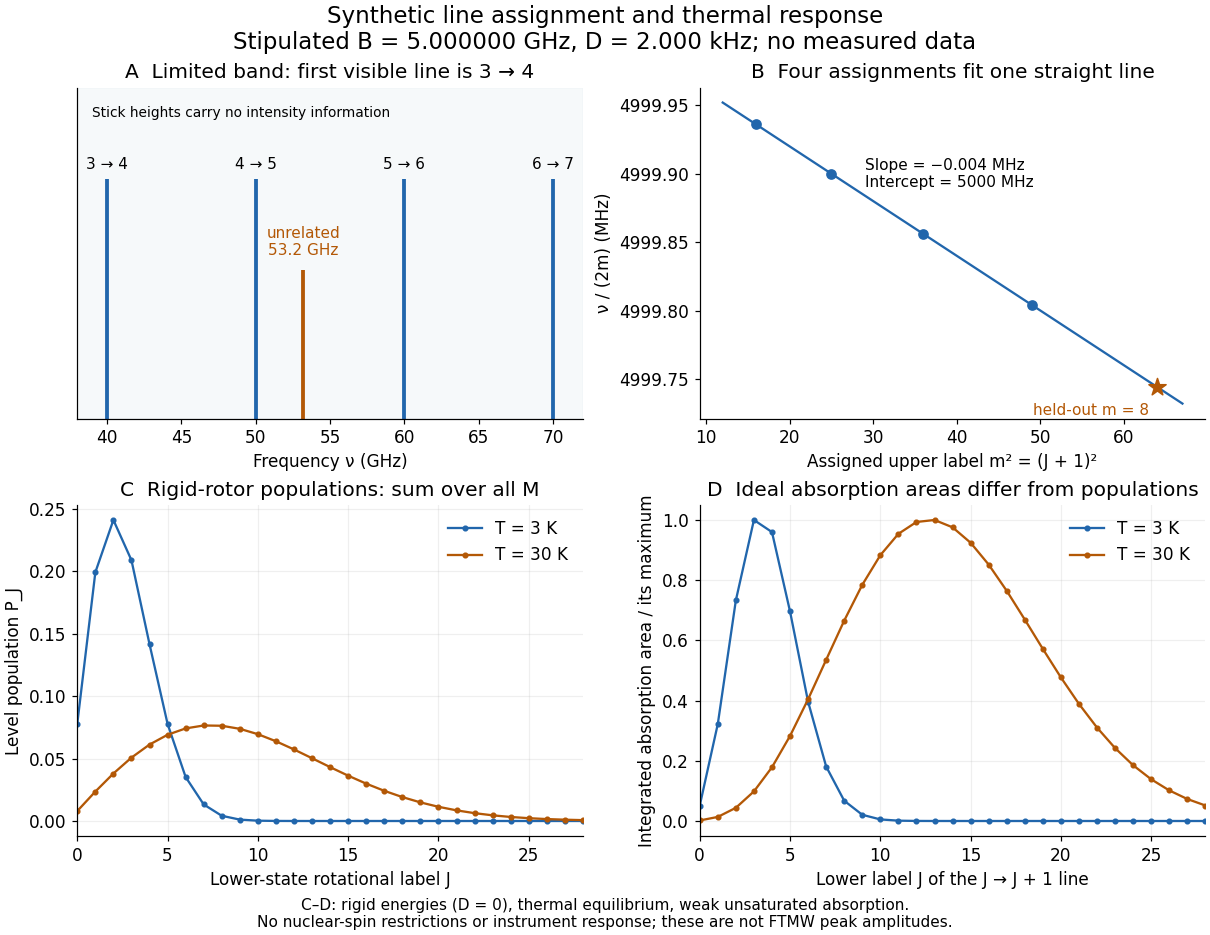
Original synthetic rotational spectral line assignment, fit diagnostic, and rotational state populations
. Stipulated values, not measured data. Upper panels use and ; stick heights show positions only. Lower panels independently use the linear rigid rotor with the same , , and temperatures and . Rotational state populations and ideal integrated absorption areas are different quantities; each absorption curve is normalized separately. Neither is a predicted pulsed FTMW spectroscopy peak amplitude. Details.An assignment earns confidence when several independently observed spectral lines, including lines outside the fitted interval, agree within uncertainty and expected strong accessible lines are present. Inspect the residual of an inverse problem for each line against : systematic curvature can signal inadequate centrifugal distortion, whereas isolated discrepancies suggest a blend or wrong assignment. Comparing a known sample, a blank, and an isotope shift of a linear rotor supplies different checks. These are general inference controls; the actual reported controls of the NIST trace-gas FTMW validation experiment are described separately. One isolated match or one fitted rotational constant alone cannot certify molecular identity.
For the spin-free linear rigid rotor in thermal equilibrium at temperature , assume all integer are allowed and ignore nuclear-spin restrictions. Each level has quantum states sharing one energy eigenvalue, an instance of degenerate energy levels, so the Boltzmann distribution givesHere is a rotational partition function, the Planck constant, the Boltzmann constant, and a frequency in . Thus is dimensionless. The factor counts magnetic quantum numbers; it does not mean that a whole level is one quantum state. For the stipulated , the most populated levels are at and at .
Population alone is insufficient to predict intensity. In weak, unsaturated absorption, the integrated absorption coefficient includes the transition frequency, the squared electric dipole moment matrix element, and the difference of lower and upper substate populations because stimulated emission returns energy to the field. A pulsed FTMW spectroscopy signal additionally depends on excitation, quantum coherence, cavity tuning, and receiver response.[ref]
Absorption lineshapes by Andrei Tokmakoff. Andrei Tokmakoff, §§6.1–6.2, printed pp. 6-2–6-6, equations (6.8)–(6.10), (6.27)–(6.29): population difference and rotational dipole matrix elements
For an isotropic sample with polarization of an electromagnetic wave along , write . Normalized spherical harmonics giveThe last equality follows from . Combining this sum with the per-substate Boltzmann distribution and subtracting stimulated emission gives relative integrated absorption areasThe common factor includes and cancels upon normalization. This formula describes integrated weak absorption in a thermal, spin-free linear rigid rotor, not arbitrary peak heights. The example's strongest integrated lines originate at and for and , respectively: they differ from the most populated levels. A missing line can reflect population, coupling, coverage, or sensitivity; it does not prove that the corresponding quantum state is absent.
The rotational state populations of a spin-free polar linear rigid rotor are proportional to . Differentiating their logarithm with respect to continuous gives the displayed maximum when it is nonnegative. The actual maximum must be selected among nonnegative integers by comparing adjacent populations. This population maximum generally differs from a maximum in measured spectral line intensity.
Recovering molecular geometry from rotational constants is an inverse problem. In the synthetic assignment, gives . For a diatomic molecule with known masses, rotational constant explains how to infer an effective bond length. For a longer linear molecule, one cannot determine every bond length: several different arrangements can have the same moment of inertia.
For a fixed three-atom linear model with positions and positive masses , subtracting the centre of mass givesThis is one equation for two unknown bond lengths. Even fixing the order of the chemical atoms leaves a family of solutions. Additional isotope substitutions change known masses and supply independent equations, provided the effective molecular geometry can be treated as shared. For nonlinear molecules, three principal moments of inertia give frequency-valued constants , , and ; a single evenly spaced comb is generally insufficient.
Vibrational averaging, unresolved hyperfine structure, internal motion, and centrifugal distortion limit structural inference. A ground-vibrational fitted rotational constant is not automatically the equilibrium constant. Ordinary field-free rotational spectroscopy also gives identical spectra for opposite enantiomers under the usual parity-symmetric molecular Hamiltonian; assigning composition and conformation does not by itself determine handedness. Molecular identification from a rich fingerprint can therefore succeed even when a unique full molecular geometry cannot be reconstructed.
Rotational Raman spectroscopy observes a frequency change of scattered light associated with molecular rotation. The coupling uses the induced electric dipole moment, , where is the electric polarizability tensor. For a linear molecule, the useful anisotropy is : the response differs for an electric field parallel or perpendicular to the molecular axis. A permanent electric dipole moment is not required.[ref]
Absorption lineshapes by Andrei Tokmakoff. Andrei Tokmakoff, §6.2, printed pp. 6-7–6-8, equations (6.40)–(6.44): induced dipole, polarizability tensor and rotational Raman response
For the spin-free linear rigid rotor in one internal quantum state, the anisotropic tensor depends quadratically on the molecular direction. Its angular part has even parity and degree two in spherical harmonics. The triangle inequality for coupled angular momenta permits , and even parity removes odd , leaving . The contribution is unshifted light; shifted rotational lines have . Consequently the rigid-model Stokes shifts, in ordinary frequency units, areSuccessive allowed shifts are separated by , rather than the absorption spacing of pure rotational electric-dipole selection rules. In spectroscopic wavenumber units replace by and by , using the speed of light in for .
A homonuclear diatomic molecule such as molecular hydrogen has no permanent electric dipole moment in its symmetric internal state, so it lacks the ordinary electric-dipole microwave ladder. Its anisotropic electric polarizability can nevertheless give rotational Raman spectroscopy lines. Nuclear-spin symmetry can change the populations of even and odd levels, so the spin-free population example above must not be reused unchanged for molecular hydrogen. The method of coupling, as well as the energy eigenvalues, determines what the experiment can see.
Fourier transform microwave spectroscopy excites gaseous molecules with a pulse of electromagnetic radiation, then records the emitted time-dependent electric field. A Fourier transform extracts transition frequencies from the decaying signal. In a cavity implementation, two facing mirrors form a resonator; tuned excitation, receiver electronics and digitization replace the molecule-counting readout of molecular beam electric resonance. The pulsed radiation prepares quantum coherence between rotational quantum states; it does not set the whole gas spinning at one classical angular velocity.
For documented laboratory context, Evolution of Microwave Spectroscopy at the National Bureau of Standards (NBS) and the National Institute of Standards and Technology (NIST) by F. J. Lovas and others (§5, printed pp. 280–282) describes the NIST cavity instrument, phase-locked sources, mirror tuning and detector-mixer modifications. That account explains one instrument family; it does not establish the electronics of every later commercial spectrometer.
The NIST validation report used carbonyl sulfide in argon to illustrate the readout. A pulsed nozzle injected a molecular beam along a two-mirror cavity. Approximately excitation prepared quantum coherence; a receiver digitized the decaying electric field, then a Fourier transform produced spectral lines. Counterpropagating cavity waves produced a Doppler shift doublet; its midpoint represents one rest-frame transition.[ref]
The Validation of Fourier-Transform Microwave Spectroscopy for Trace-Gas Analysis. The Validation of Fourier-Transform Microwave Spectroscopy for Trace-Gas Analysis, printed pp. 25–26, Figures 2–3: coaxial apparatus, excitation and OCS readout; PDF pages 31–32
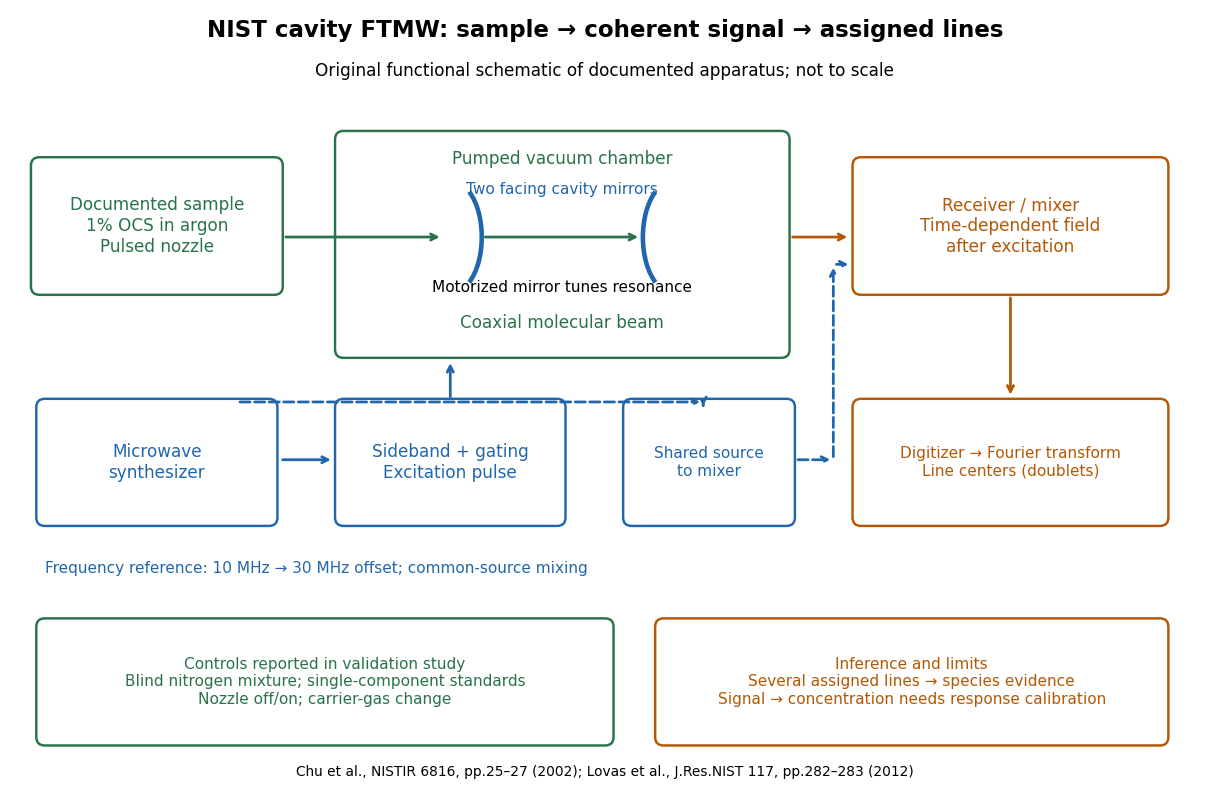
Original functional schematic of the NIST trace-gas FTMW validation experiment
. An original arrangement of the documented sample, cavity, excitation and readout functions; no published figure is copied. The frequency-reference branch summarizes the later portable electronics described in the NIST historical account. The sample fraction is a reported preparation, not a synthetic measured spectrum. Details.The portable electronics used a common microwave source and a offset derived from a reference. Cavity tuning selects the accessible band; it does not independently calibrate the line's frequency. Absolute accuracy also requires a characterized reference and receiver offset.[ref]
Evolution of Microwave Spectroscopy at the National Bureau of Standards (NBS) and the National Institute of Standards and Technology (NIST) by F. J. Lovas and others. §5, printed pp. 282–283, Figure 20: source splitting, frequency reference, single-sideband modulation, mixer and digitizer
Reported controls included nozzle off/on, carrier-gas changes, and a blind nitrogen mixture. Assigned components were correctly identified. Single-component standards supplied preliminary concentration calibration; one standard per quantified component left response validation incomplete. Condensation and departure from thermal equilibrium in the nozzle were acknowledged limitations.[ref]
The Validation of Fourier-Transform Microwave Spectroscopy for Trace-Gas Analysis. printed pp. 26–27: nozzle/carrier comparison in Figure 6, blind mixture in Table II, one-standard calibration and nozzle-expansion limitations
The lesson is that rotational spectral line assignment and concentration inference answer different questions. Reproducible frequencies support molecular identity; converting signal size into concentration requires calibrated response under the same transfer and excitation conditions. The thermal absorption example above does not model a nozzle's nonequilibrium populations or the cavity's pulsed response.
A distinct experiment in An Automated, Highly Selective Reaction Monitoring Instrument Using Molecular Rotational Resonance Spectroscopy by Ann Adele Byars and others (Figure 1 and Figure 3) tracked exchange of hydrogen for deuterium in ethyl acetoacetate mixed with deuterated methanol. A pump circulated chemical solution through a valve; a calibrated loop injected aliquots into a temperature-controlled inlet, held at room temperature for this exchange experiment. Neon carried the vaporized sample to a cavity spectrometer. Separately recorded broadband spectra and fitted rotational Hamiltonians identified transitions for the four isotopic forms before targeted monitoring.[ref]
An Automated, Highly Selective Reaction Monitoring Instrument Using Molecular Rotational Resonance Spectroscopy by Ann Adele Byars and others. apparatus and assignment paragraphs around Figure 1; deuterium-exchange method and Figure 3
The readout was each assigned line's signal over reaction time, normalized by the sum of the four signals. Transitions with the same quantum numbers reduced response-factor differences. A solvent wash addressed observed sample carryover. The signals distinguished the unsubstituted, two singly substituted, and doubly substituted forms. Only one gas-phase structural form was detected; the authors explicitly caution that their readout does not recover the structural chemical equilibrium in chemical solution.[ref]
An Automated, Highly Selective Reaction Monitoring Instrument Using Molecular Rotational Resonance Spectroscopy by Ann Adele Byars and others. deuterium-exchange paragraphs surrounding Figure 3; sample carryover and wash paragraph
This example uses nonlinear molecules, so neither the single-constant linear rigid rotor nor the synthetic comb above is a fit to its spectrum. Its connection to the model is the sensitivity of moments of inertia to isotope placement. Line position helps assign a species; signal size additionally depends on sample transfer, initial quantum state populations and instrument response. Matching quantum numbers is a useful control, not a proof of identical response factors. These distinctions explain why resolving species and determining their concentrations are separate inference steps.
A linear molecule has collinear atomic nuclei in its idealized molecular geometry. Both a diatomic molecule and carbon dioxide can supply linear rigid rotor examples, although their electric-dipole selection rules need not give an observable permanent-electric dipole spectrum.
A diatomic molecule contains two chemical atoms; hydrogen chloride and carbon monoxide are examples. Their fixed-separation moment of inertia is in the linear rigid rotor model.
A heteronuclear three-valence-electron diatomic. A simple bonding/antibonding two-orbital description predicts bond order one-half and one unpaired electron. More electronegative beryllium carries the negative end of the bond dipole.
The neutral molecule Li-two. In the elementary valence molecular orbital description, its two valence electrons occupy the bonding sigma-two-s orbital, giving bond order one and a closed-shell ground state.
A very weakly bound van der Waals molecule, observed in cold helium expansions. The absence of an ordinary covalent bond in the elementary molecular orbital model must not be confused with absence of every possible bound dimer.[ref]
The neutral molecule Be-two. Its simplest filled sigma-two-s/bonding and antibonding description gives zero bond order, but mixing of accessible two-p configurations and electron correlation produce a weak covalent bond. Resolved vibrational levels establish a bound ground-state potential.[ref]
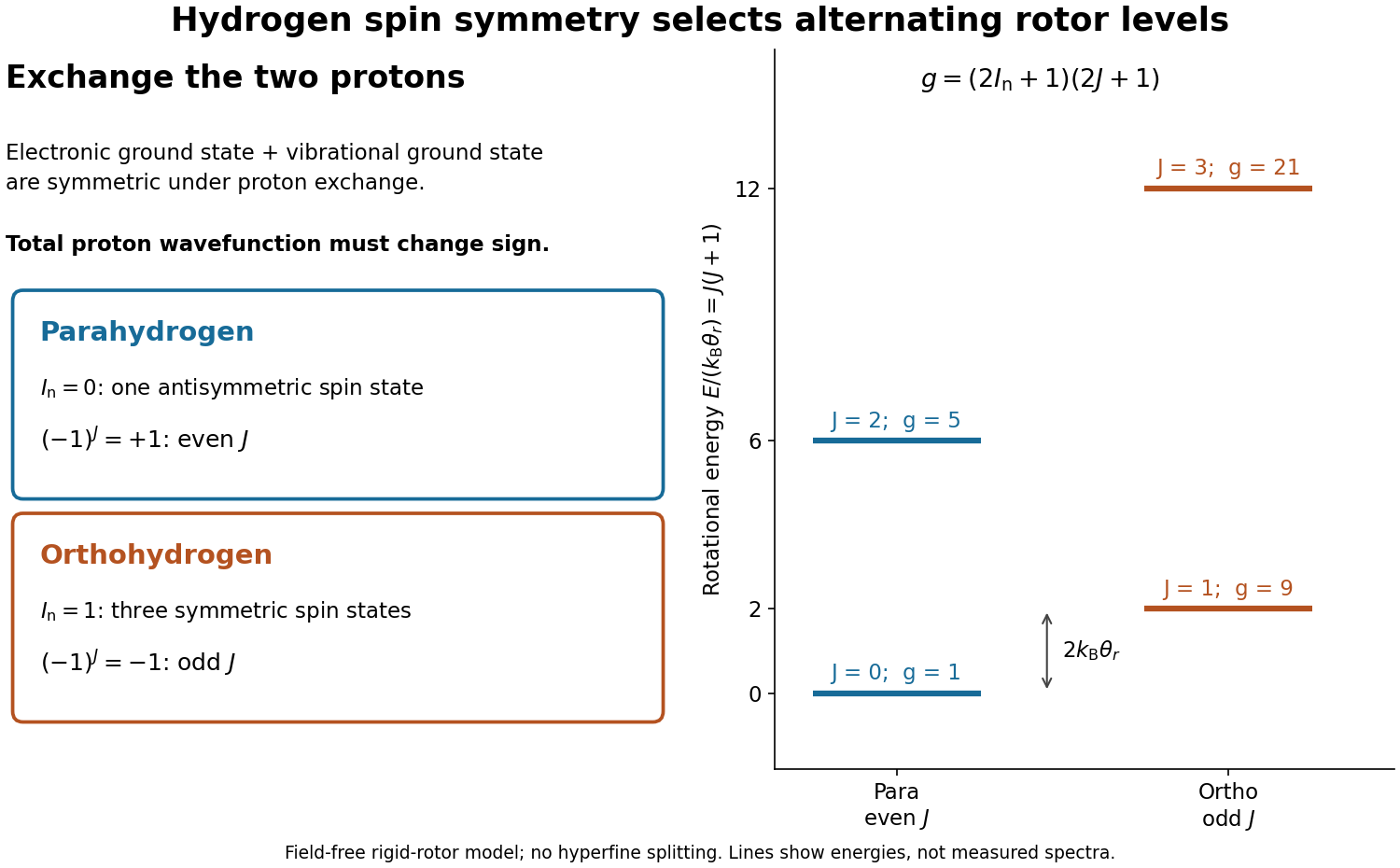
Spin isomers of hydrogen are two forms of molecular hydrogen, , distinguished by the combined nuclear spin of their two protons. They have the same chemical formula and electronic ground state, but different allowed molecular rotation states. Parahydrogen has total nuclear spin zero and even rotational quantum number ; orthohydrogen has total nuclear spin one and odd . The difference makes heat capacity a probe of fermionic exchange symmetry, and makes cooling history matter for a tank of molecular hydrogen.
Assume the electronic ground state and the vibrational ground state of a free molecule. The electronic factor is symmetric under exchanging the two protons, and the vibrational factor depends only on their separation, so it is also symmetric. These assumptions concern the exchange of protons; the electronic wavefunction separately obeys fermionic exchange symmetry under exchange of electrons. Neglect electronic excitation, vibrational excitation, external fields, and small interactions involving nuclear spin when calculating rotational energy eigenvalues.
The two protons are identical particles with spin . Their complete wavefunction must change sign under their particle exchange operator. Interchanging the two ends reverses the internuclear direction , and the spherical harmonic rotational factor satisfiesThe antisymmetric spin-one-half singlet state therefore requires symmetric, even- rotation; the symmetric spin-one-half triplet state requires antisymmetric, odd- rotation. This is exchange symmetry of two identical spin-one-half fermions applied inside a diatomic molecule, not an extra rotational force. A linear rigid rotor may omit spin-dependent splittings while still requiring this restriction on its allowed quantum states.
Interconversion of orthohydrogen and parahydrogen, which changes the coupled nuclear-spin and rotational populations. An active conversion mechanism allows the mole fractions to follow equilibrium as temperature changes; slow conversion instead gives a frozen ortho-para mixture. Whether conversion remains active during a thermal measurement must therefore be distinguished from how the initial sample was prepared.
For hydrogen approximated as a linear rigid rotor, the to energy decrease is , with moment of inertia . A sample of mass initially containing an orthohydrogen fraction therefore releases on complete conversion to the lowest parahydrogen level. This estimate neglects the electron contribution to molecular mass and changes of the rotational constant with environment. It describes an internal heat load that external insulation cannot remove.
A mixture whose orthohydrogen and parahydrogen mole fractions are fixed on the observation timescale, although each species can equilibrate over its own rotational levels. Its molar heat capacity is . normal hydrogen retained during cooling has and . A mixture initially prepared at some other equilibrium composition can also be frozen; its subsequent heat response does not include a changing-composition term.
Parahydrogen uses the antisymmetric spin-one-half singlet state,Here labels total nuclear spin; it is not the moment of inertia in the linear rigid rotor formula. There is one nuclear-spin state for every rotational quantum state. The lowest allowed rotational level is , and the next is . The description “opposite spins” alone is insufficient: the relative minus sign distinguishes this singlet state from the zero-projection member of the triplet state.
Orthohydrogen uses the three symmetric spin-one-half triplet states,These three states give a nuclear-spin multiplicity of three, in addition to the rotational multiplicity . Thus the lowest orthohydrogen level, , has nine states, whereas the lowest parahydrogen level, , has one. The familiar high-temperature ratio is not the ratio of these two lowest levels: at high temperature, many even and odd rotational levels contribute.
Normal hydrogen denotes the orthohydrogen-to-parahydrogen mixture, the high-temperature equilibrium limit. Near room temperature the equilibrium ratio is already close to this limit. Cooling an isolated sample need not change its composition on the measurement timescale: ordinary collisions can redistribute rotational populations within each spin species much faster than they interconvert the spin species. A kinetically frozen composition can therefore coexist with rotational thermal equilibrium separately within each species.
The distinction was historically decisive. The institutional account Die Entdeckung des para-Wasserstoffs, in its discussion of the rotational heat capacity, explains that assuming an equilibrating composition missed the observed behavior, whereas freezing the high-temperature ratio reproduced it. It also records Karl Friedrich Bonhoeffer and Paul Harteck's 1929 preparation using a catalyst and thermal conductivity detection.[ref]
Die Entdeckung des para-Wasserstoffs. paragraphs on frozen high-temperature composition and the 1929 charcoal/thermal-conductivity discovery
Write the linear rigid rotor energy eigenvalues as , where is the rotational temperature scale, the moment of inertia, the frequency-valued rotational constant, and the Boltzmann constant. Put and . Define sums that include rotational multiplicity but exclude nuclear-spin multiplicity:The canonical partition function for one equilibrating internal rotor is , so its equilibrium orthohydrogen fraction isFor , the lowest allowed levels give and , hence . For , the densely populated even and odd ladders have equal leading sums, , hence . The factor nine belongs to the low-temperature two-level approximation, and the factor three to the high-temperature spin multiplicities.
A frozen mixture requires two separately normalized probability distributions,Multiply these by the prescribed fractions and , respectively. The nuclear-spin factor three cancels from the conditional orthohydrogen distribution. For fixed counts and , the internal part of the many-molecule partition function is proportional to , with combinatorial factors independent of temperature. Its logarithm yields the two conditional means weighted by the fixed counts. Using instead would silently permit conversion and change the physical constraint.
Let and for the conditional distributions of parahydrogen and orthohydrogen, with . Differentiating the normalized Boltzmann factors gives . Thus the rotational heat capacity at constant volume per molecule of a composition frozen at isAt conversion equilibrium, the law of total variance adds a nonnegative contribution from the changing species populations:The last term is the contribution from conversion. Compare the first two terms with a frozen sample at the same instantaneous composition; a frozen sample generally has different weights too. This formula follows directly from the variance of a mixture: subtract the overall mean inside each species, expand the square, and the cross terms vanish because each conditional deviation has zero mean. It also proves nonnegative rotational heat capacity in either model.
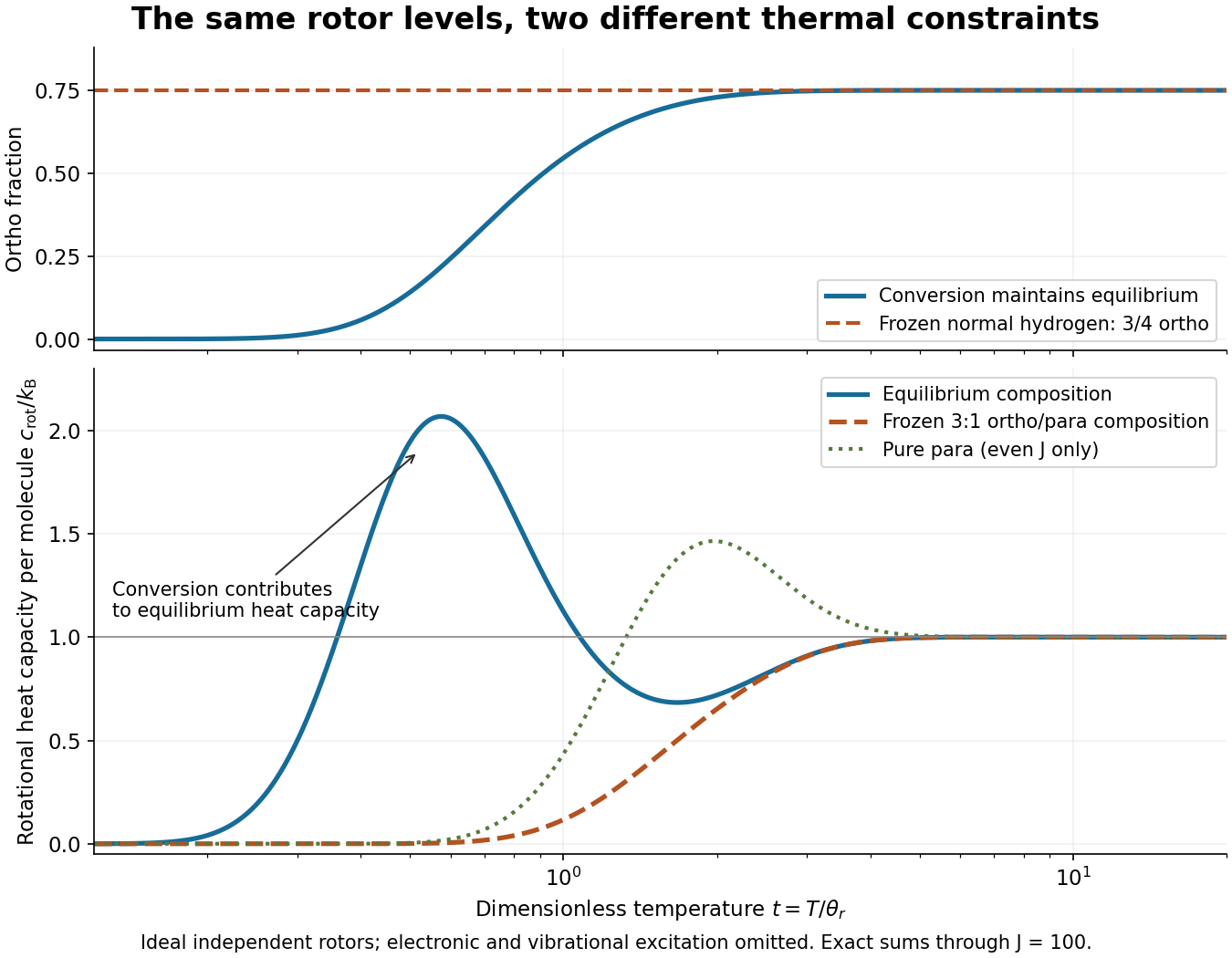
For an original worked example at , summing the allowed ladders gives , , and . The calculated rotational heat capacities are and for frozen normal hydrogen. The contrast is large because changing species accesses the to separation, whereas fixed species must use the larger to or to separations. These are model numbers at a chosen dimensionless temperature, not measured hydrogen data.
Both rotational heat capacities approach zero as , although frozen normal hydrogen retains nonzero rotational internal energy. Both approach as within the rotor model. The high-temperature limit is a formal limit with all other excitations suppressed; actual molecular hydrogen eventually needs molecular vibration, nonrigidity, and dissociation. Multiplying the per-molecule result by the Avogadro constant gives rotational molar heat capacity in units of the molar gas constant . A dilute classical ideal gas additionally contributes from translation to its heat capacity at constant volume.
As , the conditional mean rotational energies approach and , using the para level as the common zero. A frozen mixture with ortho fraction therefore retains . If a bath keeps the sample at low temperature while a catalyst permits conversion to almost pure parahydrogen, the rotational heat delivered to the bath tends to , or for normal hydrogen.
One may shift the ortho ladder to its own lowest level for computing its conditional heat capacity, because a constant energy offset disappears on differentiation at fixed composition. That offset must be restored before comparing species or calculating conversion heat. Otherwise the calculation loses precisely the stored rotational energy that conversion releases. The expression above accounts for the internal rotor contribution at fixed bath temperature; it does not model liquid intermolecular energies, latent heat, or an adiabatic temperature rise.
A catalyst changes the conversion rate and allows heat removal during cooling; it does not change the free-gas equilibrium weights at a specified temperature. This connects the microscopic exchange rule to refrigeration: delayed conversion supplies a continuing internal heat source. Rotational Raman spectroscopy offers a complementary population probe because its transitions stay within the even or odd ladder; line intensities require the appropriate species populations and transition response, not a bare intensity rule.
The 1935 primary paper The Spin-Isomerization of Hydrogen at Paramagnetic and Diamagnetic Surfaces, pp. 1251–1252, describes evacuated catalyst samples cooled before admitting molecular hydrogen. Gas samples were analyzed in a glass cell in liquid air: a heated platinum wire and Wheatstone bridge converted changes in thermal conductivity into electrical resistance readings, calibrated against normal hydrogen.[ref]
The Spin-Isomerization of Hydrogen at Paramagnetic and Diamagnetic Surfaces by Hugh Stott Taylor and H. Diamond. p. 1251, Experimental Details: sample handling and heated-wire thermal-conductivity analysis
Its comparison of oxide surfaces supplied a control: specimens exhibiting strong paramagnetism converted the gas much faster than the comparison exhibiting diamagnetism despite all adsorbing molecular hydrogen. Contact time, pressure, and temperature were recorded. This supports a role for surface magnetic properties beyond adsorption alone; it does not identify every microscopic surface site or directly measure nuclear-spin orientations.[ref]
The Spin-Isomerization of Hydrogen at Paramagnetic and Diamagnetic Surfaces by Hugh Stott Taylor and H. Diamond. p. 1252, Table I description and Discussion of Results: rare-earth oxide comparison and adsorption qualification
The inference chain is preparation, contact with a specified surface, then a calibrated bulk transport readout of composition. It is distinct from a direct calorimetry measurement of heat capacity: transport and heat capacity can both depend on the spin populations, but they are different measured quantities. Changing the catalyst's own surface structure, introducing magnetic impurities, or changing the detector's gas pressure can confound an uncalibrated comparison. The free-rotor partition functions predict equilibrium populations and stored energy, not the conversion rate on a particular surface.
Molecular vibration changes internal separations and bond angles, unlike the fixed internal molecular geometry of a rigid rotor. Its coupling to molecular rotation makes measured rotational constants depend on the vibrational quantum state.
A diatomic molecule has one internal stretching coordinate: its two atomic nuclei approach and separate about an equilibrium bond length. The diatomic bond stretch turns this motion into a particularly useful model. The local potential energy curvature supplies the restoring force, while the reduced mass accounts for both moving partners. Thus the same chemical bond can vibrate more slowly after an isotope substitution even when its electronic structure is nearly unchanged.
This separation makes infrared spectroscopy informative: transition frequencies constrain chemical bond stiffness, and isotope scaling of diatomic vibration tests the mass dependence. The University of Florida HCl and DCl FTIR experiment illustrates the measurement. Detectability also requires vibrational infrared activity; having vibrational energy eigenvalues alone does not guarantee an infrared absorption line.
Loss of excess vibrational excitation to other molecular degrees of freedom or to the surroundings. It can occur within one electronic state without photon emission, reducing the energy available to subsequent fluorescence.
A mass-weighted displacement coordinate along an eigenvector of the molecular harmonic force-constant matrix after rigid translations and rotations are removed. An orthonormal normal-mode basis gives kinetic energy and harmonic potential . This use of normal coordinate concerns molecular vibrations, rather than normal coordinates of a spacetime metric.
In the quadratic vibrational term expression , the constant is dimensionless, while has units of spectroscopic wavenumber. A positive value makes adjacent level spacings decrease. For an exact Morse oscillator, . Using only two low-lying transitions to extrapolate this identity to a real molecule assumes the higher-order anharmonic terms are negligible all the way to dissociation.
Coordinates belonging to inequivalent irreducible representations cannot have an invariant bilinear cross term. Two copies of the same real irreducible representation can: their componentwise dot product is invariant. Diagonalizing the multiplicity-space force-constant matrix produces the normal modes. Symmetry alone therefore does not require two coordinate sets to have zero coupling before that diagonalization.
Coupling between electronic and nuclear vibrational motion. Dependence of an electronic electric dipole transition moment on a normal mode coordinate can give intensity to a transition whose purely electronic matrix element vanishes at the equilibrium geometry.
An otherwise forbidden electronic transition gains intensity when accompanying molecular vibration supplies a symmetry factor that permits a nonzero electric dipole transition moment. A symmetry-allowed total vibronic state specifies a possible transition, while the coupling determines its actual strength.
A joint electronic and vibrational quantum state of a molecule. In a product approximation its irreducible representation is the tensor product of group representations of the electronic and vibrational factors.
The angular momentum associated with motion in a degenerate bending normal mode of a linear molecule. A one-quantum bend has , and the total rotational quantum number obeys .
Spectroscopy of simultaneous changes of vibrational and rotational state. The transition wavenumbers combine vibrational energy differences with rotational constant terms. The allowed rotational changes depend on the molecule and the transition type.
A symmetric-top vibrational band whose transition dipole is perpendicular to the symmetry axis, with . Unresolved Q subbranches can create a regular sequence controlled mainly by .
A symmetric-top vibrational band whose transition dipole is parallel to the symmetry axis, with in the elementary model.
The rovibrational spectroscopy branch in which absorption raises the total rotational angular momentum quantum number by one. A label conventionally specifies the lower-state value .
Articles were limited to the first 100 out of 166 total.
Articles by others on the same topic

A molecule is a group of two or more atoms that are bonded together by chemical forces. Molecules can consist of the same type of atoms, such as in diatomic molecules like oxygen (O₂) and nitrogen (N₂), or different types of atoms, such as in water (H₂O) and carbon dioxide (CO₂). Molecules can be classified into different categories: 1. **Elementary Molecules**: Formed from atoms of the same element (e.g.



