
A strong orientation is an orientation of a graph with strong connectivity: for every ordered pair of vertices, there is a directed path from to . A length-zero directed path permits . Ordinary connectivity of the underlying undirected graph is necessary, but does not ensure this two-way reachability after directions are chosen. The acyclic is not a strong orientation; the cyclic is, since a journey can continue around its directed cycle.
Attach a new vertex to that triangle in a graph by the single edge . This edge is a bridge in a graph. If oriented , no directed path leaves for the triangle in a graph; if oriented , no directed path from the triangle in a graph reaches . Neither choice gives a strong orientation, even when the triangle in a graph itself is cyclically oriented. By contrast, the four-vertex cycle graph has the strong orientationFollowing this directed cycle reaches any requested vertex in at most three steps. Removing any one of its undirected edges leaves a graph path through all four vertices, so it has no bridge in a graph.
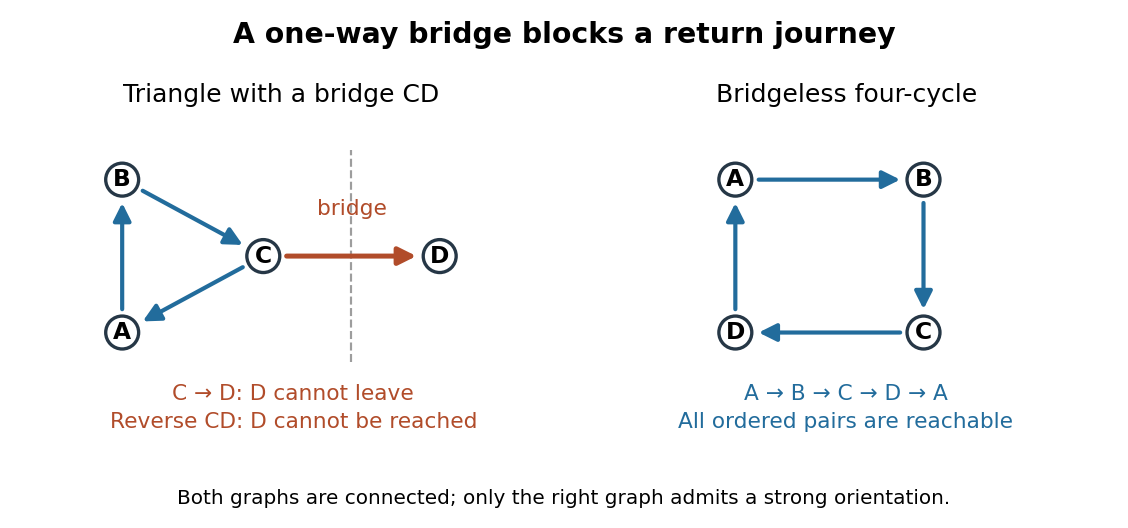
For more than one vertex, a strong orientation cannot also be an acyclic orientation: directed paths from to and back give a nonempty closed directed walk, from which removing repeated portions leaves a directed cycle. A directed graph containing one directed cycle need not have strong connectivity, as the attached shows.


"Strong orientation" can refer to various concepts depending on the context in which it is used. Here are a few potential interpretations: 1. **Psychological Context**: In psychology, strong orientation might refer to having a clear and well-defined sense of direction or purpose in one’s life or career. Individuals with strong orientation may exhibit high levels of motivation and focus.
New to topics? Read the docs here!