
A metric satisfies : visiting an intermediate point cannot beat the direct endpoint distance. A norm satisfies the corresponding inequality .
Take , , and . For Euclidean distance, the triangle inequality reads . The direct line segment has metric path length , while the route through has metric path length . For Manhattan distance, the same comparison becomes : both routes are shortest. The line segment and the bent route both become metric geodesics when progress is measured by metric path length. For Chebyshev distance, the direct line segment has metric path length , while the same bent route still costs .
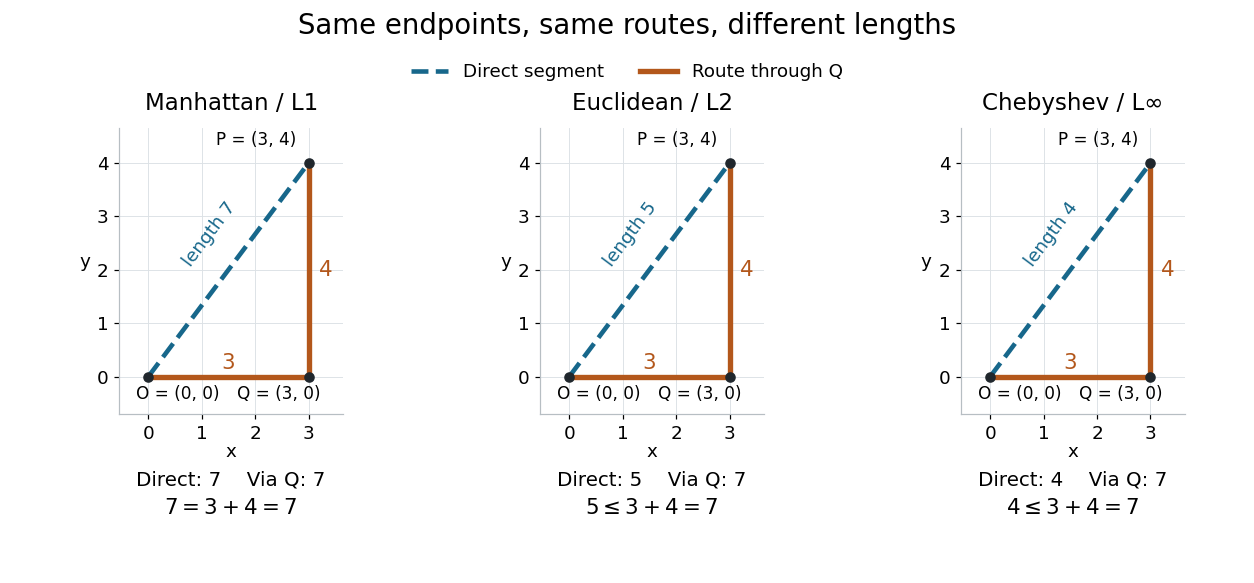
Repeated application of the triangle inequality bounds the endpoint distance by the sum along any finite chain of intermediate points. This explains why metric path length is always at least the distance between endpoints. Equality reveals a shortest route, but its shape and uniqueness depend on the chosen metric.


The triangle inequality is a fundamental concept in geometry and mathematics that states the following for any triangle with sides of lengths \( a \), \( b \), and \( c \): 1. \( a + b > c \) 2. \( a + c > b \) 3. \( b + c > a \) In essence, the triangle inequality asserts that the sum of the lengths of any two sides of a triangle must be greater than the length of the remaining side.
New to topics? Read the docs here!