A norm assigns a nonnegative length to each vector, is zero only at the zero vector, is absolutely homogeneous, and satisfies the triangle inequality.
For a real or complex polynomial p(t)=∑k≥0aktk, this finite sum defines a norm: definiteness follows from uniqueness of polynomial coefficients, absolute homogeneity of a norm follows termwise, and the triangle inequality follows by summing ∣ak+bk∣≤∣ak∣+∣bk∣. On [0,1], its supremum norm satisfies ∥p∥∞≤∥p∥coef,1, since ∣tk∣≤1. The reverse comparison has no constant independent of the degree of a polynomial: for pn(t)=(1−t)n, the two norms are 1 and 2n respectively, by the binomial theorem.
A quasi-norm on a vector space is nonnegative, vanishes only at zero, is absolutely homogeneous, and satisfies a triangle inequality with one constant factor C≥1. For 0<p<1, (∫∣f∣p)1/p on an Lp space is a quasi-norm: ∥f+g∥pp≤∥f∥pp+∥g∥pp gives a quasi-triangle inequality. Measure-preserving composition preserves this quantity even though the Minkowski inequality is unavailable below exponent one.
A dual norm measures how strongly a bounded linear functional can respond to a unit-sized input. If p is a bounded linear functional on a normed vector space X, write ⟨p,x⟩=p(x) and defineIt is the operator norm of p when its scalar output is measured by absolute value. On Rn, represent p(x)=aTx using a coefficient vector a. The unit ball is symmetric, so maximizing ∣aTx∣ gives the same value as maximizing aTx: negate an input whenever its output is negative.[ref]
∥p∥∗=sup∥x∥≤1∣p(x)∣.
Convex Optimization by Stephen Boyd and Lieven Vandenberghe. §A.1.6, printed p. 636: dual norm and scalar operator-norm interpretation
For an original two-coordinate example, fix a=(2,−1)T, so p(x)=2x1−x2. The input norm changes the allowable unit ball and hence the dual norm:Under the L1 norm, ∣2x1−x2∣≤2(∣x1∣+∣x2∣)≤2, and (1,0)T attains the bound. Under the Euclidean norm, the Cauchy-Schwarz inequality gives ∣aTx∣≤∥a∥2∥x∥2≤5, with equality at the displayed normalized vector. Under the maximum norm, each coordinate can reach unit absolute value, so ∣2x1−x2∣≤2+1=3; (1,−1)T attains it. Thus the dual norms of these three vector norms are respectively the maximum norm, the Euclidean norm, and the L1 norm. For 1≤p≤∞, Lp norms on a finite coordinate space pair with their Holder conjugate exponents.[ref]
∥x∥1≤1∥x∥2≤1∥x∥∞≤1:∥p∥∗=2,:∥p∥∗=5,:∥p∥∗=3,x∗=(1,0)T,x∗=(2,−1)T/5,x∗=(1,−1)T.
Convex Optimization by Stephen Boyd and Lieven Vandenberghe. §A.1.6, printed p. 637: Euclidean self-duality and one-, infinity- and p-norm duality; the numerical vector and maximizing points here are independent examples
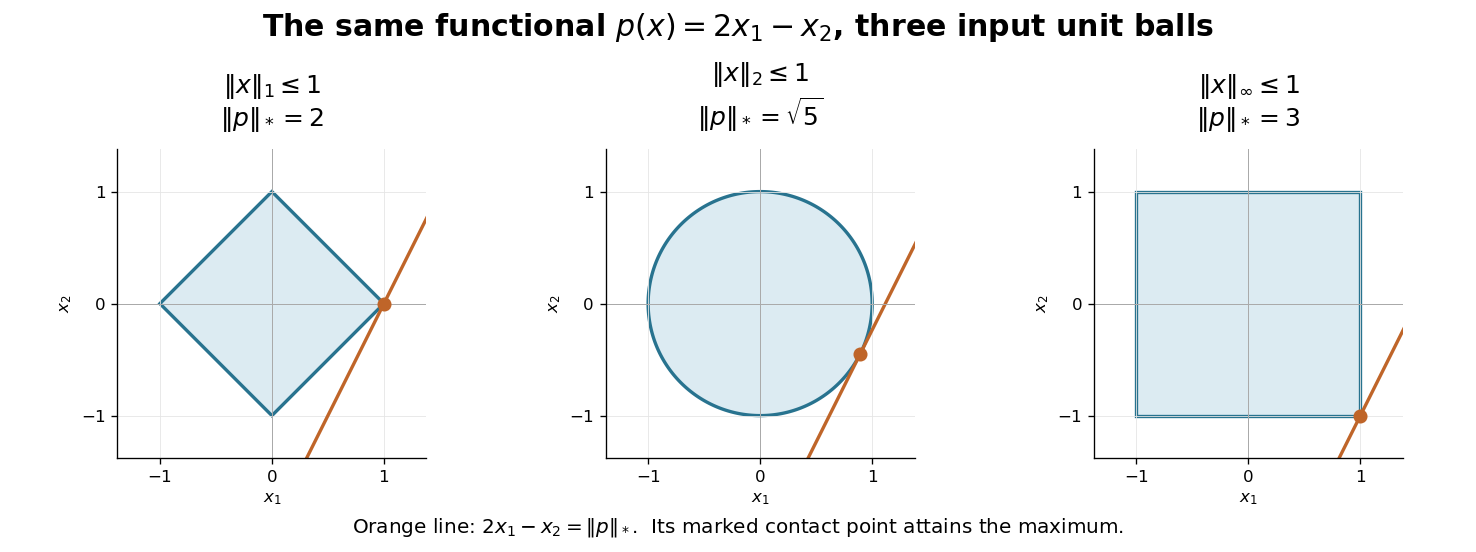

This geometry explains the usefulness of a dual norm: it translates a bound on inputs into the sharp bound on a linear output. The support function of the unit ball gives its value in the coefficient direction a. Changing the input budget changes the set of possible inputs; the three different answers do not conflict. In finite dimensions a closed unit ball is compact, so a continuous linear functional achieves its maximum absolute value. In an infinite-dimensional normed vector space, the supremum remains the definition and need not be achieved.
Suppose a perturbation δx satisfies ∥δx∥≤ε, with ε≥0. Absolute homogeneity of a norm and the dual norm definition giveFor nonzero δx, divide it by its norm to obtain an input in the unit ball; for zero perturbation the inequality is immediate. This is an exact error bound for a linear functional, for every perturbation in the stated input set.
∣p(x+δx)−p(x)∣=∣p(δx)∣≤∥p∥∗∥δx∥≤ε∥p∥∗.
For p(x)=2x1−x2 and a budget ε=0.1, the sharp output-error bounds are 0.2 for ∥δx∥1≤0.1, 5/10≃0.224 for ∥δx∥2≤0.1, and 0.3 for ∥δx∥∞≤0.1. Scale the maximizing vectors from the preceding example by 0.1 to attain the positive endpoints; their negatives attain the negative endpoints. The L1 norm budget constrains a total absolute error; the maximum norm budget permits each coordinate to have that error separately. These budgets define nested sets and carry different information.
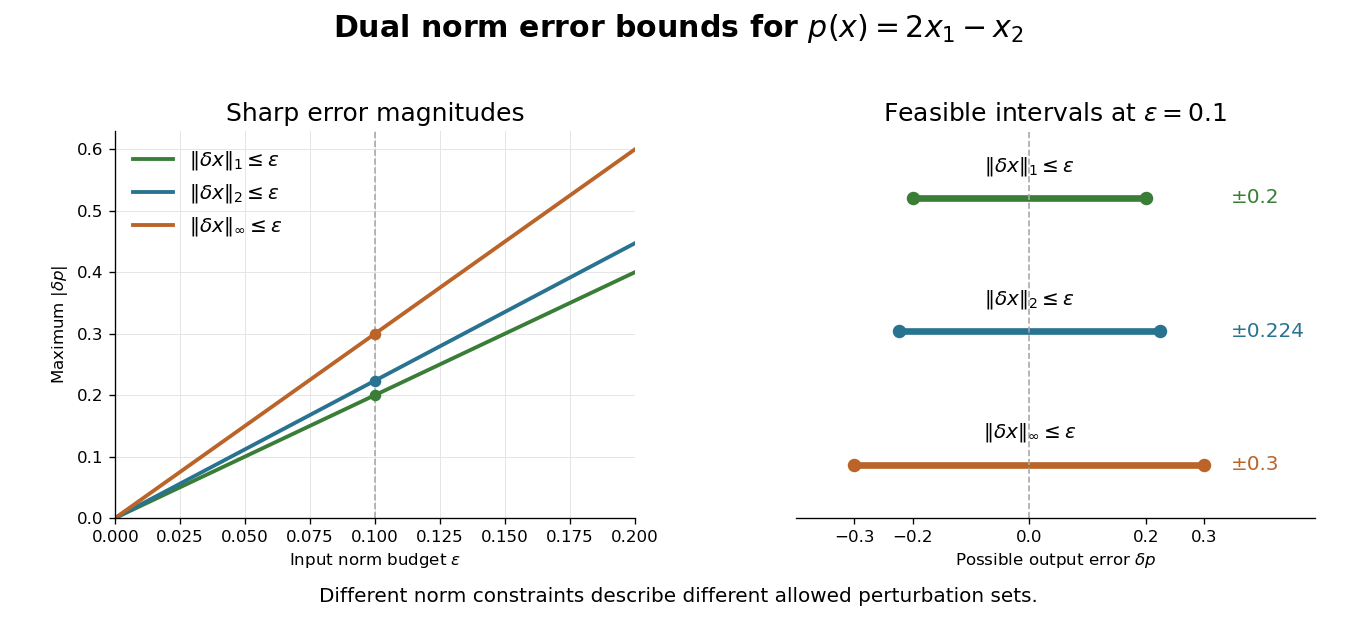
Dual norms give exact worst-case errors for the same linear functional
. Original bounds for p(x)=2x1−x2. Lines show the sharp error magnitude as the stated input norm budget increases. The right panel gives the full possible error intervals at ε=0.1; these are the full feasible intervals for the stated deterministic bounds. Details.
The coordinates must use the stated scale and units. Rescaling one coordinate changes both its coefficient in a and the meaning of its input budget. For a nonlinear differentiable function with scalar values, its Fréchet derivative at the base point is a linear functional governing the first-order response. An exact finite-perturbation error bound additionally needs control of the Taylor remainder or of the Fréchet derivative along the path.
On the real space of sequences converging to zero c0, use the supremum norm and define the linear functionalThe geometric series gives ∣p(x)∣≤∥x∥∞, so p is a bounded linear functional and ∥p∥∗≤1. The sequence with its first N entries equal to one and all later entries zero belongs to c0, has unit supremum norm, and gives p(x)=1−2−N. Hence ∥p∥∗=1. But if ∥x∥∞≤1 and xn→0, not all coordinates can equal one or all equal minus one. Since every weight 2−n is positive, −1<p(x)<1. The supremum is approached but never attained on the unit ball.
p(x)=∑n=1∞2−nxn.
The block mixed norm sums the ℓq norm of each block, for q≥1. Its dual norm is ∥p∥q′,∞=maxi∥pi∥q′, where q′=q/(q−1) for q>1 and q′=∞ for q=1. Apply Holder inequality blockwise and choose a norming block to attain equality. Absolute values are essential for signed components.
For λ≥0 and a linear map A between finite-dimensional real inner product spaces,Thus the penalty is the support function of the compact convex set A∗{p:maxi∥pi∥q′≤λ}. The Moreau decomposition makes its proximal operator the identity minus the Euclidean projection onto a convex set.
λ∥Au∥q,1=supmaxi∥pi∥q′≤λ⟨A∗p,u⟩.
Definiteness says that a norm vanishes only at the zero vector. The box norm on a nonempty finite Cartesian product is definite because its defining sum of squares includes equal-column terms, each of which is the square of an average of squares. Omitting repeated coordinates would destroy this proof and can produce a different quantity.
Absolute homogeneity is the norm axiom ∥av∥=∣a∣∥v∥ for every scalar a and vector v. It distinguishes a norm from a merely homogeneous expression of a different degree; for example the fourth root in the box norm converts a degree-four expression into a degree-one norm.
On a real vector space, suppose B contains zero, is convex, and meets every line Rv, v=0, in the finite symmetric open segment {tv:∣t∣<λ(v)} with λ(v)>0. Then its Minkowski functional is a norm, with pB(v)=1/λ(v) and B={x:pB(x)<1}. Absolute homogeneity follows by rescaling the segment. If s>pB(x) and t>pB(y), convexity puts (x+y)/(s+t) in B, giving pB(x+y)<s+t; passing to the infima proves the triangle inequality. Conversely the open unit ball uniquely determines any norm by the displayed formula. No prior topology on the vector space is needed for these radial hypotheses.
On a uniform d-dimensional spatial grid, the discrete L2 norm weights the squared Euclidean norm by the cell volume. It approximates the continuous L2 norm and is induced by the discrete L2 inner product. A contraction bound in this norm with a mesh-independent constant proves stability of a numerical method for the spatially discretized evolution.
Ancestors (6)
Incoming links (1168)
- Absolute homogeneity of a norm
- Absolutely summable sequence space
- Absolute-series criterion for completeness
- Admissible crystallographic Coxeter graph
- Algebra involution
- All-time boundedness of a wave equation with a reaction term
- Almost-everywhere convergence from weak-type domination
- Almost-sure convergence and convergence of second moments
- Amplitude amplification
- Analytic torsion
- Analytic Wiener algebra
- Anchored variation norm
- Angular momentum ladder endpoint
- A norm-closed dual subspace need not be weak-star closed
- Antiunitary operator
- Approximable operator
- Approximation theory
- Arc length
- Atomic approximation on finite-dimensional spaces of continuous functions
- Automatic continuity onto a semisimple Banach algebra
- Backward error
- Backward preservation of local indistinguishability
- Backward stability
- Banach algebra
- Banach-Saks property
- Banach space
- Basis pursuit
- BDF2 discrete energy identity
- Bézier curve
- Bidual of a normed space
- Bielecki norm method
- Bilinearity
- Bivector
- Block averaging compactness counterexample
- Block mixed norm
- Boltzmann Volterra operator
- Born rule
- Bounded bilinear form
- Bounded BV extension operator
- Bounded continuous functions
- Bounded-Lipschitz metric
- Bounded-variation compactness
- Bounded-variation step outside W11
- Box norm
- BPS bound in supersymmetry
- Bragg plane
- Branch weight
- Brownian martingale proof of Gaussian concentration
- Cartesian and oblique coordinate reconstruction
- Cartesian basis
- Cartesian basis under rotation
- Cauchy-Schwarz inequality
- Characters of the bilateral absolutely summable convolution algebra
- Character space of the Wiener algebra
- Circle reduction of eleven-dimensional supergravity
- Clamped second-order Sobolev space
- Closed convex hull of a compact set
- Closed subspace of a Hilbert space
- Closed unit ball
- Coefficient condition number of a normalized B-spline basis
- Coefficient of determination
- Coercive bilinear form
- Coercive energy estimate for kinetic transport
- Coercive Neumann energy with a positive reaction term
- Common representer coefficients for a sum of kernels
- Compact closed-ball image forces finite rank on c0
- Compact factorial triangular operator on l1
- Compact harmonic-spinor rigidity under nonnegative scalar curvature
- Completeness of a graph norm from a bounded right inverse
- Completeness of continuous square-integrable martingales
- Completeness of the bounded-variation space
- Completion of a normed space
- Concentrating spikes distinguish weak Lp and weak L1 compactness
- Confining-potential energy space
- Conformal unitarity bound
- Conjugate of the squared distance to a convex set
- Constant-drift massive-Laplacian Dirichlet problem
- Constrained second-variation stability in elasticity
- Continuous dependence on forcing
- Continuous linear operator
- Controllability Gramian
- Control-point influence on a curve
- Convergence criterion for a stationary iteration
- Coordinate seminorms
- Coulomb radial origin condition
- Covariantly constant vector Higgs field
- Covariant photon Fock space
- Croot-Sisask almost-periodicity theorem
- C-star algebra
- C-star isomorphism
- Curvature
- Curvature-matching diffeomorphism between two surfaces of revolution
- Cutoff proof of invariance for a zero-flux diffusion density
- Cyclic multiplication model for a normal operator
- David Milman
- Decoupled coefficients of orthogonal polynomial projections
- Definiteness of a norm
- Derivative of a continuous bilinear map
- Derivative seminorms on a compact interval
- Diagonal operator on sequence space
- Diamond norm of the transposition map
- Differentiability under equivalent norms
- Differentiation of the Dyson time-ordered exponential
- Differentiation operator
- Dimension bound for a commutative Euclidean normed algebra
- Dirac plane waves in the standard representation
- Dirac spinor pseudo-unitarity
- Directional derivative
- Dirichlet energy of a map
- Dirichlet energy space
- Dirichlet energy space with zero boundary at infinity
- Dirichlet form of the Kac collision operator
- Discrete L2 inner product
- Discrete sampling inner product on polynomial spaces
- Discrete Sobolev norm
- Distance from a sphere to a disjoint surface
- Distance to the nearest integer
- Dual-exponent Clarkson inequality
- Dual invariance under dense inclusion
- Duality mapping
- Dual norm
- Dual norm as a worst-case linear error bound
- Dual of the convergent sequence space
- Dual test-function norm
- Dunford-Pettis theorem
- Edge vector
- Eigenfunction expansion
- Endpoint kernel bound for a zero-trace Sobolev function
- Energy release from an antiplane square-root coefficient
- Equality in the projected Cauchy-Schwarz inequality
- Equatorial coordinate system
- Equiangular direction in least angle regression
- Equivalent terminal and maximal norms for L2-bounded continuous martingales
- Error modes of a three-variable Jacobi iteration
- Error norm
- Evaluation onto the dual of a reflexive dual subspace
- Even-function spectral gap on a hypercube
- Exact inverse norm of midpoint cubic spline collocation
- Existence for nonnegative shifted Poisson regularization
- Explicit time stepping for bounded reaction diffusion
- Exponential of a bounded skew-adjoint operator is unitary
- Exponential trial state for a half-harmonic oscillator
- Exponential variational trial for a square-root half-line well
- Failure of L2-to-Linfinity Poisson gradient bounds in three dimensions
- Failure of Rellich compactness on an unbounded domain
- Failure of unique factorization in the ring of integers generated by square root of minus five
- Feasible inner products with two unit vectors
- Fernique's theorem
- Field norm
- Finite-codimensional weak-star dense dual subspace is norming
- Finite-dimensional interpolation form of Goldstine's theorem
- Finite-dimensional spectral theorem
- Finite-dimensional weak and norm topologies coincide
- Finite-evaluation inner product on polynomials
- First-order two-local Hamiltonian simulation
- Fixed-axis spin obstruction for positive-energy Dirac spinors
- Flat-direction exception to the adjoint cubic stationarity bound
- Floquet growth rate
- Forced Airy boundary-value problem
- Forward error
- Fourier extension estimate
- Fourier orthogonality
- Fourier transform of a basis-copying isometry
- Fréchet differentiability of a first-order variational integral
- Fréchet space
- Freidlin--Wentzell action
- Frobenius inner product
- Functional analysis
- Functional calculus preserves closed faces of the positive unit interval
- Functional mean test
- Function space
- Gâteaux derivative
- Gaussian identity design for debiased Lasso
- Gaussian least-squares contrast
- Gaussian number operator
- Gaussian prime
- Gaussian series with square-summable coefficients
- Generalized parallelogram identity
- Generalized singular vector
- General-order Cauchy-Kovalevskaya theorem
- Generating-function proof of Hermite orthogonality
- Generator of a multiplication semigroup
- Geometric minimum action
- Ghost zero-mode pairing
- Gliding-hump continuity principle
- Global discrete gradient-norm denoising
- Good rate function
- Gowers uniformity norm
- Gradient descent
- Gram matrix
- Gram-Schmidt process
- Gravitino mass from a superpotential
- Hadamard interference with environment overlap
- Hadamard matrix
- Half-density
- Half-integer cosine expansion of a linear profile
- Harmonic Hardy space of the upper half-space
- Heine-Borel theorem
- Hermitian Banach algebra
- Hermitian commutator potential in D-brane Yang-Mills theory
- Hermitian form
- Hermitian inner product
- Hermitian operator
- Hilbert-Schmidt inner product
- Hilbert space
- Hilbert space completion
- Homogeneous function
- Horizontal coordinate system
- Identity component of Banach-algebra invertibles
- Ill-posed inverse problem
- Incompleteness of finitely supported sequences
- Indefinite Klein-Gordon charge density
- Induced metric
- Infinite-dimensional bounded sequences can lack convergent subsequences
- Inner product
- Inner product space
- Instanton translation zero mode
- Integral basis of an odd biquadratic field containing square root of two
- Isomorphic embedding
- Isospin multiplet
- James–Stein shrinkage toward the sample mean
- Jordan-von Neumann theorem
- Kac collision operator
- Kahane-Khintchine inequality
- Kaplansky density theorem
- Kendall's tau-b
- Kernel of a seminorm
- Kernel-orthogonal proof of the Riesz representation theorem
- Kernel ridge regression
- Klein-Gordon plane-wave normalization
- L0 sparsity count
- L1 convolution bound
- L1 Kolmogorov-Riesz compactness criterion
- L2 inner product
- Labelled hypergraph copy count
- Laguerre derivative square identity
- Lasso
- Lasso support bound from sparse eigenvalues
- Lebesgue constant of interpolation
- Legendre expansion of the sign function
- Length of a curve
- Level-two scalar in covariant string quantization
- Lévy construction of Brownian motion
- Lévy maximal inequality
- Liénard radiated-power formula
- Linear span
- Linear-system residual norm
- L-infinity norm
- Lipschitz gradient
- Local indistinguishability
- Locally square-integrable function
- Logarithmic conjugacy of a repeated-root Euler operator
- Log-cosh energy on a Sobolev space
- Lower-frequency Lp approximation to a single harmonic
- Lower norm of an operator
- Low-rank approximation
- Lp conservation for incompressible transport
- Lp norm
- Matrix norm
- Maximal left ideal
- Mean control for positive imaging operators
- Mean-square completion of trigonometric polynomials
- Metric embedding
- Metric topology
- Minimal total family in a normed space
- Minimum of a coercive convex functional on a Hilbert space
- Minkowski inequality
- Minkowski inequality for error aggregation
- Minkowski inequality for finite vectors
- Mixed boundary data distinguish heat, Laplace and wave uniqueness
- Modal amplitude norm versus wavefront RMS
- Modulation property of the Fourier transform
- Multinomial central limit theorem
- Negative-norm string state
- Neural tangent kernel
- Nonlinear compact operator
- Nonpositive modes in a Dirichlet-Robin interval expansion
- Nonzero-momentum condition in the massless vector norm test
- Normalization of photon-added and photon-subtracted states
- Normalized curvature form of a Hermitian holomorphic line bundle
- Normalized highest-weight lowering formula
- Normalized velocity-reset projection
- Normal reversal around the Möbius core
- Norm-closed convex set is weakly closed
- Norm conservation of a semidiscrete Schrödinger equation
- Norm determined by a convex radial unit ball
- Normed algebra
- Normed vector space
- Norm from a bounded symmetric convex neighbourhood
- Norming functional
- Norming subspace of a dual space
- Norming vector for Holder inequality
- Null energy condition for the electromagnetic field
- Null string state
- Numerical radius
- Oblique projection
- Octahedral quasirandomness of a three-uniform hypergraph
- One-dimensional harmonic oscillator form domain
- One-particle state
- Orthogonal decomposition in a positive-definite metric
- Orthogonality of supported and harmonic Dirichlet functions
- Orthogonal polynomial
- Orthogonal projection
- Orthogonal projection onto a finite-dimensional subspace
- Orthogonal splitting with bounded volume ratio
- Orthonormal polynomial
- Orthonormal set
- Out-mode number fluctuations in the in-vacuum
- Partial inner product
- Partial-sum norm on absolutely summable sequences
- Past exam of the advanced quantum physics course of the University of Cambridge / 2022 / Section B / 6 / b / Solution
- Past exam of the algebra 1 and differential equations 1 course of the University of Oxford / 2015 / 3 / b / iii / Solution
- Past exam of the algebra, analysis and differential equations 1 course of the University of Oxford / 2006 / 2 / Solution
- Past exam of the algebra, analysis and differential equations 1 course of the University of Oxford / 2011 / 2 / c / Solution
- Past exam of the algebra, analysis and differential equations II course of the University of Oxford / 2005 / Algebra / 2 / iii / Solution
- Past exam of the algebra, analysis and differential equations II course of the University of Oxford / 2005 / Algebra / 2 / ii / Solution
- Past exam of the algebra, analysis and differential equations II course of the University of Oxford / 2009 / Algebra / 2
- Past exam of the algebra, analysis and differential equations II course of the University of Oxford / 2009 / Algebra / 2 / b / Solution
- Past exam of the algebra, analysis and differential equations II course of the University of Oxford / 2011 / Algebra / 2 / b / Solution
- Past exam of the algebra, analysis and differential equations II course of the University of Oxford / 2012 / 2 / a / Solution
- Past exam of the algebra and analysis II for mathematics and philosophy course of the University of Oxford / 2013 / 2 / a / Solution
- Past exam of the algebra and analysis II for mathematics and philosophy course of the University of Oxford / 2013 / 2 / b / ii / Solution
- Past exam of the algebra course of the University of Oxford / 2010 / B / 6 / b / Solution
- Past exam of the algebra course of the University of Oxford / 2010 / B / 6 / d / Solution
- Past exam of the algorithmic foundations of learning course of the University of Oxford / 2025 / 2 / b / Solution
- Past exam of the analysis course of the University of Oxford / 2007 / A / 1 / Solution
- Past exam of the analysis course of the University of Oxford / 2007 / A / 2 / Solution
- Past exam of the analysis course of the University of Oxford / 2007 / A / 3 / Solution
- Past exam of the analysis course of the University of Oxford / 2007 / A / 4 / Solution
- Past exam of the analysis course of the University of Oxford / 2007 / B / 5 / a / Solution
- Past exam of the analysis course of the University of Oxford / 2007 / B / 5 / b / iii / Solution
- Past exam of the analysis course of the University of Oxford / 2007 / B / 5 / b / iv / Solution
- Past exam of the analysis course of the University of Oxford / 2007 / B / 8 / Solution
- Past exam of the analysis course of the University of Oxford / 2008 / A / 1 / Solution
- Past exam of the analysis course of the University of Oxford / 2008 / A / 2 / Solution
- Past exam of the analysis course of the University of Oxford / 2008 / A / 3 / Solution
- Past exam of the analysis course of the University of Oxford / 2008 / B / 5 / Solution
- Past exam of the analysis course of the University of Oxford / 2008 / B / 8 / a / Solution
- Past exam of the analysis course of the University of Oxford / 2008 / B / 8 / b / Solution
- Past exam of the analysis course of the University of Oxford / 2009 / A / 1 / i / Solution
- Past exam of the analysis course of the University of Oxford / 2009 / A / 2 / Solution
- Past exam of the analysis course of the University of Oxford / 2009 / B / 4 / i / Solution
- Past exam of the analysis course of the University of Oxford / 2009 / B / 6 / i / Solution
- Past exam of the analysis course of the University of Oxford / 2010 / A / 1 / a / Solution
- Past exam of the analysis course of the University of Oxford / 2010 / A / 1 / b / Solution
- Past exam of the analysis course of the University of Oxford / 2010 / A / 1 / d / Solution
- Past exam of the analysis course of the University of Oxford / 2010 / A / 2 / a / Solution
- Past exam of the analysis course of the University of Oxford / 2010 / A / 2 / b / Solution
- Past exam of the analysis course of the University of Oxford / 2010 / B / 6 / a / i / Solution
- Past exam of the analysis course of the University of Oxford / 2011 / 1 / a / Solution
- Past exam of the analysis course of the University of Oxford / 2011 / 1 / b / iii / Solution
- Past exam of the analysis course of the University of Oxford / 2011 / 1 / b / ii / Solution
- Past exam of the analysis course of the University of Oxford / 2011 / 1 / b / i / Solution
- Past exam of the analysis course of the University of Oxford / 2011 / 2 / b / Solution
- Past exam of the analysis course of the University of Oxford / 2011 / 2 / c / Solution
- Past exam of the analysis course of the University of Oxford / 2011 / 2 / Solution
- Past exam of the analysis course of the University of Oxford / 2011 / 3 / a / iii / Solution
- Past exam of the analysis course of the University of Oxford / 2011 / 3 / a / ii / Solution
- Past exam of the analysis course of the University of Oxford / 2011 / 4 / a / Solution
- Past exam of the analysis course of the University of Oxford / 2011 / 4 / b / ii / Solution
- Past exam of the analysis course of the University of Oxford / 2011 / 4 / b / iv / Solution
- Past exam of the analysis course of the University of Oxford / 2011 / 4 / b / v / Solution
- Past exam of the analysis course of the University of Oxford / 2011 / 5 / a / i / Solution
- Past exam of the analysis course of the University of Oxford / 2011 / 6 / a / Solution
- Past exam of the analysis course of the University of Oxford / 2011 / 6 / b / i / Solution
- Past exam of the analysis course of the University of Oxford / 2011 / 6 / c / Solution
- Past exam of the approximation theory and finite element methods course of the University of Oxford / 2007 / A / 1 / c / Solution
- Past exam of the approximation theory and finite element methods course of the University of Oxford / 2007 / A / 1 / d / Solution
- Past exam of the approximation theory and finite element methods course of the University of Oxford / 2007 / A / 2 / d / Solution
- Past exam of the approximation theory and finite element methods course of the University of Oxford / 2007 / A / 3 / b / Solution
- Past exam of the approximation theory and finite element methods course of the University of Oxford / 2007 / B / 5 / i / Solution
- Past exam of the approximation theory and finite element methods course of the University of Oxford / 2007 / B / 7 / iii / Solution
- Past exam of the approximation theory and finite element methods course of the University of Oxford / 2007 / B / 8 / ii / Solution
- Past exam of the approximation theory and finite element methods course of the University of Oxford / 2008 / A / 1 / b / Solution
- Past exam of the approximation theory and finite element methods course of the University of Oxford / 2008 / A / 1 / c / Solution
- Past exam of the approximation theory and finite element methods course of the University of Oxford / 2008 / B / 5 / a / Solution
- Past exam of the approximation theory and finite element methods course of the University of Oxford / 2008 / B / 7 / b / Solution
- Past exam of the approximation theory and finite element methods course of the University of Oxford / 2008 / B / 7 / c / Solution
- Past exam of the Banach and C*-algebras course of the University of Oxford / 2011 / 1 / Solution
- Past exam of the Banach and C*-algebras course of the University of Oxford / 2011 / 3 / Solution
- Past exam of the chemistry A course of the University of Cambridge / 2025 / Paper 1 / A1 / a / ii / 1 / Solution
- Past exam of the chemistry A course of the University of Cambridge / 2025 / Paper 1 / A1 / b / ii / Solution
- Past exam of the computer science course of the University of Oxford / 2019 / Quantum information / 1 / b / i / Solution
- Past exam of the computer science course of the University of Oxford / 2020 / Quantum information / 1 / a / Solution
- Past exam of the computer science course of the University of Oxford / 2020 / Quantum information / 1 / d / Solution
- Past exam of the computer science course of the University of Oxford / 2020 / Quantum information / 2 / b / iii / Solution
- Past exam of the computer science course of the University of Oxford / 2020 / Quantum information / 2 / b / i / Solution
- Past exam of the computer science course of the University of Oxford / 2020 / Quantum information / 2 / d / iii / Solution
- Past exam of the computer science course of the University of Oxford / 2020 / Quantum information / 3 / a / Solution
- Past exam of the computer science course of the University of Oxford / 2020 / Quantum information / 3 / b / ii / Solution
- Past exam of the computer science course of the University of Oxford / 2020 / Quantum information / 3 / c / Solution
- Past exam of the computer science course of the University of Oxford / 2020 / Quantum information / 3 / d / Solution
- Past exam of the computer science course of the University of Oxford / 2021 / Quantum information / 1 / a / i / Solution
- Past exam of the computer science course of the University of Oxford / 2023 / Quantum information / 1 / b / iii / Solution
- Past exam of the continuous martingales and stochastic calculus course of the University of Oxford / 2023 / 1 / b / i / Solution
- Past exam of the differential equations 2 course of the University of Oxford / 2017 / 2 / b / ii / Solution
- Past exam of the distribution theory course of the University of Oxford / 2023 / 2 / a / i / Solution
- Past exam of the finite element methods for partial differential equations course of the University of Oxford / 2023 / 1 / a / Solution
- Past exam of the finite element methods for partial differential equations course of the University of Oxford / 2023 / 1 / b / Solution
- Past exam of the finite element methods for partial differential equations course of the University of Oxford / 2023 / 3 / d / Solution
- Past exam of the fixed point methods for nonlinear partial differential equations course of the University of Oxford / 2023 / 2 / a / iii / Solution
- Past exam of the fixed point methods for nonlinear partial differential equations course of the University of Oxford / 2023 / 2 / b / ii / Solution
- Past exam of the fixed point methods for nonlinear partial differential equations course of the University of Oxford / 2023 / 2 / b / i / Solution
- Past exam of the fixed point methods for nonlinear partial differential equations course of the University of Oxford / 2023 / 3 / c / Solution
- Past exam of the functional Analysis and Banach and C*-Algebras course of the University of Oxford / 2007 / A / 1 / iii / Solution
- Past exam of the functional Analysis and Banach and C*-Algebras course of the University of Oxford / 2007 / A / 2 / Solution
- Past exam of the functional Analysis and Banach and C*-Algebras course of the University of Oxford / 2007 / A / 3 / Solution
- Past exam of the functional Analysis and Banach and C*-Algebras course of the University of Oxford / 2007 / A / 4 / a / Solution
- Past exam of the functional Analysis and Banach and C*-Algebras course of the University of Oxford / 2007 / A / 4 / d / Solution
- Past exam of the functional Analysis and Banach and C*-Algebras course of the University of Oxford / 2007 / A / 4 / iv / Solution
- Past exam of the functional Analysis and Banach and C*-Algebras course of the University of Oxford / 2007 / B / 5 / Solution
- Past exam of the functional Analysis and Banach and C*-Algebras course of the University of Oxford / 2007 / B / 6 / Solution
- Past exam of the functional Analysis and Banach and C*-Algebras course of the University of Oxford / 2007 / B / 7 / Solution
- Past exam of the functional Analysis and Banach and C*-Algebras course of the University of Oxford / 2007 / B / 8 / Solution
- Past exam of the functional Analysis and Banach and C*-Algebras course of the University of Oxford / 2008 / A / 1 / ii / Solution
- Past exam of the functional Analysis and Banach and C*-Algebras course of the University of Oxford / 2008 / A / 2 / b / Solution
- Past exam of the functional Analysis and Banach and C*-Algebras course of the University of Oxford / 2008 / A / 3 / a / Solution
- Past exam of the functional Analysis and Banach and C*-Algebras course of the University of Oxford / 2008 / A / 3 / ii / Solution
- Past exam of the functional Analysis and Banach and C*-Algebras course of the University of Oxford / 2008 / A / 4 / Solution
- Past exam of the functional Analysis and Banach and C*-Algebras course of the University of Oxford / 2008 / B / 6 / Solution
- Past exam of the functional Analysis and Banach and C*-Algebras course of the University of Oxford / 2008 / B / 7 / Solution
- Past exam of the functional Analysis and Banach and C*-Algebras course of the University of Oxford / 2008 / B / 8 / Solution
- Past exam of the functional Analysis and Banach and C*-Algebras course of the University of Oxford / 2009 / A / 1 / i / Solution
- Past exam of the functional Analysis and Banach and C*-Algebras course of the University of Oxford / 2009 / A / 3 / ii / Solution
- Past exam of the functional Analysis and Banach and C*-Algebras course of the University of Oxford / 2009 / A / 3 / i / Solution
- Past exam of the functional Analysis and Banach and C*-Algebras course of the University of Oxford / 2009 / A / 3 / vi / Solution
- Past exam of the functional Analysis and Banach and C*-Algebras course of the University of Oxford / 2009 / B / 5 / b / Solution
- Past exam of the functional Analysis and Banach and C*-Algebras course of the University of Oxford / 2010 / A / 1 / i / a / Solution
- Past exam of the functional Analysis and Banach and C*-Algebras course of the University of Oxford / 2010 / A / 2 / iii / Solution
- Past exam of the functional Analysis and Banach and C*-Algebras course of the University of Oxford / 2010 / A / 2 / ii / Solution
- Past exam of the functional Analysis and Banach and C*-Algebras course of the University of Oxford / 2010 / A / 2 / i / Solution
- Past exam of the functional Analysis and Banach and C*-Algebras course of the University of Oxford / 2010 / B / 5 / Solution
- Past exam of the functional Analysis and Banach and C*-Algebras course of the University of Oxford / 2010 / B / 6 / ii / Solution
- Past exam of the functional analysis course of the University of Oxford / 2011 / 1 / a / i / Solution
- Past exam of the functional analysis course of the University of Oxford / 2011 / 1 / b / ii / Solution
- Past exam of the functional analysis course of the University of Oxford / 2011 / 2 / ii / Solution
- Past exam of the functional analysis course of the University of Oxford / 2011 / 2 / i / Solution
- Past exam of the functional analysis course of the University of Oxford / 2011 / 2 / iv / Solution
- Past exam of the functional analysis course of the University of Oxford / 2011 / 2 / v / Solution
- Past exam of the functional analysis course of the University of Oxford / 2011 / 3 / ii / Solution
- Past exam of the functional analysis I course of the University of Oxford / 2023 / 1 / b / ii / Solution
- Past exam of the functional analysis I course of the University of Oxford / 2023 / 1 / d / iii / Solution
- Past exam of the functional analysis I course of the University of Oxford / 2023 / 1 / e / Solution
- Past exam of the functional analysis II course of the University of Oxford / 2023 / 1 / a / iii / Solution
- Past exam of the functional analysis II course of the University of Oxford / 2023 / 1 / b / i / Solution
- Past exam of the functional analysis II course of the University of Oxford / 2023 / 1 / c / Solution
- Past exam of the functional analysis II course of the University of Oxford / 2023 / 3 / b / iii / Solution
- Past exam of the functional analytic methods for partial differential equations course of the University of Oxford / 2023 / 1 / c / ii / Solution
- Past exam of the functional analytic methods for partial differential equations course of the University of Oxford / 2023 / 3 / b / iv / Solution
- Past exam of the further quantum theory course of the University of Oxford / 2023 / 1 / a / Solution
- Past exam of the general relativity and cosmology course of the University of Oxford / 2017 / 2 / b / Solution
- Past exam of the general relativity II course of the University of Oxford / 2017 / 1 / a / Solution
- Past exam of the general relativity II course of the University of Oxford / 2017 / 2 / b / ii / Solution
- Past exam of the general relativity II course of the University of Oxford / 2017 / 3 / a / Solution
- Past exam of the integration course of the University of Oxford / 2023 / 3 / a / iii / Solution
- Past exam of the integration course of the University of Oxford / 2023 / 3 / a / ii / Solution
- Past exam of the introduction to quantum information course of the University of Oxford / 2015 / 3 / b / Solution
- Past exam of the laser science and quantum information processing course of the University of Oxford / 2008 / 5 / 1 / Solution
- Past exam of the linear algebra course of the University of Oxford / 2023 / 3 / c / i / Solution
- Past exam of the mathematical methods I course of the University of Oxford / 2014 / 10 / b / iii / Solution
- Past exam of the mathematical methods I course of the University of Oxford / 2014 / 10 / b / i / Solution
- Past exam of the mathematical methods I course of the University of Oxford / 2014 resit / 10 / b / Solution
- Past exam of the mathematical methods I course of the University of Oxford / 2014 resit / 11 / iv / Solution
- Past exam of the mathematical methods I course of the University of Oxford / 2014 resit / 11 / v / Solution
- Past exam of the mathematical methods I course of the University of Oxford / 2014 resit / 5 / Solution
- Past exam of the mathematical methods I course of the University of Oxford / 2015 resit / 12 / a / i / Solution
- Past exam of the mathematical methods I course of the University of Oxford / 2017 / 3 / ii / Solution
- Past exam of the mathematical methods I course of the University of Oxford / 2018 / 6 / Solution
- Past exam of the mathematical methods I course of the University of Oxford / 2021 resit / 3 / a / Solution
- Past exam of the mathematical methods I course of the University of Oxford / 2021 resit / 5 / Solution
- Past exam of the mathematical methods I course of the University of Oxford / 2022 / 5 / i / Solution
- Past exam of the mathematical methods I course of the University of Oxford / 2022 / 8 / a / i / Solution
- Past exam of the mathematical methods I course of the University of Oxford / 2022 / 8 / b / ii / Solution
- Past exam of the mathematical methods I course of the University of Oxford / 2022 / 8 / b / i / Solution
- Past exam of the mathematics course of the University of Cambridge / 2001 / ib / Paper 3 / 1A / a / Solution
- Past exam of the mathematics course of the University of Cambridge / 2001 / ib / Paper 3 / 1A / b / Solution
- Past exam of the mathematics course of the University of Cambridge / 2001 / ib / Paper 3 / 1A / Solution
- Past exam of the mathematics course of the University of Cambridge / 2001 / iii / Paper 53 / 3 / c / Solution
- Past exam of the mathematics course of the University of Cambridge / 2001 / iii / Paper 58 / 1 / Solution
- Past exam of the mathematics course of the University of Cambridge / 2001 / iii / Paper 58 / 2 / Solution
- Past exam of the mathematics course of the University of Cambridge / 2001 / iii / Paper 58 / 6 / Solution
- Past exam of the mathematics course of the University of Cambridge / 2001 / iii / Paper 58 / 7 / Solution
- Past exam of the mathematics course of the University of Cambridge / 2001 / iii / Paper 7 / 3 / iii / Solution
- Past exam of the mathematics course of the University of Cambridge / 2001 / iii / Paper 7 / 3 / ii / Solution
- Past exam of the mathematics course of the University of Cambridge / 2001 / iii / Paper 7 / 3 / Solution
- Past exam of the mathematics course of the University of Cambridge / 2001 / iii / Paper 7 / 5 / Solution
- Past exam of the mathematics course of the University of Cambridge / 2002 / ib / Paper 3 / 16B / a / Solution
- Past exam of the mathematics course of the University of Cambridge / 2002 / ib / Paper 3 / 1E / Solution
- Past exam of the mathematics course of the University of Cambridge / 2002 / ib / Paper 4 / 10E / a / Solution
- Past exam of the mathematics course of the University of Cambridge / 2002 / ib / Paper 4 / 10E / b / Solution
- Past exam of the mathematics course of the University of Cambridge / 2002 / ib / Paper 4 / 1E / b / Solution
- Past exam of the mathematics course of the University of Cambridge / 2002 / ib / Paper 4 / 8B / Solution
- Past exam of the mathematics course of the University of Cambridge / 2002 / iii / Paper 31 / 1 / Solution
- Past exam of the mathematics course of the University of Cambridge / 2002 / iii / Paper 7 / 1 / i / Solution
- Past exam of the mathematics course of the University of Cambridge / 2002 / iii / Paper 7 / 1 / v / Solution
- Past exam of the mathematics course of the University of Cambridge / 2002 / iii / Paper 7 / 3 / Solution
- Past exam of the mathematics course of the University of Cambridge / 2002 / iii / Paper 7 / 4 / Solution
- Past exam of the mathematics course of the University of Cambridge / 2002 / iii / Paper 7 / 5 / Solution
- Past exam of the mathematics course of the University of Cambridge / 2002 / iii / Paper 7 / 6 / ii / Solution
- Past exam of the mathematics course of the University of Cambridge / 2002 / iii / Paper 7 / 6 / i / Solution
- Past exam of the mathematics course of the University of Cambridge / 2002 / iii / Paper 77 / 4 / Solution
- Past exam of the mathematics course of the University of Cambridge / 2003 / ib / Paper 2 / 10F / Solution
- Past exam of the mathematics course of the University of Cambridge / 2003 / ib / Paper 3 / 1F / Solution
- Past exam of the mathematics course of the University of Cambridge / 2003 / ib / Paper 3 / 4F / Solution
- Past exam of the mathematics course of the University of Cambridge / 2003 / iii / Paper 10 / 5 / Solution
- Past exam of the mathematics course of the University of Cambridge / 2003 / iii / Paper 11 / 3 / Solution
- Past exam of the mathematics course of the University of Cambridge / 2003 / iii / Paper 11 / 4 / Solution
- Past exam of the mathematics course of the University of Cambridge / 2003 / iii / Paper 23 / 2 / ii / Solution
- Past exam of the mathematics course of the University of Cambridge / 2003 / iii / Paper 23 / 4 / Solution
- Past exam of the mathematics course of the University of Cambridge / 2003 / iii / Paper 23 / 5 / ii / Solution
- Past exam of the mathematics course of the University of Cambridge / 2003 / iii / Paper 47 / 1 / Solution
- Past exam of the mathematics course of the University of Cambridge / 2003 / iii / Paper 47 / 4 / Solution
- Past exam of the mathematics course of the University of Cambridge / 2003 / iii / Paper 6 / 1 / Solution
- Past exam of the mathematics course of the University of Cambridge / 2003 / iii / Paper 6 / 2 / Solution
- Past exam of the mathematics course of the University of Cambridge / 2003 / iii / Paper 6 / 3 / Solution
- Past exam of the mathematics course of the University of Cambridge / 2003 / iii / Paper 6 / 5 / Solution
- Past exam of the mathematics course of the University of Cambridge / 2003 / iii / Paper 7 / 4 / Solution
- Past exam of the mathematics course of the University of Cambridge / 2004 / ib / Paper 1 / 15G / Solution
- Past exam of the mathematics course of the University of Cambridge / 2004 / iii / Paper 10 / 1 / Solution
- Past exam of the mathematics course of the University of Cambridge / 2004 / iii / Paper 28 / 4 / Solution
- Past exam of the mathematics course of the University of Cambridge / 2004 / iii / Paper 50 / 3 / b / Solution
- Past exam of the mathematics course of the University of Cambridge / 2004 / iii / Paper 50 / 3 / Solution
- Past exam of the mathematics course of the University of Cambridge / 2004 / iii / Paper 50 / 6 / Solution
- Past exam of the mathematics course of the University of Cambridge / 2004 / iii / Paper 6 / 3 / iii / Solution
- Past exam of the mathematics course of the University of Cambridge / 2004 / iii / Paper 6 / 3 / ii / Solution
- Past exam of the mathematics course of the University of Cambridge / 2004 / iii / Paper 6 / 3 / i / Solution
- Past exam of the mathematics course of the University of Cambridge / 2004 / iii / Paper 6 / 4 / iii / Solution
- Past exam of the mathematics course of the University of Cambridge / 2004 / iii / Paper 6 / 4 / i / Solution
- Past exam of the mathematics course of the University of Cambridge / 2004 / iii / Paper 71 / 2 / 2 / Solution
- Past exam of the mathematics course of the University of Cambridge / 2004 / iii / Paper 71 / 4 / 1 / Solution
- Past exam of the mathematics course of the University of Cambridge / 2004 / iii / Paper 71 / 4 / 2 / b / Solution
- Past exam of the mathematics course of the University of Cambridge / 2004 / iii / Paper 71 / 4 / 2 / c / Solution
- Past exam of the mathematics course of the University of Cambridge / 2004 / iii / Paper 7 / 1 / Solution
- Past exam of the mathematics course of the University of Cambridge / 2004 / iii / Paper 7 / 3 / Solution
- Past exam of the mathematics course of the University of Cambridge / 2004 / iii / Paper 7 / 4 / iii / Solution
- Past exam of the mathematics course of the University of Cambridge / 2004 / iii / Paper 7 / 5 / Solution
- Past exam of the mathematics course of the University of Cambridge / 2005 / ib / Paper 2 / 16G / Solution
- Past exam of the mathematics course of the University of Cambridge / 2005 / ib / Paper 2 / 18F / b / Solution
- Past exam of the mathematics course of the University of Cambridge / 2005 / ib / Paper 4 / 10B / i / Solution
- Past exam of the mathematics course of the University of Cambridge / 2005 / ib / Paper 4 / 11C / Solution
- Past exam of the mathematics course of the University of Cambridge / 2005 / ib / Paper 4 / 1B / Solution
- Past exam of the mathematics course of the University of Cambridge / 2005 / ib / Paper 4 / 3B / Solution
- Past exam of the mathematics course of the University of Cambridge / 2005 / iii / Paper 16 / 3 / c / Solution
- Past exam of the mathematics course of the University of Cambridge / 2005 / iii / Paper 5 / 1 / Solution
- Past exam of the mathematics course of the University of Cambridge / 2005 / iii / Paper 5 / 3 / ii / b / Solution
- Past exam of the mathematics course of the University of Cambridge / 2005 / iii / Paper 5 / 4 / iii / Solution
- Past exam of the mathematics course of the University of Cambridge / 2005 / iii / Paper 5 / 4 / ii / Solution
- Past exam of the mathematics course of the University of Cambridge / 2005 / iii / Paper 5 / 4 / i / Solution
- Past exam of the mathematics course of the University of Cambridge / 2005 / iii / Paper 5 / 5 / Solution
- Past exam of the mathematics course of the University of Cambridge / 2005 / iii / Paper 6 / 1 / iii / Solution
- Past exam of the mathematics course of the University of Cambridge / 2005 / iii / Paper 6 / 1 / iv / Solution
- Past exam of the mathematics course of the University of Cambridge / 2005 / iii / Paper 6 / 3 / Solution
- Past exam of the mathematics course of the University of Cambridge / 2005 / iii / Paper 6 / 4 / Solution
- Past exam of the mathematics course of the University of Cambridge / 2005 / iii / Paper 71 / 2 / Solution
- Past exam of the mathematics course of the University of Cambridge / 2005 / iii / Paper 7 / 1 / Solution
- Past exam of the mathematics course of the University of Cambridge / 2005 / iii / Paper 7 / 3 / Solution
- Past exam of the mathematics course of the University of Cambridge / 2005 / iii / Paper 7 / 5 / Solution
- Past exam of the mathematics course of the University of Cambridge / 2005 / ii / Paper 2 / 22F / Solution
- Past exam of the mathematics course of the University of Cambridge / 2005 / ii / Paper 2 / 33B / Solution
- Past exam of the mathematics course of the University of Cambridge / 2005 / ii / Paper 3 / 19G / iv / Solution
- Past exam of the mathematics course of the University of Cambridge / 2005 / ii / Paper 3 / 21F / Solution
- Past exam of the mathematics course of the University of Cambridge / 2005 / ii / Paper 3 / 24J / a / Solution
- Past exam of the mathematics course of the University of Cambridge / 2005 / ii / Paper 3 / 24J / i / Solution
- Past exam of the mathematics course of the University of Cambridge / 2005 / ii / Paper 4 / 19G / ii / Solution
- Past exam of the mathematics course of the University of Cambridge / 2005 / ii / Paper 4 / 22F / Solution
- Past exam of the mathematics course of the University of Cambridge / 2005 / ii / Paper 4 / 6E / a / ii / Solution
- Past exam of the mathematics course of the University of Cambridge / 2005 / ii / Paper 4 / 6E / a / i / Solution
- Past exam of the mathematics course of the University of Cambridge / 2005 / ii / Paper 4 / 6E / c / Solution
- Past exam of the mathematics course of the University of Cambridge / 2006 / ib / Paper 4 / 3F / Solution
- Past exam of the mathematics course of the University of Cambridge / 2006 / iii / Paper 6 / 1 / Solution
- Past exam of the mathematics course of the University of Cambridge / 2006 / iii / Paper 6 / 3 / Solution
- Past exam of the mathematics course of the University of Cambridge / 2006 / iii / Paper 64 / 4 / Solution
- Past exam of the mathematics course of the University of Cambridge / 2006 / iii / Paper 64 / 5 / a / Solution
- Past exam of the mathematics course of the University of Cambridge / 2006 / iii / Paper 64 / 5 / d / Solution
- Past exam of the mathematics course of the University of Cambridge / 2006 / iii / Paper 64 / 5 / Solution
- Past exam of the mathematics course of the University of Cambridge / 2006 / iii / Paper 64 / 7 / Solution
- Past exam of the mathematics course of the University of Cambridge / 2006 / iii / Paper 6 / 4 / Solution
- Past exam of the mathematics course of the University of Cambridge / 2006 / iii / Paper 6 / 6 / i / Solution
- Past exam of the mathematics course of the University of Cambridge / 2006 / iii / Paper 67 / 5 / b / Solution
- Past exam of the mathematics course of the University of Cambridge / 2006 / iii / Paper 67 / 5 / c / Solution
- Past exam of the mathematics course of the University of Cambridge / 2006 / iii / Paper 67 / 5 / Solution
- Past exam of the mathematics course of the University of Cambridge / 2006 / iii / Paper 67 / 6 / c / Solution
- Past exam of the mathematics course of the University of Cambridge / 2006 / iii / Paper 68 / 5 / b / Solution
- Past exam of the mathematics course of the University of Cambridge / 2006 / iii / Paper 69 / 1 / a / Solution
- Past exam of the mathematics course of the University of Cambridge / 2006 / iii / Paper 8 / 1 / Solution
- Past exam of the mathematics course of the University of Cambridge / 2006 / iii / Paper 8 / 4 / Solution
- Past exam of the mathematics course of the University of Cambridge / 2006 / iii / Paper 8 / 5 / Solution
- Past exam of the mathematics course of the University of Cambridge / 2006 / ii / Paper 1 / 19F / b / ii / Solution
- Past exam of the mathematics course of the University of Cambridge / 2006 / ii / Paper 1 / 22G / Solution
- Past exam of the mathematics course of the University of Cambridge / 2006 / ii / Paper 2 / 19F / a / Solution
- Past exam of the mathematics course of the University of Cambridge / 2006 / ii / Paper 2 / 19F / b / Solution
- Past exam of the mathematics course of the University of Cambridge / 2006 / ii / Paper 2 / 22G / Solution
- Past exam of the mathematics course of the University of Cambridge / 2006 / ii / Paper 2 / 38C / Solution
- Past exam of the mathematics course of the University of Cambridge / 2007 / ib / Paper 3 / 13H / Solution
- Past exam of the mathematics course of the University of Cambridge / 2007 / iii / Paper 10 / 2 / a / Solution
- Past exam of the mathematics course of the University of Cambridge / 2007 / iii / Paper 10 / 2 / b / Solution
- Past exam of the mathematics course of the University of Cambridge / 2007 / iii / Paper 10 / 2 / c / Solution
- Past exam of the mathematics course of the University of Cambridge / 2007 / iii / Paper 10 / 3 / a / Solution
- Past exam of the mathematics course of the University of Cambridge / 2007 / iii / Paper 10 / 5 / Solution
- Past exam of the mathematics course of the University of Cambridge / 2007 / iii / Paper 10 / 6 / Solution
- Past exam of the mathematics course of the University of Cambridge / 2007 / iii / Paper 10 / 7 / Solution
- Past exam of the mathematics course of the University of Cambridge / 2007 / iii / Paper 10 / 8 / Solution
- Past exam of the mathematics course of the University of Cambridge / 2007 / iii / Paper 29 / 4 / c / Solution
- Past exam of the mathematics course of the University of Cambridge / 2007 / iii / Paper 29 / 6 / c / i / Solution
- Past exam of the mathematics course of the University of Cambridge / 2007 / iii / Paper 29 / 6 / c / Solution
- Past exam of the mathematics course of the University of Cambridge / 2007 / iii / Paper 30 / 1 / Solution
- Past exam of the mathematics course of the University of Cambridge / 2007 / iii / Paper 80 / 4 / a / Solution
- Past exam of the mathematics course of the University of Cambridge / 2007 / iii / Paper 80 / 4 / b / ii / Solution
- Past exam of the mathematics course of the University of Cambridge / 2007 / iii / Paper 80 / 4 / b / i / Solution
- Past exam of the mathematics course of the University of Cambridge / 2007 / iii / Paper 80 / 4 / c / Solution
- Past exam of the mathematics course of the University of Cambridge / 2007 / iii / Paper 88 / 4 / iii / Solution
- Past exam of the mathematics course of the University of Cambridge / 2007 / iii / Paper 88 / 4 / i / Solution
- Past exam of the mathematics course of the University of Cambridge / 2007 / iii / Paper 9 / 3 / Solution
- Past exam of the mathematics course of the University of Cambridge / 2007 / iii / Paper 9 / 4 / Solution
- Past exam of the mathematics course of the University of Cambridge / 2007 / iii / Paper 9 / 5 / iv / Solution
- Past exam of the mathematics course of the University of Cambridge / 2007 / ii / Paper 3 / 1F / Solution
- Past exam of the mathematics course of the University of Cambridge / 2007 / ii / Paper 3 / 21G / Solution
- Past exam of the mathematics course of the University of Cambridge / 2007 / ii / Paper 3 / 24J / a / Solution
- Past exam of the mathematics course of the University of Cambridge / 2007 / ii / Paper 3 / 24J / b / Solution
- Past exam of the mathematics course of the University of Cambridge / 2007 / ii / Paper 3 / 29A / Solution
- Past exam of the mathematics course of the University of Cambridge / 2007 / ii / Paper 3 / 32D / Solution
- Past exam of the mathematics course of the University of Cambridge / 2008 / ib / Paper 4 / 13F / Solution
- Past exam of the mathematics course of the University of Cambridge / 2008 / ib / Paper 4 / 3F / Solution
- Past exam of the mathematics course of the University of Cambridge / 2008 / ib / Paper 4 / 6A / Solution
- Past exam of the mathematics course of the University of Cambridge / 2008 / iii / Paper 11 / 3 / Solution
- Past exam of the mathematics course of the University of Cambridge / 2008 / iii / Paper 11 / 4 / Solution
- Past exam of the mathematics course of the University of Cambridge / 2008 / iii / Paper 11 / 5 / Solution
- Past exam of the mathematics course of the University of Cambridge / 2008 / iii / Paper 1 / 1 / a / Solution
- Past exam of the mathematics course of the University of Cambridge / 2008 / iii / Paper 1 / 1 / b / Solution
- Past exam of the mathematics course of the University of Cambridge / 2008 / iii / Paper 1 / 1 / c / Solution
- Past exam of the mathematics course of the University of Cambridge / 2008 / iii / Paper 12 / 1 / Solution
- Past exam of the mathematics course of the University of Cambridge / 2008 / iii / Paper 1 / 3 / a / Solution
- Past exam of the mathematics course of the University of Cambridge / 2008 / iii / Paper 1 / 3 / b / Solution
- Past exam of the mathematics course of the University of Cambridge / 2008 / iii / Paper 14 / 1 / Solution
- Past exam of the mathematics course of the University of Cambridge / 2008 / iii / Paper 14 / 3 / Solution
- Past exam of the mathematics course of the University of Cambridge / 2008 / iii / Paper 1 / 4 / Solution
- Past exam of the mathematics course of the University of Cambridge / 2008 / iii / Paper 1 / 5 / b / Solution
- Past exam of the mathematics course of the University of Cambridge / 2008 / iii / Paper 1 / 5 / d / Solution
- Past exam of the mathematics course of the University of Cambridge / 2008 / iii / Paper 16 / 3 / iii / Solution
- Past exam of the mathematics course of the University of Cambridge / 2008 / iii / Paper 16 / 3 / ii / Solution
- Past exam of the mathematics course of the University of Cambridge / 2008 / iii / Paper 16 / 3 / i / Solution
- Past exam of the mathematics course of the University of Cambridge / 2008 / iii / Paper 1 / 6 / Solution
- Past exam of the mathematics course of the University of Cambridge / 2008 / iii / Paper 17 / 1 / a / Solution
- Past exam of the mathematics course of the University of Cambridge / 2008 / iii / Paper 1 / 7 / c / Solution
- Past exam of the mathematics course of the University of Cambridge / 2008 / iii / Paper 1 / 8 / a / Solution
- Past exam of the mathematics course of the University of Cambridge / 2008 / iii / Paper 1 / 8 / b / Solution
- Past exam of the mathematics course of the University of Cambridge / 2008 / iii / Paper 34 / 3 / a / Solution
- Past exam of the mathematics course of the University of Cambridge / 2008 / iii / Paper 34 / 3 / c / Solution
- Past exam of the mathematics course of the University of Cambridge / 2008 / iii / Paper 3 / 4 / ii / Solution
- Past exam of the mathematics course of the University of Cambridge / 2008 / iii / Paper 57 / 1 / b / Solution
- Past exam of the mathematics course of the University of Cambridge / 2008 / iii / Paper 61 / 3 / a / ii / Solution
- Past exam of the mathematics course of the University of Cambridge / 2008 / iii / Paper 75 / 2 / Solution
- Past exam of the mathematics course of the University of Cambridge / 2008 / iii / Paper 75 / 3 / Solution
- Past exam of the mathematics course of the University of Cambridge / 2008 / iii / Paper 80 / 2 / a / Solution
- Past exam of the mathematics course of the University of Cambridge / 2008 / iii / Paper 80 / 3 / b / Solution
- Past exam of the mathematics course of the University of Cambridge / 2008 / iii / Paper 80 / 5 / b / Solution
- Past exam of the mathematics course of the University of Cambridge / 2008 / iii / Paper 80 / 6 / a / Solution
- Past exam of the mathematics course of the University of Cambridge / 2008 / iii / Paper 80 / 6 / c / Solution
- Past exam of the mathematics course of the University of Cambridge / 2008 / ii / Paper 1 / 20G / b / Solution
- Past exam of the mathematics course of the University of Cambridge / 2008 / ii / Paper 1 / 22F / Solution
- Past exam of the mathematics course of the University of Cambridge / 2009 / ia / Paper 1 / 2B / b / Solution
- Past exam of the mathematics course of the University of Cambridge / 2009 / ib / Paper 3 / 16B / Solution
- Past exam of the mathematics course of the University of Cambridge / 2009 / ib / Paper 3 / 3E / Solution
- Past exam of the mathematics course of the University of Cambridge / 2009 / ib / Paper 3 / 7B / Solution
- Past exam of the mathematics course of the University of Cambridge / 2009 / ib / Paper 4 / 13E / Solution
- Past exam of the mathematics course of the University of Cambridge / 2009 / iii / Paper 12 / 2 / ii / Solution
- Past exam of the mathematics course of the University of Cambridge / 2009 / iii / Paper 12 / 3 / i / Solution
- Past exam of the mathematics course of the University of Cambridge / 2009 / iii / Paper 12 / 4 / ii / Solution
- Past exam of the mathematics course of the University of Cambridge / 2009 / iii / Paper 34 / 3 / Solution
- Past exam of the mathematics course of the University of Cambridge / 2009 / iii / Paper 72 / 1 / a / Solution
- Past exam of the mathematics course of the University of Cambridge / 2009 / iii / Paper 72 / 4 / b / Solution
- Past exam of the mathematics course of the University of Cambridge / 2009 / iii / Paper 72 / 6 / Solution
- Past exam of the mathematics course of the University of Cambridge / 2009 / iii / Paper 78 / 3 / b / ii / Solution
- Past exam of the mathematics course of the University of Cambridge / 2009 / ii / Paper 4 / 19F / a / Solution
- Past exam of the mathematics course of the University of Cambridge / 2009 / ii / Paper 4 / 20H / Solution
- Past exam of the mathematics course of the University of Cambridge / 2010 / iii / Paper 14 / 1 / a / Solution
- Past exam of the mathematics course of the University of Cambridge / 2010 / iii / Paper 14 / 1 / b / Solution
- Past exam of the mathematics course of the University of Cambridge / 2010 / iii / Paper 14 / 3 / b / Solution
- Past exam of the mathematics course of the University of Cambridge / 2010 / iii / Paper 1 / 5 / a / Solution
- Past exam of the mathematics course of the University of Cambridge / 2010 / iii / Paper 24 / 2 / a / Solution
- Past exam of the mathematics course of the University of Cambridge / 2010 / iii / Paper 5 / 1 / b / Solution
- Past exam of the mathematics course of the University of Cambridge / 2010 / iii / Paper 5 / 2 / b / Solution
- Past exam of the mathematics course of the University of Cambridge / 2010 / iii / Paper 5 / 3 / a / Solution
- Past exam of the mathematics course of the University of Cambridge / 2010 / iii / Paper 5 / 3 / b / Solution
- Past exam of the mathematics course of the University of Cambridge / 2010 / iii / Paper 70 / 4 / a / Solution
- Past exam of the mathematics course of the University of Cambridge / 2010 / iii / Paper 70 / 4 / c / i / Solution
- Past exam of the mathematics course of the University of Cambridge / 2012 / iii / Paper 19 / 4 / Solution
- Past exam of the mathematics course of the University of Cambridge / 2012 / iii / Paper 29 / 2 / Solution
- Past exam of the mathematics course of the University of Cambridge / 2012 / iii / Paper 36 / 1 / a / Solution
- Past exam of the mathematics course of the University of Cambridge / 2012 / iii / Paper 48 / 1 / Solution
- Past exam of the mathematics course of the University of Cambridge / 2012 / iii / Paper 48 / 2 / Solution
- Past exam of the mathematics course of the University of Cambridge / 2012 / iii / Paper 70 / 6 / a / Solution
- Past exam of the mathematics course of the University of Cambridge / 2012 / iii / Paper 82 / 5 / Solution
- Past exam of the mathematics course of the University of Cambridge / 2013 / ia / Paper 1 / 5C / ii / Solution
- Past exam of the mathematics course of the University of Cambridge / 2013 / ia / Paper 1 / 5C / Solution
- Past exam of the mathematics course of the University of Cambridge / 2013 / ia / Paper 1 / 8B / c / Solution
- Past exam of the mathematics course of the University of Cambridge / 2013 / ib / Paper 2 / 3F / Solution
- Past exam of the mathematics course of the University of Cambridge / 2013 / iii / Paper 15 / 2 / Solution
- Past exam of the mathematics course of the University of Cambridge / 2013 / iii / Paper 16 / 2 / Solution
- Past exam of the mathematics course of the University of Cambridge / 2013 / iii / Paper 36 / 1 / b / Solution
- Past exam of the mathematics course of the University of Cambridge / 2013 / iii / Paper 36 / 4 / c / Solution
- Past exam of the mathematics course of the University of Cambridge / 2013 / iii / Paper 58 / 4 / a / ii / Solution
- Past exam of the mathematics course of the University of Cambridge / 2013 / iii / Paper 6 / 1 / f / Solution
- Past exam of the mathematics course of the University of Cambridge / 2013 / iii / Paper 6 / 3 / a / Solution
- Past exam of the mathematics course of the University of Cambridge / 2013 / iii / Paper 64 / 1 / Solution
- Past exam of the mathematics course of the University of Cambridge / 2013 / iii / Paper 64 / 2 / Solution
- Past exam of the mathematics course of the University of Cambridge / 2013 / iii / Paper 9 / 2 / c / Solution
- Past exam of the mathematics course of the University of Cambridge / 2014 / ib / Paper 1 / 11F / Solution
- Past exam of the mathematics course of the University of Cambridge / 2014 / ib / Paper 4 / 11E / a / Solution
- Past exam of the mathematics course of the University of Cambridge / 2014 / ib / Paper 4 / 17D / i / Solution
- Past exam of the mathematics course of the University of Cambridge / 2014 / ib / Paper 4 / 1G / Solution
- Past exam of the mathematics course of the University of Cambridge / 2014 / iii / Paper 16 / 6 / c / Solution
- Past exam of the mathematics course of the University of Cambridge / 2014 / iii / Paper 5 / 1 / d / Solution
- Past exam of the mathematics course of the University of Cambridge / 2014 / iii / Paper 5 / 1 / f / Solution
- Past exam of the mathematics course of the University of Cambridge / 2014 / iii / Paper 5 / 3 / a / iii / Solution
- Past exam of the mathematics course of the University of Cambridge / 2014 / iii / Paper 5 / 3 / a / iv / Solution
- Past exam of the mathematics course of the University of Cambridge / 2014 / iii / Paper 5 / 3 / b / iii / Solution
- Past exam of the mathematics course of the University of Cambridge / 2014 / iii / Paper 5 / 3 / b / i / Solution
- Past exam of the mathematics course of the University of Cambridge / 2014 / iii / Paper 5 / 4 / a / iii / Solution
- Past exam of the mathematics course of the University of Cambridge / 2014 / iii / Paper 6 / 2 / iii / Solution
- Past exam of the mathematics course of the University of Cambridge / 2014 / iii / Paper 6 / 2 / i / Solution
- Past exam of the mathematics course of the University of Cambridge / 2014 / iii / Paper 6 / 2 / iv / Solution
- Past exam of the mathematics course of the University of Cambridge / 2014 / iii / Paper 6 / 3 / Solution
- Past exam of the mathematics course of the University of Cambridge / 2014 / iii / Paper 64 / 1 / iii / Solution
- Past exam of the mathematics course of the University of Cambridge / 2014 / iii / Paper 64 / 1 / ii / Solution
- Past exam of the mathematics course of the University of Cambridge / 2014 / iii / Paper 64 / 1 / i / Solution
- Past exam of the mathematics course of the University of Cambridge / 2014 / iii / Paper 64 / 2 / iii / Solution
- Past exam of the mathematics course of the University of Cambridge / 2014 / iii / Paper 64 / 2 / ii / Solution
- Past exam of the mathematics course of the University of Cambridge / 2014 / iii / Paper 64 / 3 / i / Solution
- Past exam of the mathematics course of the University of Cambridge / 2014 / iii / Paper 6 / 5 / Solution
- Past exam of the mathematics course of the University of Cambridge / 2014 / iii / Paper 68 / 1 / Solution
- Past exam of the mathematics course of the University of Cambridge / 2014 / iii / Paper 68 / 2 / Solution
- Past exam of the mathematics course of the University of Cambridge / 2014 / iii / Paper 68 / 3 / Solution
- Past exam of the mathematics course of the University of Cambridge / 2014 / iii / Paper 7 / 1 / c / Solution
- Past exam of the mathematics course of the University of Cambridge / 2014 / iii / Paper 7 / 1 / d / Solution
- Past exam of the mathematics course of the University of Cambridge / 2014 / iii / Paper 7 / 1 / e / Solution
- Past exam of the mathematics course of the University of Cambridge / 2014 / iii / Paper 72 / 3 / d / Solution
- Past exam of the mathematics course of the University of Cambridge / 2014 / iii / Paper 7 / 2 / d / Solution
- Past exam of the mathematics course of the University of Cambridge / 2014 / iii / Paper 7 / 2 / e / Solution
- Past exam of the mathematics course of the University of Cambridge / 2014 / iii / Paper 7 / 3 / d / Solution
- Past exam of the mathematics course of the University of Cambridge / 2015 / ia / Paper 1 / 8A / a / i / Solution
- Past exam of the mathematics course of the University of Cambridge / 2015 / iii / Paper 5 / 2 / 1 / Solution
- Past exam of the mathematics course of the University of Cambridge / 2015 / iii / Paper 5 / 2 / 2 / Solution
- Past exam of the mathematics course of the University of Cambridge / 2015 / iii / Paper 6 / 1 / Solution
- Past exam of the mathematics course of the University of Cambridge / 2015 / iii / Paper 6 / 3 / Solution
- Past exam of the mathematics course of the University of Cambridge / 2015 / iii / Paper 6 / 4 / Solution
- Past exam of the mathematics course of the University of Cambridge / 2015 / iii / Paper 68 / 2 / b / Solution
- Past exam of the mathematics course of the University of Cambridge / 2015 / iii / Paper 68 / 3 / c / Solution
- Past exam of the mathematics course of the University of Cambridge / 2015 / iii / Paper 68 / 5 / a / Solution
- Past exam of the mathematics course of the University of Cambridge / 2015 / iii / Paper 68 / 5 / b / Solution
- Past exam of the mathematics course of the University of Cambridge / 2015 / iii / Paper 68 / 6 / Solution
- Past exam of the mathematics course of the University of Cambridge / 2015 / iii / Paper 7 / 1 / Solution
- Past exam of the mathematics course of the University of Cambridge / 2015 / iii / Paper 7 / 2 / Solution
- Past exam of the mathematics course of the University of Cambridge / 2015 / iii / Paper 7 / 4 / Solution
- Past exam of the mathematics course of the University of Cambridge / 2015 / iii / Paper 76 / 3 / d / Solution
- Past exam of the mathematics course of the University of Cambridge / 2015 / ii / Paper 2 / 16H / ii / Solution
- Past exam of the mathematics course of the University of Cambridge / 2015 / ii / Paper 2 / 19G / b / i / Solution
- Past exam of the mathematics course of the University of Cambridge / 2015 / ii / Paper 2 / 19G / b / iv / Solution
- Past exam of the mathematics course of the University of Cambridge / 2015 / ii / Paper 2 / 23J / b / Solution
- Past exam of the mathematics course of the University of Cambridge / 2016 / ib / Paper 1 / 14A / a / Solution
- Past exam of the mathematics course of the University of Cambridge / 2016 / ib / Paper 1 / 18D / a / Solution
- Past exam of the mathematics course of the University of Cambridge / 2016 / ib / Paper 1 / 6D / b / Solution
- Past exam of the mathematics course of the University of Cambridge / 2016 / ib / Paper 2 / 12G / a / Solution
- Past exam of the mathematics course of the University of Cambridge / 2016 / ib / Paper 2 / 12G / b / Solution
- Past exam of the mathematics course of the University of Cambridge / 2016 / ib / Paper 2 / 17B / d / Solution
- Past exam of the mathematics course of the University of Cambridge / 2016 / ib / Paper 4 / 12G / a / Solution
- Past exam of the mathematics course of the University of Cambridge / 2016 / iii / Paper 111 / 3 / Solution
- Past exam of the mathematics course of the University of Cambridge / 2016 / iii / Paper 210 / 3 / c / Solution
- Past exam of the mathematics course of the University of Cambridge / 2017 / ib / Paper 2 / 12G / ii / Solution
- Past exam of the mathematics course of the University of Cambridge / 2017 / ib / Paper 2 / 12G / i / Solution
- Past exam of the mathematics course of the University of Cambridge / 2017 / ib / Paper 3 / 16B / b / Solution
- Past exam of the mathematics course of the University of Cambridge / 2017 / iii / Paper 105 / 1 / 1 / a / Solution
- Past exam of the mathematics course of the University of Cambridge / 2017 / iii / Paper 105 / 2 / d / Solution
- Past exam of the mathematics course of the University of Cambridge / 2017 / iii / Paper 105 / 2 / f / Solution
- Past exam of the mathematics course of the University of Cambridge / 2017 / iii / Paper 105 / 2 / h / Solution
- Past exam of the mathematics course of the University of Cambridge / 2017 / iii / Paper 105 / 3 / 2 / f / Solution
- Past exam of the mathematics course of the University of Cambridge / 2017 / iii / Paper 106 / 1 / Solution
- Past exam of the mathematics course of the University of Cambridge / 2017 / iii / Paper 106 / 2 / a / Solution
- Past exam of the mathematics course of the University of Cambridge / 2017 / iii / Paper 106 / 2 / b / iii / Solution
- Past exam of the mathematics course of the University of Cambridge / 2017 / iii / Paper 106 / 2 / b / ii / Solution
- Past exam of the mathematics course of the University of Cambridge / 2017 / iii / Paper 106 / 2 / b / i / Solution
- Past exam of the mathematics course of the University of Cambridge / 2017 / iii / Paper 106 / 3 / Solution
- Past exam of the mathematics course of the University of Cambridge / 2017 / iii / Paper 106 / 4 / a / Solution
- Past exam of the mathematics course of the University of Cambridge / 2017 / iii / Paper 106 / 4 / b / Solution
- Past exam of the mathematics course of the University of Cambridge / 2017 / iii / Paper 106 / 5 / Solution
- Past exam of the mathematics course of the University of Cambridge / 2017 / iii / Paper 129 / 4 / Solution
- Past exam of the mathematics course of the University of Cambridge / 2017 / iii / Paper 202 / 1 / b / Solution
- Past exam of the mathematics course of the University of Cambridge / 2017 / iii / Paper 202 / 1 / d / Solution
- Past exam of the mathematics course of the University of Cambridge / 2017 / iii / Paper 203 / 2 / d / Solution
- Past exam of the mathematics course of the University of Cambridge / 2017 / iii / Paper 205 / 1 / Solution
- Past exam of the mathematics course of the University of Cambridge / 2017 / iii / Paper 205 / 6 / Solution
- Past exam of the mathematics course of the University of Cambridge / 2017 / iii / Paper 305 / 1 / b / Solution
- Past exam of the mathematics course of the University of Cambridge / 2017 / iii / Paper 307 / 1 / Solution
- Past exam of the mathematics course of the University of Cambridge / 2017 / iii / Paper 324 / 3 / b / i / Solution
- Past exam of the mathematics course of the University of Cambridge / 2017 / iii / Paper 326 / 1 / 1 / b / Solution
- Past exam of the mathematics course of the University of Cambridge / 2017 / iii / Paper 326 / 1 / 2 / a / Solution
- Past exam of the mathematics course of the University of Cambridge / 2017 / iii / Paper 326 / 1 / 2 / b / Solution
- Past exam of the mathematics course of the University of Cambridge / 2017 / iii / Paper 326 / 1 / 3 / b / Solution
- Past exam of the mathematics course of the University of Cambridge / 2017 / iii / Paper 326 / 1 / 3 / c / Solution
- Past exam of the mathematics course of the University of Cambridge / 2017 / iii / Paper 326 / 3 / 3 / Solution
- Past exam of the mathematics course of the University of Cambridge / 2017 / iii / Paper 326 / 3 / 5 / Solution
- Past exam of the mathematics course of the University of Cambridge / 2017 / iii / Paper 326 / 4 / 3 / Solution
- Past exam of the mathematics course of the University of Cambridge / 2017 / iii / Paper 328 / 2 / Solution
- Past exam of the mathematics course of the University of Cambridge / 2017 / iii / Paper 331 / 3 / b / iii / Solution
- Past exam of the mathematics course of the University of Cambridge / 2017 / iii / Paper 339 / 1 / d / Solution
- Past exam of the mathematics course of the University of Cambridge / 2017 / iii / Paper 340 / 1 / c / Solution
- Past exam of the mathematics course of the University of Cambridge / 2017 / iii / Paper 340 / 2 / b / Solution
- Past exam of the mathematics course of the University of Cambridge / 2017 / iii / Paper 340 / 3 / a / Solution
- Past exam of the mathematics course of the University of Cambridge / 2017 / iii / Paper 340 / 5 / c / Solution
- Past exam of the mathematics course of the University of Cambridge / 2017 / iii / Paper 341 / 5 / i / Solution
- Past exam of the mathematics course of the University of Cambridge / 2017 / iii / Paper 341 / 6 / Solution
- Past exam of the mathematics course of the University of Cambridge / 2017 / iii / Paper 341 / 7 / Solution
- Past exam of the mathematics course of the University of Cambridge / 2017 / ii / Paper 1 / 21F / a / Solution
- Past exam of the mathematics course of the University of Cambridge / 2017 / ii / Paper 1 / 21F / b / Solution
- Past exam of the mathematics course of the University of Cambridge / 2017 / ii / Paper 1 / 21F / c / Solution
- Past exam of the mathematics course of the University of Cambridge / 2017 / ii / Paper 1 / 22F / d / Solution
- Past exam of the mathematics course of the University of Cambridge / 2017 / ii / Paper 1 / 32C / Solution
- Past exam of the mathematics course of the University of Cambridge / 2017 / ii / Paper 1 / 36D / Solution
- Past exam of the mathematics course of the University of Cambridge / 2017 / ii / Paper 3 / 24J / b / Solution
- Past exam of the mathematics course of the University of Cambridge / 2017 / ii / Paper 3 / 24J / c / Solution
- Past exam of the mathematics course of the University of Cambridge / 2017 / ii / Paper 3 / 39A / ii / Solution
- Past exam of the mathematics course of the University of Cambridge / 2017 / ii / Paper 4 / 20I / d / Solution
- Past exam of the mathematics course of the University of Cambridge / 2017 / ii / Paper 4 / 21F / iii / Solution
- Past exam of the mathematics course of the University of Cambridge / 2017 / ii / Paper 4 / 35D / Solution
- Past exam of the mathematics course of the University of Cambridge / 2017 / ii / Paper 4 / 39A / a / Solution
- Past exam of the mathematics course of the University of Cambridge / 2018 / ib / Paper 2 / 12F / c / Solution
- Past exam of the mathematics course of the University of Cambridge / 2018 / ib / Paper 3 / 16B / Solution
- Past exam of the mathematics course of the University of Cambridge / 2018 / ib / Paper 3 / 2F / Solution
- Past exam of the mathematics course of the University of Cambridge / 2018 / iii / Paper 106 / 4 / Solution
- Past exam of the mathematics course of the University of Cambridge / 2018 / iii / Paper 326 / 1 / 1 / a / Solution
- Past exam of the mathematics course of the University of Cambridge / 2018 / iii / Paper 326 / 1 / 1 / c / Solution
- Past exam of the mathematics course of the University of Cambridge / 2018 / iii / Paper 326 / 2 / 2 / b / Solution
- Past exam of the mathematics course of the University of Cambridge / 2018 / iii / Paper 326 / 2 / 2 / e / Solution
- Past exam of the mathematics course of the University of Cambridge / 2018 / iii / Paper 326 / 2 / 2 / f / Solution
- Past exam of the mathematics course of the University of Cambridge / 2018 / iii / Paper 326 / 3 / 1 / d / Solution
- Past exam of the mathematics course of the University of Cambridge / 2018 / iii / Paper 340 / 1 / a / Solution
- Past exam of the mathematics course of the University of Cambridge / 2018 / iii / Paper 340 / 3 / b / Solution
- Past exam of the mathematics course of the University of Cambridge / 2018 / iii / Paper 340 / 3 / c / Solution
- Past exam of the mathematics course of the University of Cambridge / 2018 / iii / Paper 340 / 3 / e / Solution
- Past exam of the mathematics course of the University of Cambridge / 2018 / iii / Paper 340 / 5 / b / Solution
- Past exam of the mathematics course of the University of Cambridge / 2018 / iii / Paper 341 / 3 / b / Solution
- Past exam of the mathematics course of the University of Cambridge / 2018 / iii / Paper 341 / 5 / a / Solution
- Past exam of the mathematics course of the University of Cambridge / 2018 / iii / Paper 341 / 7 / Solution
- Past exam of the mathematics course of the University of Cambridge / 2018 / ii / Paper 1 / 33D / Solution
- Past exam of the mathematics course of the University of Cambridge / 2019 / ib / Paper 2 / 12E / a / ii / Solution
- Past exam of the mathematics course of the University of Cambridge / 2019 / ib / Paper 2 / 12E / a / i / Solution
- Past exam of the mathematics course of the University of Cambridge / 2019 / iii / Paper 328 / 2 / Solution
- Past exam of the mathematics course of the University of Cambridge / 2019 / iii / Paper 341 / 6 / Solution
- Past exam of the mathematics course of the University of Cambridge / 2019 / iii / Paper 348 / 2 / b / ii / Solution
- Past exam of the mathematics course of the University of Cambridge / 2019 / ii / Paper 3 / 21H / b / Solution
- Past exam of the mathematics course of the University of Cambridge / 2019 / ii / Paper 4 / 32B / Solution
- Past exam of the mathematics course of the University of Oxford / 2015 / Prelims / Mathematics I / 4 / b / i / Solution
- Past exam of the mathematics course of the University of Oxford / 2015 / Prelims / Mathematics V resit / Question 4 / c / Solution
- Past exam of the mathematics course of the University of Oxford / 2023 / Prelims / Mathematics IV / 1 / a / Solution
- Past exam of the mathematics course of the University of Oxford / 2023 / Prelims / Mathematics IV / 3 / b / ii / Solution
- Past exam of the mathematics course of the University of Oxford / 2023 / Prelims / Mathematics V / 5 / b / ii / Solution
- Past exam of the mathematics course of the year 1 of the natural sciences course of the University of Cambridge / 2001 / Paper 1 / 3 / b / Solution
- Past exam of the mathematics course of the year 1 of the natural sciences course of the University of Cambridge / 2002 / Paper 1 / 6 / b / Solution
- Past exam of the mathematics course of the year 1 of the natural sciences course of the University of Cambridge / 2018 / Paper 1 / 18 / b / Solution
- Past exam of the mathematics course of the year 1 of the natural sciences course of the University of Cambridge / 2018 / Paper 1 / 6 / a / Solution
- Past exam of the mathematics course of the year 1 of the natural sciences course of the University of Cambridge / 2018 / Paper 1 / 6 / b / Solution
- Past exam of the mathematics course of the year 1 of the natural sciences course of the University of Cambridge / 2018 / Paper 2 / 13 / b / ii / Solution
- Past exam of the mathematics course of the year 1 of the natural sciences course of the University of Cambridge / 2018 / Paper 2 / 1 / a / Solution
- Past exam of the mathematics course of the year 1 of the natural sciences course of the University of Cambridge / 2019 / Paper 1 / 10 / a / Solution
- Past exam of the mathematics course of the year 1 of the natural sciences course of the University of Cambridge / 2019 / Paper 1 / 9 / b / Solution
- Past exam of the mathematics course of the year 1 of the natural sciences course of the University of Cambridge / 2020 / Paper 1 / 19 / b / Solution
- Past exam of the mathematics course of the year 1 of the natural sciences course of the University of Cambridge / 2020 / Paper 1 / 7 / Solution
- Past exam of the mathematics course of the year 1 of the natural sciences course of the University of Cambridge / 2021 / Paper 1 / 18 / d / i / Solution
- Past exam of the mathematics course of the year 1 of the natural sciences course of the University of Cambridge / 2021 / Paper 1 / 6 / Solution
- Past exam of the mathematics course of the year 1 of the natural sciences course of the University of Cambridge / 2021 / Paper 2 / 11 / c / ii / Solution
- Past exam of the mathematics course of the year 1 of the natural sciences course of the University of Cambridge / 2021 / Paper 2 / 2 / Solution
- Past exam of the mathematics course of the year 1 of the natural sciences course of the University of Cambridge / 2022 / Paper 2 / 18 / a / iii / Solution
- Past exam of the mathematics course of the year 1 of the natural sciences course of the University of Cambridge / 2022 / Paper 2 / 18 / a / ii / Solution
- Past exam of the mathematics course of the year 1 of the natural sciences course of the University of Cambridge / 2023 / Paper 1 / 17 / b / Solution
- Past exam of the mathematics course of the year 1 of the natural sciences course of the University of Cambridge / 2024 / Paper 2 / 18 / a / Solution
- Past exam of the mathematics course of the year 1 of the natural sciences course of the University of Cambridge / 2024 / Paper 2 / 18 / b / ii / Solution
- Past exam of the mathematics course of the year 1 of the natural sciences course of the University of Cambridge / 2024 / Paper 2 / 18 / b / i / Solution
- Past exam of the mathematics course of the year 2 of the natural sciences course of the University of Cambridge / 2003 / Paper 1 / 5 / Solution
- Past exam of the mathematics course of the year 2 of the natural sciences course of the University of Cambridge / 2005 / Paper 1 / 4 / Solution
- Past exam of the mathematics course of the year 2 of the natural sciences course of the University of Cambridge / 2014 / Paper 1 / 10 / ii / Solution
- Past exam of the mathematics course of the year 2 of the natural sciences course of the University of Cambridge / 2014 / Paper 1 / 5 / i / Solution
- Past exam of the mathematics course of the year 2 of the natural sciences course of the University of Cambridge / 2015 / Paper 1 / 5 / b / Solution
- Past exam of the mathematics course of the year 2 of the natural sciences course of the University of Cambridge / 2015 / Paper 1 / 9 / b / Solution
- Past exam of the mathematics course of the year 2 of the natural sciences course of the University of Cambridge / 2016 / Paper 1 / 10 / a / i / Solution
- Past exam of the mathematics course of the year 2 of the natural sciences course of the University of Cambridge / 2016 / Paper 1 / 5 / b / Solution
- Past exam of the mathematics course of the year 2 of the natural sciences course of the University of Cambridge / 2016 / Paper 2 / 1 / d / Solution
- Past exam of the mathematics course of the year 2 of the natural sciences course of the University of Cambridge / 2021 / Paper 1 / 4 / a / Solution
- Past exam of the mathematics course of the year 2 of the natural sciences course of the University of Cambridge / 2021 / Paper 1 / 6 / a / Solution
- Past exam of the mathematics course of the year 2 of the natural sciences course of the University of Cambridge / 2021 / Paper 1 / 6 / b / Solution
- Past exam of the mathematics course of the year 2 of the natural sciences course of the University of Cambridge / 2021 / Paper 2 / 10 / d / Solution
- Past exam of the mathematics course of the year 2 of the natural sciences course of the University of Cambridge / 2021 / Paper 2 / 10 / e / Solution
- Past exam of the mathematics course of the year 2 of the natural sciences course of the University of Cambridge / 2021 / Paper 2 / 1 / a / ii / Solution
- Past exam of the mathematics course of the year 2 of the natural sciences course of the University of Cambridge / 2022 / Paper 1 / 1 / b / Solution
- Past exam of the mathematics course of the year 2 of the natural sciences course of the University of Cambridge / 2022 / Paper 1 / 4 / c / Solution
- Past exam of the mathematics course of the year 2 of the natural sciences course of the University of Cambridge / 2022 / Paper 1 / 6 / a / Solution
- Past exam of the mathematics course of the year 2 of the natural sciences course of the University of Cambridge / 2023 / Paper 1 / 1 / b / Solution
- Past exam of the mathematics course of the year 2 of the natural sciences course of the University of Cambridge / 2024 / Paper 1 / 10 / c / Solution
- Past exam of the mathematics course of the year 2 of the natural sciences course of the University of Cambridge / 2024 / Paper 1 / 4 / d / Solution
- Past exam of the mathematics course of the year 2 of the natural sciences course of the University of Cambridge / 2025 / Paper 1 / 5 / a / Solution
- Past exam of the mathematics course of the year 2 of the natural sciences course of the University of Cambridge / 2025 / Paper 1 / 6 / a / Solution
- Past exam of the mathematics course of the year 2 of the natural sciences course of the University of Cambridge / 2025 / Paper 2 / 1 / b / Solution
- Past exam of the methods of applied functional analysis course of the University of Oxford / 2009 / A / 1 / a / Solution
- Past exam of the methods of applied functional analysis course of the University of Oxford / 2009 / A / 2 / Solution
- Past exam of the methods of applied functional analysis course of the University of Oxford / 2009 / B / 6 / b / Solution
- Past exam of the metric spaces and complex analysis course of the University of Oxford / 2014 / 1 / b / v / Solution
- Past exam of the metric spaces and complex analysis course of the University of Oxford / 2021 / 2 / a / ii / Solution
- Past exam of the metric spaces and complex analysis course of the University of Oxford / 2021 / 2 / a / i / Solution
- Past exam of the number theory course of the University of Oxford / 2008 / B / 6 / Solution
- Past exam of the number theory course of the University of Oxford / 2008 / B / 8 / Solution
- Past exam of the number theory course of the University of Oxford / 2010 / B / 4 / Solution
- Past exam of the number theory course of the University of Oxford / 2010 / B / 5 / Solution
- Past exam of the number theory course of the University of Oxford / 2010 / B / 6 / Solution
- Past exam of the number theory course of the University of Oxford / 2011 / B / 4 / b / Solution
- Past exam of the number theory course of the University of Oxford / 2011 / B / 5 / a / Solution
- Past exam of the number theory course of the University of Oxford / 2011 / B / 5 / b / Solution
- Past exam of the number theory course of the University of Oxford / 2011 / B / 5 / c / Solution
- Past exam of the number theory course of the University of Oxford / 2011 / B / 6 / b / Solution
- Past exam of the number theory course of the University of Oxford / 2011 / B / 6 / c / Solution
- Past exam of the number theory course of the University of Oxford / 2011 / B / 6 / d / Solution
- Past exam of the numerical analysis course of the University of Oxford / 2014 / 2 / a / Solution
- Past exam of the numerical solution of differential equations course of the University of Oxford / 2010 / B / 4 / c / Solution
- Past exam of the numerical solution of differential equations course of the University of Oxford / 2010 / B / 5 / d / Solution
- Past exam of the numerical solutions of partial differential equations course of the University of Oxford / 2023 / 1 / b / Solution
- Past exam of the numerical solutions of partial differential equations course of the University of Oxford / 2023 / 1 / d / Solution
- Past exam of the numerical solutions of partial differential equations course of the University of Oxford / 2023 / 3 / b / Solution
- Past exam of the numerical solutions of partial differential equations course of the University of Oxford / 2023 / 3 / e / Solution
- Past exam of the optimisation for data science course of the University of Oxford / 2023 / 1 / d / Solution
- Past exam of the options I course of the University of Oxford / 2006 / P / P2 / Solution
- Past exam of the options I course of the University of Oxford / 2010 / P / P2 / Solution
- Past exam of the options I course of the University of Oxford / 2012 / P / P1 / a / Solution
- Past exam of the options I course of the University of Oxford / 2012 / P / P1 / b / Solution
- Past exam of the options II course of the University of Oxford / 2004 / J / J2 / Solution
- Past exam of the options II course of the University of Oxford / 2005 / D / 3 / ii / Solution
- Past exam of the options II course of the University of Oxford / 2005 / P / 4 / Solution
- Past exam of the options II course of the University of Oxford / 2007 / F / F2 / Solution
- Past exam of the options II course of the University of Oxford / 2008 / P / P3 / a / Solution
- Past exam of the options II course of the University of Oxford / 2008 / P / P3 / d / Solution
- Past exam of the options II course of the University of Oxford / 2008 printed variant / P / P3 / a / Solution
- Past exam of the options II course of the University of Oxford / 2008 printed variant / P / P3 / d / Solution
- Past exam of the options II course of the University of Oxford / 2009 / F / F2 / b / Solution
- Past exam of the options II course of the University of Oxford / 2010 / E / E4 / c / ii / Solution
- Past exam of the options II course of the University of Oxford / 2010 / E / E4 / c / i / Solution
- Past exam of the options II course of the University of Oxford / 2010 / P / P3 / d / ii / Solution
- Past exam of the options II course of the University of Oxford / 2011 / F / F2 / b / iv / Solution
- Past exam of the options II course of the University of Oxford / 2011 / P / P3 / a / Solution
- Past exam of the options II course of the University of Oxford / 2012 / P / P3 / b / Solution
- Past exam of the options II course of the University of Oxford / 2012 / P / P3 / c / Solution
- Past exam of the options II course of the University of Oxford / 2013 / D4 / d / ii / Solution
- Past exam of the options II for mathematics and philosophy course of the University of Oxford / 2013 / D4 / d / ii / Solution
- Past exam of the partial differential equations for pure and applied mathematicians and calculus of variations course of the University of Oxford / 2007 / A / 1 / Solution
- Past exam of the partial differential equations for pure and applied mathematicians and calculus of variations course of the University of Oxford / 2007 / A / 2 / Solution
- Past exam of the partial differential equations for pure and applied mathematicians and calculus of variations course of the University of Oxford / 2007 / A / 4 / Solution
- Past exam of the partial differential equations for pure and applied mathematicians and calculus of variations course of the University of Oxford / 2007 / B / 5 / a / i / Solution
- Past exam of the partial differential equations for pure and applied mathematicians and calculus of variations course of the University of Oxford / 2007 / B / 7 / a / ii / Solution
- Past exam of the partial differential equations for pure and applied mathematicians and calculus of variations course of the University of Oxford / 2008 / A / 3 / Solution
- Past exam of the partial differential equations for pure and applied mathematicians and calculus of variations course of the University of Oxford / 2008 / B / 7 / a / Solution
- Past exam of the partial differential equations for pure and applied mathematicians and calculus of variations course of the University of Oxford / 2008 / B / 7 / b / ii / Solution
- Past exam of the partial differential equations for pure and applied mathematicians and calculus of variations course of the University of Oxford / 2008 / B / 8 / b / Solution
- Past exam of the particle physics course of the University of Oxford / 2017 / 1 / a / Solution
- Past exam of the particle physics course of the University of Oxford / 2017 / 1 / d / Solution
- Past exam of the particle physics course of the University of Oxford / 2018 / 4 / c / Solution
- Past exam of the physics A course of the University of Cambridge / 2018 / Paper 1 / Section A / A3 / Solution
- Past exam of the physics A course of the University of Cambridge / 2018 / Paper 1 / Section B / B7 / b / Solution
- Past exam of the physics A course of the University of Cambridge / 2019 / Paper 1 / Section B / B9 / c / Solution
- Past exam of the physics A course of the University of Cambridge / 2019 / Paper 1 / Section C / C11 / a / Solution
- Past exam of the physics A course of the University of Cambridge / 2022 / Paper 1 / Section B / B6 / b / Solution
- Past exam of the physics A course of the University of Cambridge / 2022 / Paper 1 / Section B / B6 / c / Solution
- Past exam of the physics A course of the University of Cambridge / 2022 / Paper 1 / Section D / D9 / Solution
- Past exam of the physics B course of the University of Cambridge / 2010 / Paper 2A / Section D / D17 / d / Solution
- Past exam of the physics of atmospheres and oceans course of the University of Oxford / 2017 / 6 / b / Solution
- Past exam of the physics of atmospheres and oceans course of the University of Oxford / 2017 / 6 / c / Solution
- Past exam of the physics of atmospheres and oceans course of the University of Oxford / 2017 / 6 / d / Solution
- Past exam of the physics of atmospheres and oceans course of the University of Oxford / 2017 / 6 / e / Solution
- Past exam of the Probability, statistics and options II course of the University of Oxford / 2011 / P / P3 / b / Solution
- Past exam of the quantum mechanics and electromagnetism course of the University of Oxford / 2011 / A / 2 / Solution
- Past exam of the quantum mechanics and electromagnetism course of the University of Oxford / 2011 / A / 3 / Solution
- Past exam of the quantum mechanics and electromagnetism course of the University of Oxford / 2011 / B / 6 / Solution
- Past exam of the quantum mechanics quantum theory and quantum computers course of the University of Oxford / 2008 / A / 2 / Solution
- Past exam of the quantum mechanics quantum theory and quantum computers course of the University of Oxford / 2008 / A / 4 / Solution
- Past exam of the quantum mechanics quantum theory and quantum computers course of the University of Oxford / 2008 / B / 7 / Solution
- Past exam of the quantum mechanics quantum theory and quantum computers course of the University of Oxford / 2010 / A / 2 / Solution
- Past exam of the quantum mechanics quantum theory and quantum computers course of the University of Oxford / 2010 / A / 3 / Solution
- Past exam of the quantum mechanics quantum theory and quantum computers course of the University of Oxford / 2010 / B / 5 / Solution
- Past exam of the quantum mechanics quantum theory and quantum computers course of the University of Oxford / 2010 / B / 6 / Solution
- Past exam of the quantum physics course of the University of Oxford / 2016 / 8 / b / Solution
- Past exam of the quantum theory and quantum computers course of the University of Oxford / 2008 / 3 / Solution
- Past exam of the quantum theory and quantum computers course of the University of Oxford / 2010 / 2 / Solution
- Past exam of the quantum theory and quantum computers course of the University of Oxford / 2010 / 3 / Solution
- Past exam of the quantum theory and quantum computers course of the University of Oxford / 2011 / 3 / Solution
- Past exam of the quantum theory course of the University of Oxford / 2014 / 1 / c / Solution
- Past exam of the quantum theory course of the University of Oxford / 2014 / 3 / a / iii / Solution
- Past exam of the quantum theory course of the University of Oxford / 2014 / 3 / a / ii / Solution
- Past exam of the quantum theory course of the University of Oxford / 2015 / 1 / a / ii / Solution
- Past exam of the quantum theory course of the University of Oxford / 2015 / 2 / b / iii / Solution
- Past exam of the quantum theory course of the University of Oxford / 2015 / 2 / b / ii / Solution
- Past exam of the quantum theory course of the University of Oxford / 2015 / 2 / b / iv / Solution
- Past exam of the quantum theory course of the University of Oxford / 2017 / 2 / a / Solution
- Past exam of the quantum theory course of the University of Oxford / 2017 / 2 / b / Solution
- Past exam of the quantum theory course of the University of Oxford / 2017 / 3 / a / Solution
- Past exam of the quantum theory course of the University of Oxford / 2017 / 3 / b / iii / Solution
- Past exam of the quantum theory course of the University of Oxford / 2017 / 3 / b / ii / Solution
- Past exam of the quantum theory course of the University of Oxford / 2021 / 2 / c / i / Solution
- Past exam of the quantum theory course of the University of Oxford / 2021 / 3 / a / ii / Solution
- Past exam of the quantum theory course of the University of Oxford / 2023 / 1 / b / ii / Solution
- Past exam of the quantum theory course of the University of Oxford / 2023 / 1 / b / iv / Solution
- Past exam of the quantum theory course of the University of Oxford / 2023 / 2 / c / Solution
- Past exam of the random matrix theory course of the University of Oxford / 2025 / 2 / a / ii / Solution
- Past exam of the random matrix theory course of the University of Oxford / 2025 / 2 / b / ii / Solution
- Past exam of the representation theory of semisimple Lie algebras course of the University of Oxford / 2010 / 3 / c / Solution
- Past exam of the short options paper shared by Parts A and B of the physics course of the University of Oxford / 2019 / S31 / 1 / d / Solution
- Past exam of the short options paper shared by Prelims and Parts A and B of the physics course of the University of Oxford / 2017 / S3 / 2 / 2 / Solution
- Past exam of the solid mechanics course of the University of Oxford / 2010 / 3 / b / Solution
- Past exam of the stochastic analysis and partial differential equations course of the University of Oxford / 2025 / 3 / c / Solution
- Past exam of the stochastic differential equations and Brownian motion in complex analysis course of the University of Oxford / 2008 / B / 8 / Solution
- Past exam of the year 1 of the computer science course of the University of Oxford / 2019 / Digital systems, linear algebra, introduction to formal proof / 6 / a / iv / Solution
- Past exam of the year 1 of the computer science course of the University of Oxford / 2022 / Discrete mathematics, continuous mathematics and probability resit / 3 / d / Solution
- Past exam of the year 1 of the computer science course of the University of Oxford / 2023 / Digital systems, linear algebra and introduction to formal proof / 4 / g / Solution
- Penalized least-squares estimator
- Phase-gate discretization error
- Physics normalization of anyon diagrams
- Planar nematic divergence-elasticity identity
- Poincare inequality with a boundary trace
- Poincare inequality with a partial Dirichlet boundary
- Point evaluation functional
- Point-evaluation kernel is not closed in the integral norm
- Poisson convergence on expanding balls in a homogeneous Sobolev space
- Polarization sum for a massive vector boson
- Polynomial coefficient sum norm
- Polynomial construction of hydrogen S states
- Positive-definite bilinear form
- Positive definiteness of a Gram matrix
- Positive semidefinite Hermitian form
- Power iteration convergence for a diagonalizable matrix
- Power iteration direction error
- Practical stability of a finite difference scheme
- Prime-restriction metric for pretentious distance
- Pseudospectrum
- Pure state on a C-star algebra
- Pythagorean theorem in an inner-product space
- QR decomposition
- QR decomposition by Givens rotations
- Quadratic arch expansion in half-integer cosine modes
- Quadratic form of a positive quantum Hamiltonian
- Quadratic-norm proof of the Heisenberg uncertainty relation
- Quadratic uniformity of a set
- Quantum equilibrium
- Quantum state continuity at a finite Hamiltonian step
- Quantum state ray
- Quantum superposition
- Quantum theory
- Quasi-norm
- Qubit state
- Quotient norm on an irreducible Banach module
- Radial Dirichlet spectrum in three dimensions
- Radial profile
- Radial retraction of a punctured ball
- Rashba spin texture
- Rayleigh quotient
- Reaction contribution in backward Euler energy dissipation
- Real-valued function
- Rectangular corner algebra from a partial isometry
- Regularization of an inverse problem
- Relative state of a bipartite vector
- Renorming a bounded multiplicative semigroup
- Renorming a separately continuous Banach algebra
- Reproducing kernel Hilbert space
- Residual of an inverse problem
- Resolvent components in a closed unital subalgebra
- Restriction-to-rectangle overlap principle
- Retraction of a Hilbert ball onto its sphere
- Riemannian metric
- Riesz-Fischer theorem for an orthonormal system
- Riesz-Thorin theorem
- Runge-Kutta contractivity identity
- Scalar-valued function
- Schauder approximation lemma
- Schilder theorem
- Schur test
- Score test under a simple null
- Seminorm
- Sharp Rademacher second-moment inequality
- Shift domination criterion for a Banach limit
- Sine sequence is not Cauchy in the integral norm
- Single-qubit interference with conditional environment states
- Singular value decomposition
- Smooth convergence on a compact interval
- Sobolev norm
- Space of continuous functions on a compact space
- Spatially homogeneous Boltzmann equation
- Spectral essential range in Borel functional calculus
- Spectral projection of the Stokes operator
- Spectral values attained by C-star states
- Spectrum of a polynomial-generated Banach subalgebra
- Sphere in a normed vector space
- Spherical mean of a Poisson solution outside its source
- Spin expectation value
- Spin ladder operator
- Square-root Lasso
- Stable construction of a Givens rotation
- Standard unit sequences in the real countable product
- Star-algebra
- Star-subalgebra
- State on a C-star algebra
- States and finite-support GNS models of convergent sequences
- Stone's theorem on one-parameter unitary groups
- Strict convexity separates uniqueness from existence in best approximation
- Strong continuity of functional calculus through resolvents
- Strong stability preserving Runge-Kutta method
- Structure theorem for functions of bounded variation
- Sum of Lp spaces
- Swap test
- Symmetric preconditioning as energy geometry
- Test-function seminorm
- Tikhonov regularization
- Topological vector space
- Topology determines norm equivalence
- Total differential
- Total variation under opposite smooth flows
- Translation continuity in Lp
- Transverse one-photon physical quotient
- Triangle counting with one box-uniform pair and constant opposite degree
- Triangle inequality
- Triangle inequality for pretentious distance
- Two-channel scattering with flux normalization
- Two-dimensional partial-wave scattering formula
- Two-pair component of polarization-entangled down-conversion
- Two-particle antisymmetrization
- Unbounded operator
- Unbounded torsion obstructs uniform control of four-term progressions
- Uniform noise bound for relaxed Landweber iteration
- Unital versus nonunital generation by a normal element
- Unitary highest-weight termination
- Unitary operator
- Unitary time evolution
- Unit-circle spectrum of a unitary operator
- Unitization of an algebra
- Unitization of the vanishing-at-zero ideal on an interval
- Unit sphere net from ball covering
- Unit vector
- Unit-width box kernel
- Upwind finite difference scheme
- Vacuum energy density
- Vector
- Vector measure
- Vector normalization is not linear
- Vector state on a C-star algebra
- Vector-valued function
- Velocity vector
- Virasoro Verma module
- Von Neumann algebra
- Wavelet coefficient decay for Hölder functions
- Weak holomorphy implies norm holomorphy
- Weak lower semicontinuity
- Weakly holomorphic Banach-valued function
- Weak mixed Poisson problem
- Weak operator topology
- Weak-star fixed point theorem for an adjoint operator
- Weak-type operator
- Weighted Euclidean inner product
- Weighted Hilbert structure of velocity-reset relaxation
- Weighted holomorphic norm on a shrinking time domain
- Weighted linear projection of a quadratic monomial
- Weighted linear projection of a semicircle profile
- Weighted Neumann heat kernel with constant drift
- Weighted norm
- Weighted permutation unitarity criterion
- Weighted summable sequence space isometry
- Wiener algebra
Synonyms (1)
Discussion (0) New discussion
There are no discussions about this article yet.
Articles by others on the same topic (0)
There are currently no matching articles.