
The Turán graph is a complete multipartite graph with independent sets of sizes differing by at most one, with every cross edge present. Empty parts are allowed when .[ref]
Graph Theory by Reinhard Diestel. third electronic edition (2005), §7.1, printed p. 165, definition of Turán graphs and convention for empty partition sets
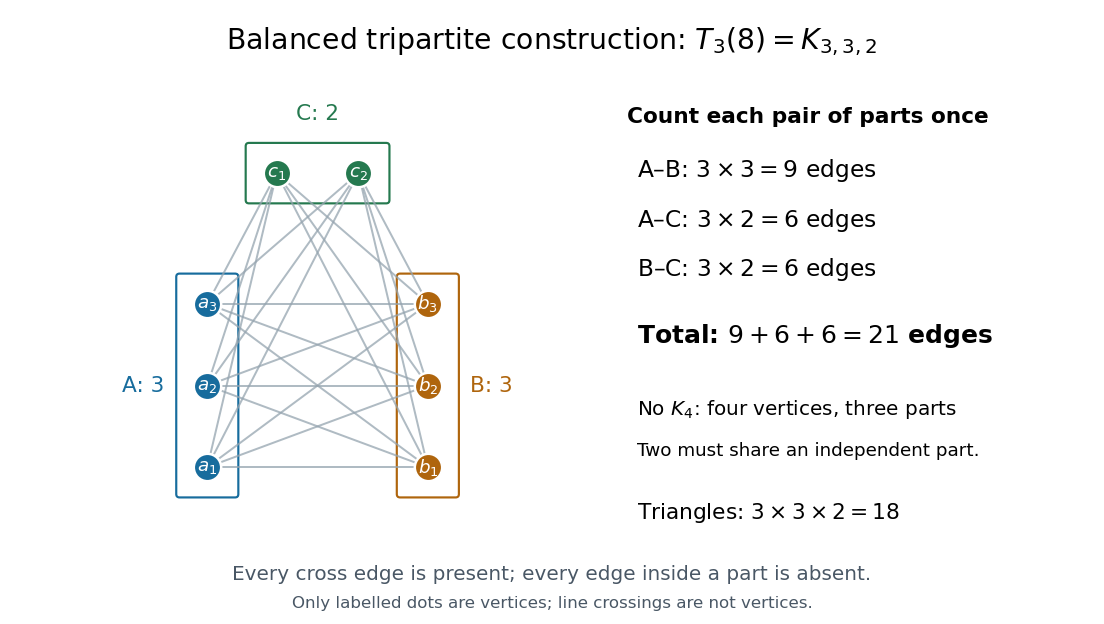
In this example, the independent sets are , and . Count the edges between each pair of parts:Any four vertices put at least two in the same independent set, by the pigeonhole principle, so they cannot form . Conversely, every choice of one vertex from each part is a triangle in a graph, giving triangles in a graph. Clique exclusion here does not mean triangle-free.
For the exact count, Euclidean division writes , where uses the floor function and is the remainder, with . There are parts of size and of size . For any part sizes summing to , count cross edges by expanding the square:ThereforeFor , we have , giving . The Quadratic Turan edge bound gives instead: the exact correction subtracts .
Balancing is an integer optimization with a simple reason. If two part sizes satisfy , moving one vertex from the larger part to the smaller decreases their contribution to the sum of squares byso it increases the edge count by . For eight vertices, parts give edges; moving one vertex produces and edges. The most symmetric permitted sizes pack the most cross edges, which explains the sharp construction in Turán's theorem.


The Turán graph, denoted as \( T(n, r) \), is a specific type of graph used in extremal graph theory, which studies the conditions under which graphs contain certain subgraphs. The Turán graph is designed to be the largest \( K_{r+1} \)-free graph (a graph that does not contain a complete subgraph of \( r+1 \) vertices) with \( n \) vertices.
New to topics? Read the docs here!