Two-level address translation
ID: two-level-address-translation

Choose an original teaching model with 16-bit virtual addresses, 16-bit physical addresses, and 256-byte memory pages and page frames. The eight high bits identify a virtual memory page; divide these into two four-bit indices. The eight low bits are the offset within the memory page. Thus each page table has 16 entries: the root selects a lower-level page table, and that table selects a data page frame. Every page table entry is four bytes, including its reference and flags. These are chosen model parameters, not a hardware entry encoding.
For a virtual address , extract the root index , lower-level index , and offset by Euclidean division:Here is the floor function and denotes the remainder in Euclidean division. Each index ranges from 0 to 15, and ranges from 0 to 255. In hexadecimal, virtual address
0x1234 splits into , , and ; its binary numeral system representation is 0001 | 0010 | 00110100.Fix the requested operation to be a one-byte user read. Assume both table nodes and the data page frame are resident, table reads are allowed, and no mapping changes during the page table walk. The model requires presence at both levels and takes the set intersection of the two entries' read, write, execute, and user-access permissions. This is an explicit memory protection rule for this model; Sv39 page tables use different rules. The root's physical address is
0x8000; the relevant entries are:| Record | Physical address of record | Reference held in the page table entry | Presence and permissions |
|---|---|---|---|
| Root entry 1 | 0x8000 + 1*4 = 0x8004 | Lower-level table at 0x9000 | Present; user; read/write; no execute |
| Lower-level entry 2 | 0x9000 + 2*4 = 0x9008 | Data page frame 0x07, base 0x0700 | Present; user; read-only; no execute |
The first lookup obtains a table reference, not the final data physical address. The second lookup obtains page frame number 7. Both entries permit a user read, so the original offset is added to the data page frame base:The page table walk therefore reads records at
0x8004 and 0x9008, then the requested read accesses data at 0x0734. All three are distinct physical addresses. These are two dependent table lookups followed by one data access, not a claim of three accesses to main computer memory: a memory cache can satisfy table lookups, and cached intermediate translations can skip them.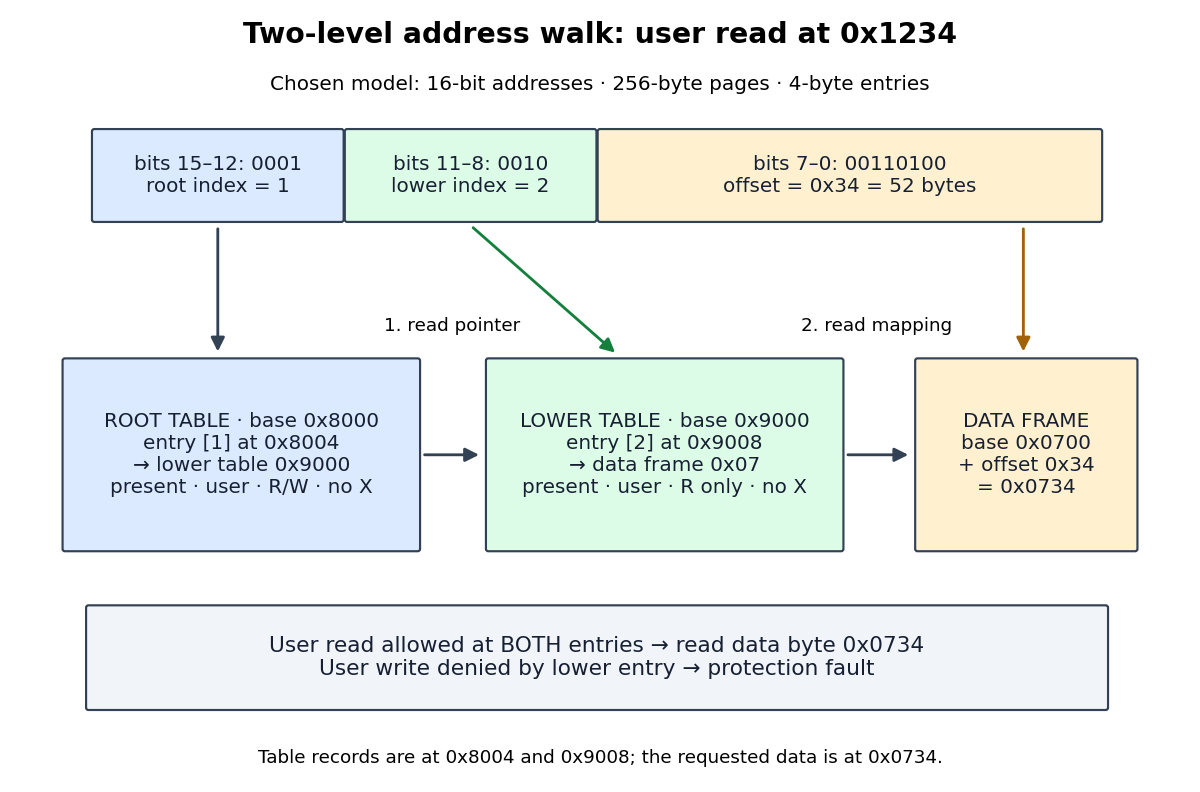

Under the same memory protection rule, a user write at
0x1234 fails because lower-level entry 2 denies writes, even though root entry 1 allows them. Clearing either entry's presence flag also prevents the access. An absent root entry stops the page table walk before any lower-level lookup. A page fault then requires the operating system to determine whether a permitted mapping needs storage or the access is invalid; absence alone does not establish demand paging eligibility.With an empty translation lookaside buffer, the permitted read causes a TLB miss and this successful page table walk, with no page fault. If the resulting mapping and permissions are cached for the current address space, a later read at
0x1235 can use a TLB hit to reach 0x0735. A later write can cause a protection page fault on a TLB hit because the cached mapping remains read-only. Assume cached permissions are current; changing them requires the architecture's prescribed invalidation. A TLB miss describes a missing cached translation, while a page fault describes an access that cannot proceed under the translation or protection rules. [ref]Page Tables by The kernel development community. MMU, TLB, and Page Faults: translation caches, page walks, and faults for missing or forbidden mappings
New to topics? Read the docs here!