
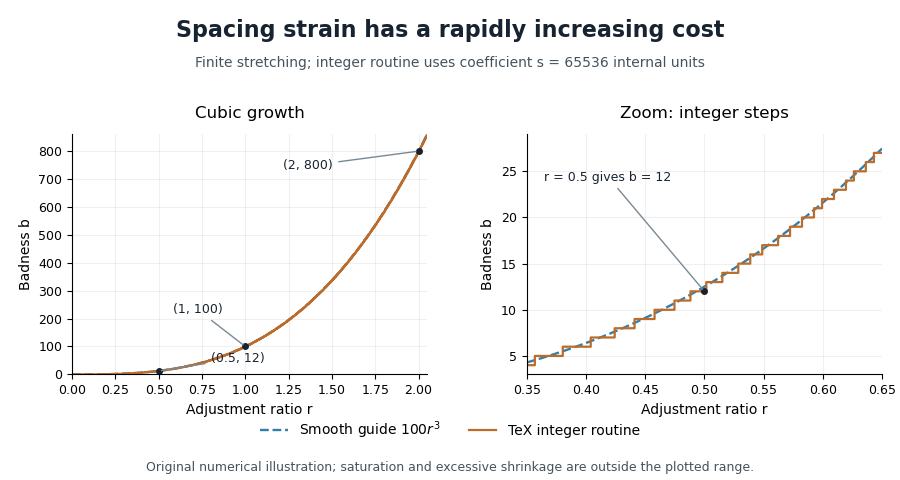
Typesetting badness scores the spacing strain needed to fit a line. For ordinary finite stretch or permitted finite shrink, a useful smooth guide iswhere is the line adjustment ratio. Doubling the required ratio multiplies this guide by eight, so it strongly penalizes large adjustments. The convex function on nonnegative ratios rewards more evenly distributed spacing strain.
TeX computes an integer approximation with saturation rather than evaluating that real-valued expression exactly. With stretch coefficient in the routine's internal units, excess widths give ratios and routine outputs . In particular, the first differs from the smooth guide value 12.5.[ref]
TeX source code by Donald E. Knuth. badness(t,s): fixed-point approximation, rounding constants and inf_bad; chosen input values evaluated directly
Cubic spacing cost and integer typesetting badness
. Original calculation comparing the smooth guide with TeX's badness routine at chosen finite stretch coefficients. The right panel enlarges the integer steps near r=0.5. All plotted ratios describe stretching. Details.
The sentinel 10000 represents saturated badness in the routine. Excessive shrinking is tested separately in paragraph breaking; higher-order stretch has its own treatment. A paragraph's typesetting demerits also include typesetting penalties and possible neighbour-dependent charges, so choosing solely by badness can miss the best layout.
New to topics? Read the docs here!