Wire-address position model
ID: wire-address-position-model

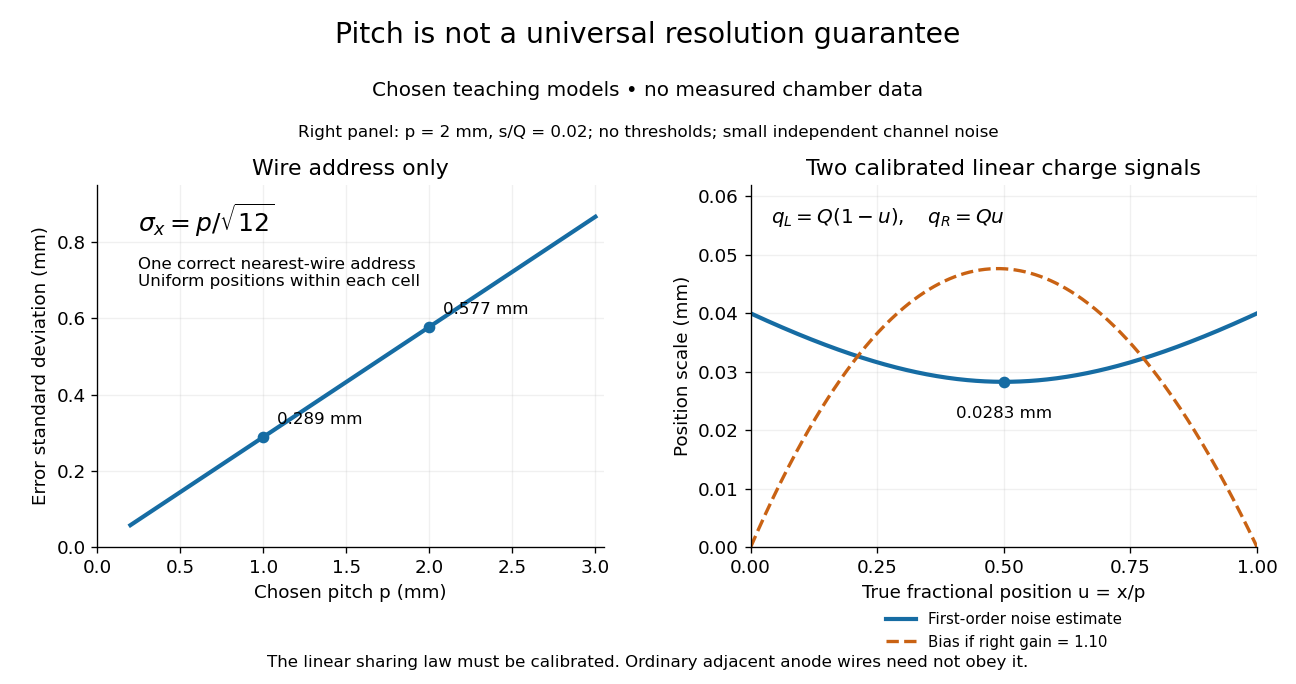
Consider an original idealized track reconstruction model. Let equally spaced wires have positions and assign each event to the nearest wire, reporting . Assume exactly one correct wire address, perfect detection efficiency, exact wire positions and a uniform distribution of true positions within each cell. These assumptions explicitly exclude missed pulses, false addresses and several unresolved tracks.
Writing , the measurement error is , with uniform on . Symmetry gives zero expected value. Its variance and standard deviation follow by integration:For chosen wire pitches and this gives and respectively. These are model standard deviations, not measured chamber spatial resolutions. The largest possible absolute error in this model is , which is a different quantity.
A useful subtlety is that the formula depends on the illumination. For an unresolved pencil beam fixed at , every reconstructed position is . The repeated estimates have zero variance, but every error is . Small repeat-to-repeat spread can coexist with a biased position. The uniform-cell result therefore cannot be transferred to an arbitrary beam profile or detector selection.
The wire address supplies one transverse coordinate in this model. Combining several separated measurements supports track reconstruction; a single address does not specify a complete trajectory. If two charged particles enter the same cell during one accepted interval, an address-only record can be identical to that from one particle. No reconstruction of that record can recover the lost multiplicity without additional information.

New to topics? Read the docs here!