Articles by others on the same topic

The Cavendish experiment makes the attraction predicted by Newton's law of universal gravitation measurable between laboratory masses. Two small test masses hang at the ends of a horizontal rod in a Cavendish torsion balance; nearby larger source masses exert a tiny torque. A thin suspension fiber supplies an opposing torque as it twists. Measuring its twist and calibrating its torsion constant lets an experimenter infer the gravitational force and, in a modern analysis, the gravitational constant. [ref]
https://www.phys.uconn.edu/~hamilton/phys258/N/cav.pdf. University of Connecticut, Physics 258/259, The Cavendish Experiment: apparatus and equations of motion, pp. 1–3
The beautiful feature is that the two horizontal forces can cancel as vectors while their torques add. The instrument converts weak attraction into a rotation, with sensitivity set by the fiber's torsion constant. Earth's much larger downward gravitational weight is supported by the suspension rather than supplying the intended torque about its vertical axis. A laboratory measurement can therefore probe the same Newtonian gravitational field that governs the two-body problem.
Henry Cavendish's original paper was Experiments to determine the Density of the Earth, published in Philosophical Transactions, volume 88 (1798), pp. 469–526, and read on 21 June 1798. On p. 469 he credits John Michell with the apparatus idea and explains that Michell died before using it; the instrument reached Cavendish through Francis John Hyde Wollaston. Cavendish's stated aim was Earth's mean mass density. Calling the experiment a determination of the gravitational constant is a modern interpretation, not Cavendish's own formulation of his result. [ref]
https://www.famaf.unc.edu.ar/~wolf/FisicaI/Phil.%20Trans.%20R.%20Soc.%20Lond.-1798-Cavendish-rstl.1798.0022.pdf. Cavendish (1798), original paper, opening p. 469; DOI 10.1098/rstl.1798.0022
The connection between Earth's mean mass density and the gravitational constant follows in a spherical, nonrotating model of Earth. With Earth mass , radius , and surface gravitational acceleration , the spherical shell theorem and Newton's law of universal gravitation giveThus a local comparison of gravitational attractions, together with knowledge of Earth's size and surface gravitational acceleration, reaches a property of the entire planet. These are modern equations explaining the connection, not equations quoted from Cavendish's paper.
For a worked example, use an explicitly simplified two-near-pair model. Each test point mass is , each source point mass is , and each lever arm is , so the rod's full length is . Neglect the rod's mass. At zero twist put the test masses at and , and the sources at and . Here is the near-pair center separation. Ignore each source's attraction on the test mass at the opposite end. Evaluate the two near-pair forces at zero twist and treat their torque as constant for a small twist, requiring . This is a teaching model, not a precision model of Cavendish's actual apparatus.
By Newton's law of universal gravitation, each retained force has magnitude . The left force points down and the right force points up. Using torque about the suspension axis, both contributions are counterclockwise when viewed from above:The net retained horizontal force is zero, yet the net torque is positive. Moving the sources to and reverses both forces and hence the torque. In a real apparatus, the opposite source also attracts each test mass; that correction is explicitly included in the university derivation. [ref]
https://www.phys.uconn.edu/~hamilton/phys258/N/cav.pdf. University of Connecticut, The Cavendish Experiment, p. 2, equation (1): opposite-source correction
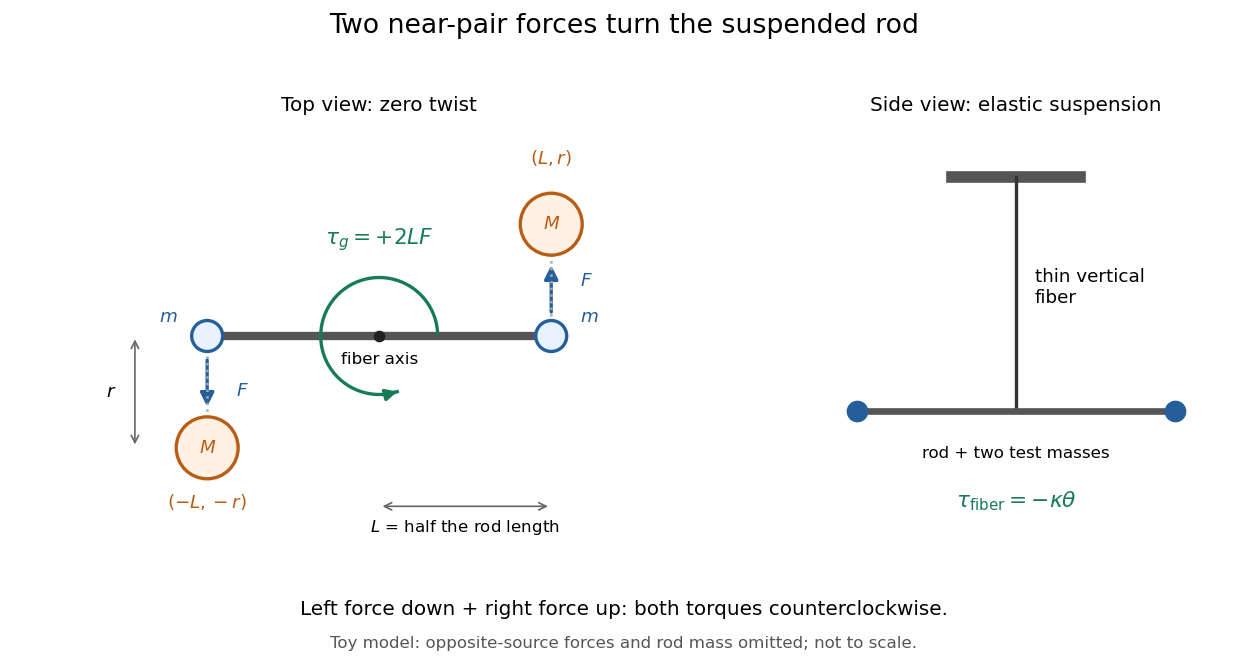
For illustrative parameters, take , , , , and torsion constant . Use , the central value in NIST's 2022 CODATA table; that table gives standard uncertainty . This is an input for the example, not a measurement made with these assumed parameters. [ref]This sub-nanonewton force produces a measurable twist in the Cavendish torsion balance. The displayed digits make the toy calculation reproducible; they do not describe experimental precision.


The Cavendish experiment, conducted by British scientist Henry Cavendish in 1797-1798, was a groundbreaking experiment that measured the force of gravitational attraction between masses. The primary aim of the experiment was to determine the density of the Earth, but it also yielded the first accurate measurement of the gravitational constant (G), which is fundamental to our understanding of gravitational interactions.