Here's an example of the chain rule. Suppose we want to calculate:So we have:and so:Therefore the final result is:
Articles by others on the same topic


The chain rule calculates the derivative of a function composition by combining local rates. If the inner function is differentiable at and the outer function is differentiable at , thenThe evaluation point matters: the outer derivative is evaluated at the inner output , not at . A small input change first scales by ; the resulting intermediate change then scales by . In terms of linear approximations, composing those two local descriptions multiplies their scale factors. [ref]
https://openstax.org/books/calculus-volume-1/pages/3-6-the-chain-rule. OpenStax, Calculus Volume 1: statement and proof of the chain rule
.For example, applies a quadratic function and then the sine. With and , the chain rule givesHere all angles are in radians. Near , increasing the input by changes by about , and the sine changes by about times that intermediate change. For , the linear approximation predicts an output increase of ; the exact increase is .
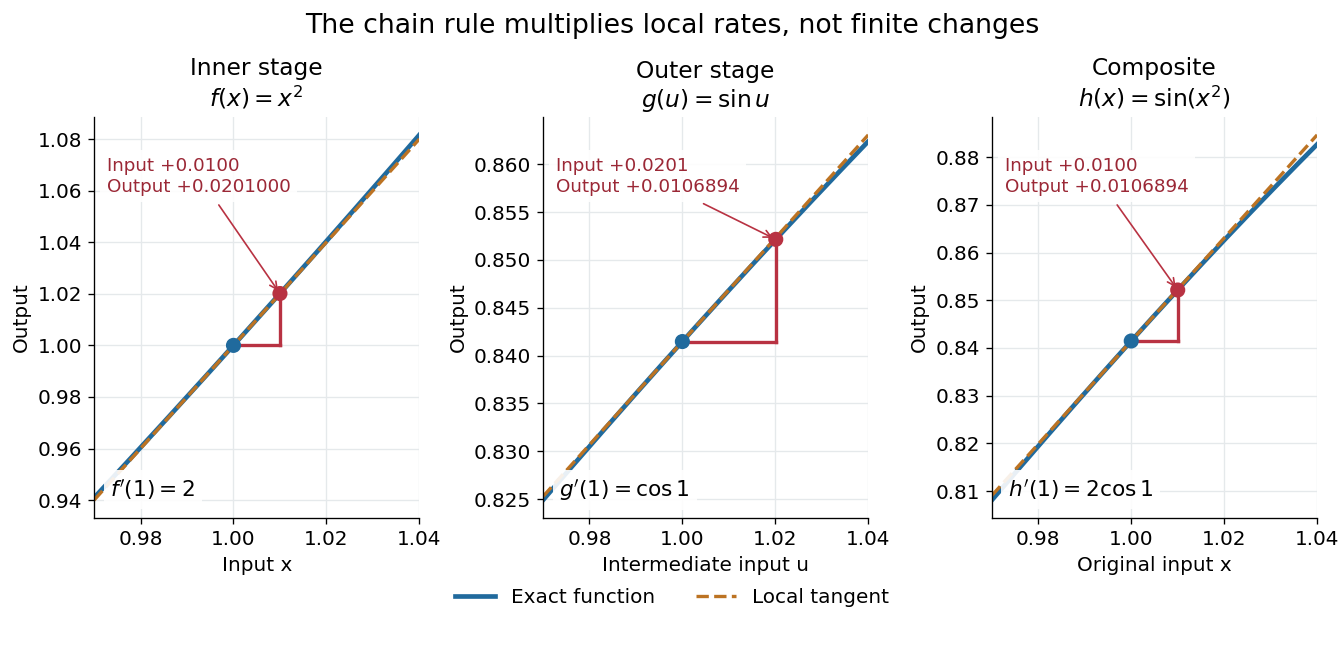
The same rule handles several nested stages. For , the derivative is under the corresponding differentiability assumptions. Writing each intermediate output prevents evaluating a derivative at the wrong stage. It also makes the chain rule useful for propagating sensitivities through a mathematical model, where one measured quantity influences another through several transformations.
For a quick proof idea, replace near by its linear approximation, then replace near by its linear approximation. The composite leading term is their product; differentiability ensures the remaining error is smaller than the original input change. This argument still applies when , so the informal cancellation should not be interpreted as division by a possibly zero finite change. The hypotheses are sufficient, but are not necessary for every composite to be differentiable, as the nondifferentiable inner function with a differentiable nondegenerate composite example shows.