CGI comms are communication mechanisms which show a login page in HTML and use HTTPS to communicate with the server securely. I.e., like any proper modern website would.
But because this was some early and weird version of the web, HTTPS was not yet in widespread use, so the main website was in HTTP and the HTTPS was used only for the login page in a subdomain. Also the login page would have a .cgi extension. This makes them particularly fingerprintable.
Some subdomain names were much more common than others, further helping to fingerprint:But various other more creative subdomains also exist which were linked to the website theme itself, e.g.:
secure.: most commonssl.: also common
musical-fortune.net has a backstage.musical-fortune.net.This is what allowed us to find our first two non Reuters ranges! Section "secure subdomain search on 2013 DNS Census"
At first we had some doubt if this was the actual comms mechanism or not, partly because CGI comms are relatively rare. But because:it feels overwhelmingly likely that they are.
The CGI responses on altworldnews.com, commercialspacedesign.com, fgnl.net, globalnewsbulletin.com and round-trip-travel.com use a
document.write in a hardcoded <script> to insert the login form, a probable obfuscation measure.If we could do a crawl search for
secure.*com/cgi-bin/*.cgi that might be a good enough fingerprint, maybe even *.*com/cgi-bin/*.cgi. Edit: it is not perfect, but we kind of did it: Section "secure subdomain search on 2013 DNS Census".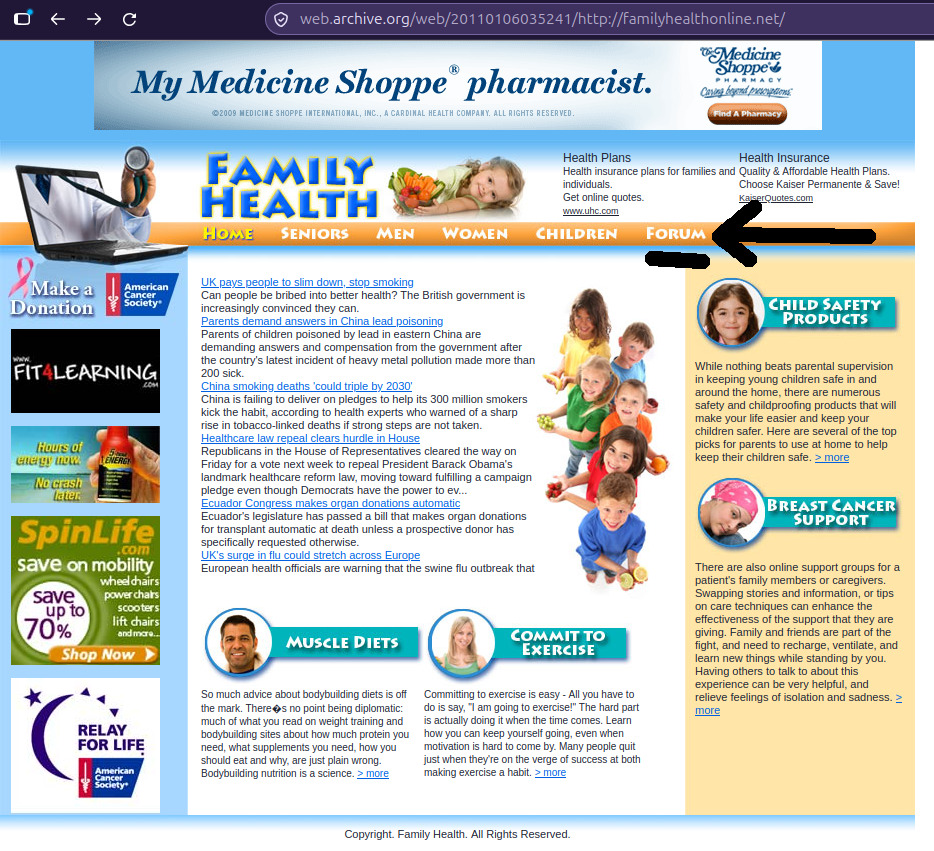
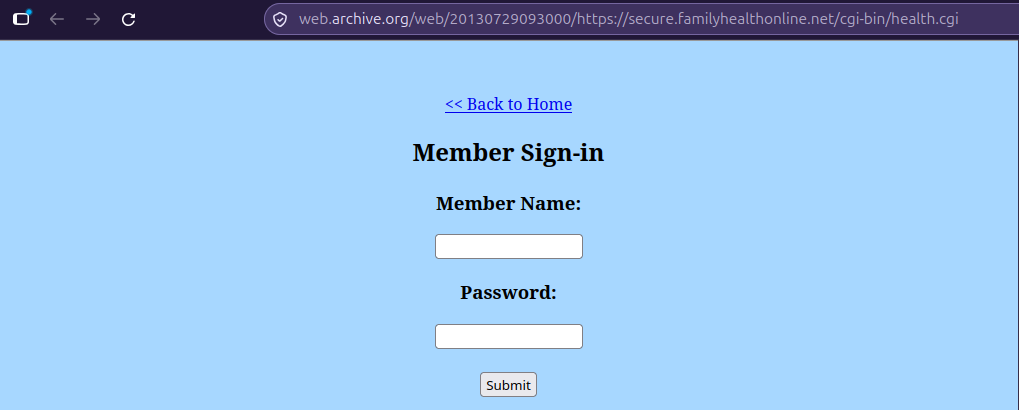
2013 Wayback Machine archive of secure.familyhealthonline.net/cgi-bin/health.cgi
. This is one of the few preserved CGI login pages that we have. Details.Later on, we've also come across some stylistic hits in IP ranges with apparent slight variations of the CGI comms pattern:
Since these are so rare, it is still a bit hard to classify them for sure, but they are of great interest no doubt, as as we start to notice these patterns more tend to come if it is a thing.
The CGI comms websites contain the only occurrence of HTTPS, so it might open up the door for a certificate fingerprint as proposed by user joelcollinsdc at: news.ycombinator.com/item?id=36280801!
crt.sh appears to be a good way to look into this:They all appear to use either of:
- backstage.musical-fortune.net:
- clients.smart-travel-consultant.com
- members.it-proonline.com
- members.metanewsdaily.com
- miembros.todosperuahora.com
- secure.altworldnews.com
- secure.driversinternationalgolf.com
- secure.freshtechonline.com
- secure.globalnewsbulletin.com
- secure.negativeaperture.com
- secure.riskandrewardnews.com
- secure.theworld-news.net
- secure.topbillingsite.com
- secure.worldnewsandent.com
- ssl.beyondnetworknews.com
- ssl.newtechfrontier.com
- www.businessexchangetoday.com
- heal.conquermstoday.com
- Go Daddy
- Thawte DV SSL CA
- Starfield Technologies, Inc.
crt.sh/?q=globalnewsbulletin.com has a hit to: crt.sh/?id=774803. With login we can see: search.censys.io/certificates/5078bce356a8f8590205ae45350b27f58f4ac04478ed47a389a55b539065cee8. Issued by www.thawte.com/repository/index.html. No hits for certificates with same public key: search.censys.io/search?resource=certificates&q=parsed.subject_key_info.fingerprint_sha256%3A+714b4a3e8b2f555d230a92c943ced4f34b709b39ed590a6a230e520c273705af or any other "same" queries though.
Let's try another one for secure.altworldnews.com: search.censys.io/certificates/e88f8db87414401fd00728db39a7698d874dbe1ae9d88b01c675105fabf69b94. Nope, no direct mega hits here either.
This project was originally done before Ciro Santilli knew how to use Codex and before Codex was so incredibly strong. Codex 6 Astra High can now just disassemble, deobfuscate and datamine the fuck out of such binaries, so we asked it to. Unfortunately it couldn't really find anything mind blowing, but here are the results anyways.
The analysis scripts is: jar.py and it should be pointed to a dump directory of the websites such as CIA 2010 websites dump. The analysis below was done as of commit b9eb31618c36421133e4875bc1cd7d7ac7763a32.
These scripts produce TODO directories.
The JARs are obfuscated, and Codex believes that they have a strong match to the Zelix KlassMaster commercial obfuscator, and points to this analysis from 2006: www.exploit-db.com/docs/english/13132-cracking-string-encryption-in-java-obfuscated-bytecode.pdf. Zelix appears to have the exact same string obfucation mechanism quat1024 had already previously manually discovered. It stores all string literals XOR'ed with 5 consecutive key bytes along:It then injects an encoder/decoder for this which transforms the strings as neede at runtime. The bytes are present in each class file itself.
switch (character_index % 5):
    case 0: key = 47
    case 1: key = 41
    case 2: key = 84
    case 3: key = 35
default: key = 14Zelix is made by an Australian company based in Narraweena and its website proudly sates:Shame they failed to list the CIA in their users list! I'm goign to ping them actually.
Leading Java Obfuscator since 1997
Here are the best small finds:
- some of the
resource/resources.binfiles contain the string:Codex could not find any clear public reference to what#Auto-generated Starbuck client config fileStarbuckis, which leads to the tentalizing possibility that could be an internal project codename. Though the possibility that it is just some internal of some public tool so obscure that even the web has lost track of it is also too strong to refute entirely.This string is part of a more complete key/value pair, e.g.dryterrainnews.comcontains:which would be present insie the- key:
Config.properties.old.1277148810409 - value:
#Auto-generated Starbuck client config file: Mon Jun 21 14:32:02 ACT 2010
#Mon Jun 21 14:32:02 ACT 2010
ServerURL=http\\://www.dryterrainnews.com/cgi-bin/nigeria.cgi
EncSharedSecret=7A948986EF08B9DDF800E5AF229EC118D4F8AD9609C5080CBF2AB92397C2A9B8
KeyE=1F7D7
KeyN=67D8EA7BF935232E55863DCED7A279F701B7492316FE96F15D00C983CBFDB93B97D35898FA8928FA13D4F320E2B62D1B92F08FA8692F7D043EC197E2857D2A540E01A2529AEB232EB386917992B80D5CADE283D2C4E8DCBF682704F419E29D013FFCF33D9A1BC94E4AA469058BB508EEE1D654CF9FC4B89977A13FA33CDEDAED
resource/resources.binfile present inside the JAR.resource/resources.binfile is encrypted with International Data Encryption Algorithm, a public symmetric encryption standard. However the key is itself present inside the JAR as an XOR obfuscated string.The decrypted form ofresource/resources.binis a custom key value format which Codex could not identify the source of for the life in it. The JAR contains a decoder for it in its code.There are different alternative filenames for this file all with the same format, each one with a single key used across all JARs, and each JAR having at most one of them:Applet.properties: key:7A5DAEC4029C91ED, occurances: 76. Exmaple:aryannews.net/20101229122727/headlines.jarpathc/b/b/Applet.properties.Client.properties: key:60A514D96C19F93C, occurances: 33. Example:activegaminginfo.com/20110202130304/gaming.jarpatha/b/f/Client.propertiesresource/resources.bin: key:0C5C45F2EC3C2A63, occurances: 45. Example:all-sport-headlines.com/20110207144821/birdie.jarpathresource/resources.bin
The remaining JARs use other arrangements:applet.configs, XOR-obfuscated as a single string: 35. Example:aeronet-news.com/20110202122601/aeronet.jarpatha/a/b/applet.configs. Deobfuscated content might look like:#Applet Properties #Thu Aug 19 08:19:00 AMT 2010 RequestKey.UserData.1.IsQuery=set Applet.BundleSize=1 ResponseKey.UserData.0.Size=85bw.properties, ZIP-packed: 30. Example:casanewsnow.com/20110201184918/casanews.jarpathb/a/bw.properties- none of these configuration resources: 9. Example:
factorforcenews.com/20110202125321/factorspeed.jar
- key:
- there's a certain number of timestamps present in the Jars. Although these could have been faked, it feels unlikey that they were. The sources of those include:
- ZIP modification time of each file
- Certificate validity dates:
- present in 37 JARs. Example:
latinamericanewsbeat.com/20100513191045/today.jarfileMETA-INF/INLINE.DSA - timezone: yes
- format: Standard binary
PKCS#7/X.509encoding unencrypted, readable with OpenSSL - usage: these are part of a standard JAR public key signatures scheme, which if a key trusted would have given greater execution priviledges to the JAR. They are validly signed but self signed as you might expect...
- present in 37 JARs. Example:
applet.configs: comment timestamp as shown aboveStarbuckclient comment as shown above:#Auto-generated Starbuck client config file: Mon Jun 21 14:32:02 ACT 2010- config key backup Unix epoch milliseconds key, e.g. the
1277148810409inConfig.properties.old.1277148810409. So their editing tool kept backups as they were editing it, which is a small OPSEC defect.
We've dumped timestamp data to: github.com/cirosantilli/media/blob/master/cia-2010-covert-communication-websites/jar/dates.csv No dates of interest was found in the SWF.
Many of the timestamps present are much older than the earliest archive we have for each website, suggesting that they were around for much longer. E.g. 2005-06-02.
The operators worked exclusively on weekdays, and much less on Friday than other days of the week, lol they're only human:92% of timestamps fall in conventional work hours between 08:00 and 18:00, so it was not a James Bond work through the clock to save the world business.
   Day          Configuration timestamps    Distinct configuration calendar dates    ZIP timestamps¹
   Monday                             21                                       11                 72
   Tuesday                            12                                       10                 78
   Wednesday                          16                                       13                 72
   Thursday                           12                                       11                 72
   Friday                              5                                        5                 60
   Saturday                            0                                        0                  0
Sunday 0 0 0The timezones are:
Timezone label    applet.configs    Backups in resources.bin    Total    Possible locations / interpretations
  EST                          9                           4       13    Eastern United States, eastern Canada, parts of the Caribbean
  EDT                          8                          11       19    Eastern United States, eastern Canada, parts of the Caribbean
  AMT                         18                           0       18    Western Brazil (Amazon Time), Armenia
  ACT                          0                          16       16    Acre in Brazil (Acre Time), Northern Territory in Australia if interpreted as Java’s short timezone ID
There are a few plausible timestamp trigram documentations with slightly different possibilities among them:
- code.googlesource.com/edge/openjdk/+/refs/heads/master/jdk/src/share/classes/java/time/ZoneId.java
- docs.oracle.com/cd/E98457_01/opera_5_6_core_help/PDFs/Time_Zones.pdf
- //android.googlesource.com/platform/libcore/+/9f08ee8977750b228382eaf9a081f4847a1e0377/jdk/src/share/classes/sun/util/resources/TimeZoneNames.java
EST an EDT are obvious, Langley. ACT is understandable, Australia, a Five Eyes country and center of US espionage is East Asia. But AMT? That one is weird.
A few sites have timestamps from multiple locations e.g.:
Site                               Labels and counts
internationalnewsworthiness.com    EDT ×2, ACT ×2
intlnewsdaily.com                  EDT ×2, ACT ×1
www.myhealthlibrary.net            EDT ×1, ACT ×5
www.todaysnewsreports.net          EDT ×1, ACT ×3
Codex also spots the interesting case of myhealthlibrary on April 11, 2011 backup sequence, configuration comments go:which in UTC would jump backwards in time if ACT actually means Australia...but would work neatly if ACT is actualy Acre Standard time at UTC-4. Damn, Brazilian operators???Codex also comments:Too strong. Too strong.
09:18:19 ACT
13:59:13 EDT
13:34:14 ACT
13:43:20 ACT
14:17:18 ACT09:18:19 ACT April 10, 23:48:19
13:59:13 EDT April 11, 17:59:13
13:34:14 ACT April 11, 04:04:14
13:43:20 ACT April 11, 04:13:20
14:17:18 ACT April 11, 04:47:1814:18:19 UTC
17:59:13 UTC
18:34:14 UTC
18:43:20 UTC
19:17:18 UTCWe have identified a few different types of JAR UIs. The underlying implementation/obfuscation details might be different across them, probably templated to mix and match, but the final UIs are the same.
This UI style contains just a password box, no username, suggesting each domain was intended for a single agent at a time.
Sample domain: europeannewsflash.com.
Reverse engineered code: github.com/cirosantilli/media/blob/master/cia-2010-covert-communication-websites/comms-reverse/jar/password-only
We have noticed that we don't know the IP range for most websites which use this UI style are, suggesting that they are possibly older and predate a massive later IP range rollout.
The server endpoint for this type of comms is
/cgi-bin/*.cgi, e.g. http://www.europeannewsflash.com/cgi-bin/home.cgi, except for technologypresstoday.com which uses /cgi/technology.cgi.Client code contains it's own litle RSA public key cryptography implementation. It uses it to establish a shared key, and encrypts further communication with AES. The exact same algorithm is used for JS comms, suggesting a shared design.
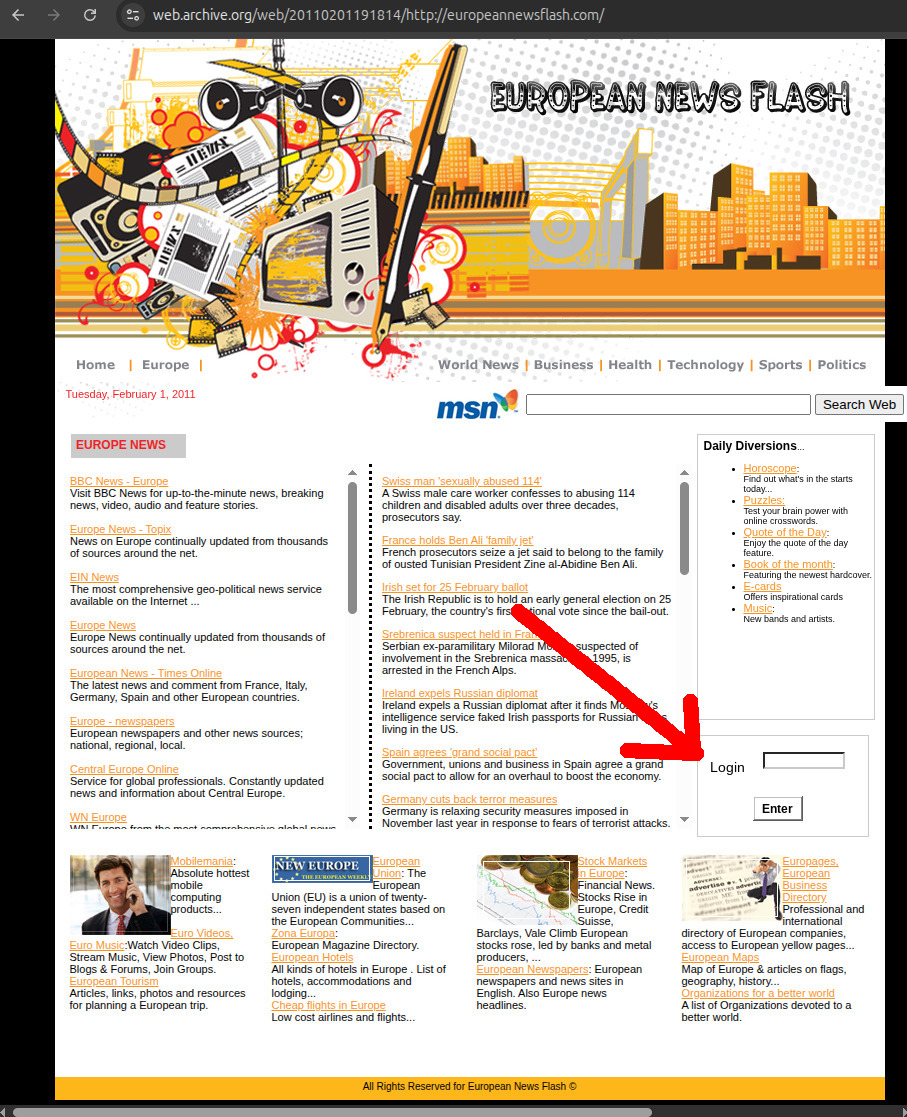
2011 Wayback Machine archive of europeannewsflash.com on Chromium 156 with CheerpJ enabled and login prompt highlighted
. With CheerpJ extension it is possible to see the password field directly on the Wayback Machine without the need for the server reconstruction. The MSN Web Search going out of bounds is just some incompatibility between old web and Chromium 156. Firefox 158 shows it better. But the CherrpJ extension is not available on Firefox. Details.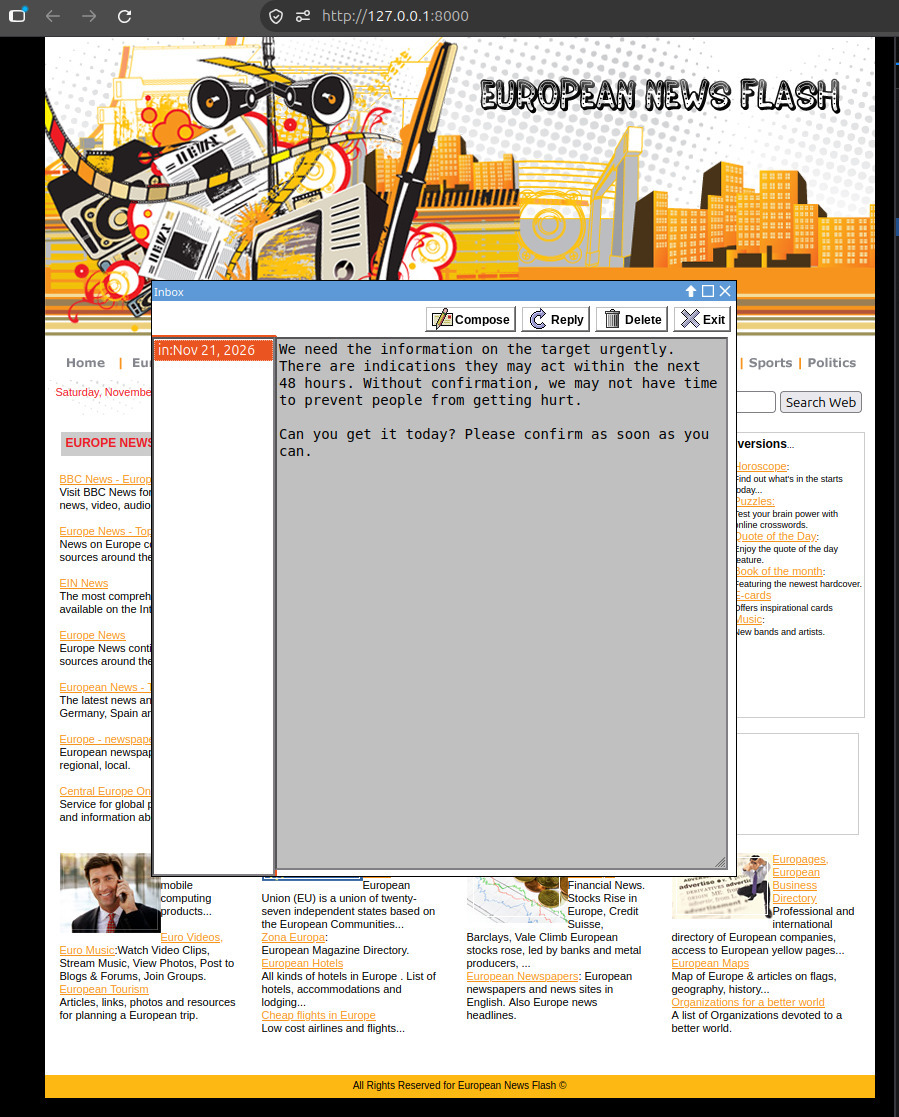
Comms reconstruction of europeannewsflash.com showing the messaging interface
. Details.Actually opening up the comms interface requires of course the server to reply, so this is only possible in reconstruction.
There was no live refresh, you'd need to refresh the page and re-login to see your handler messages.
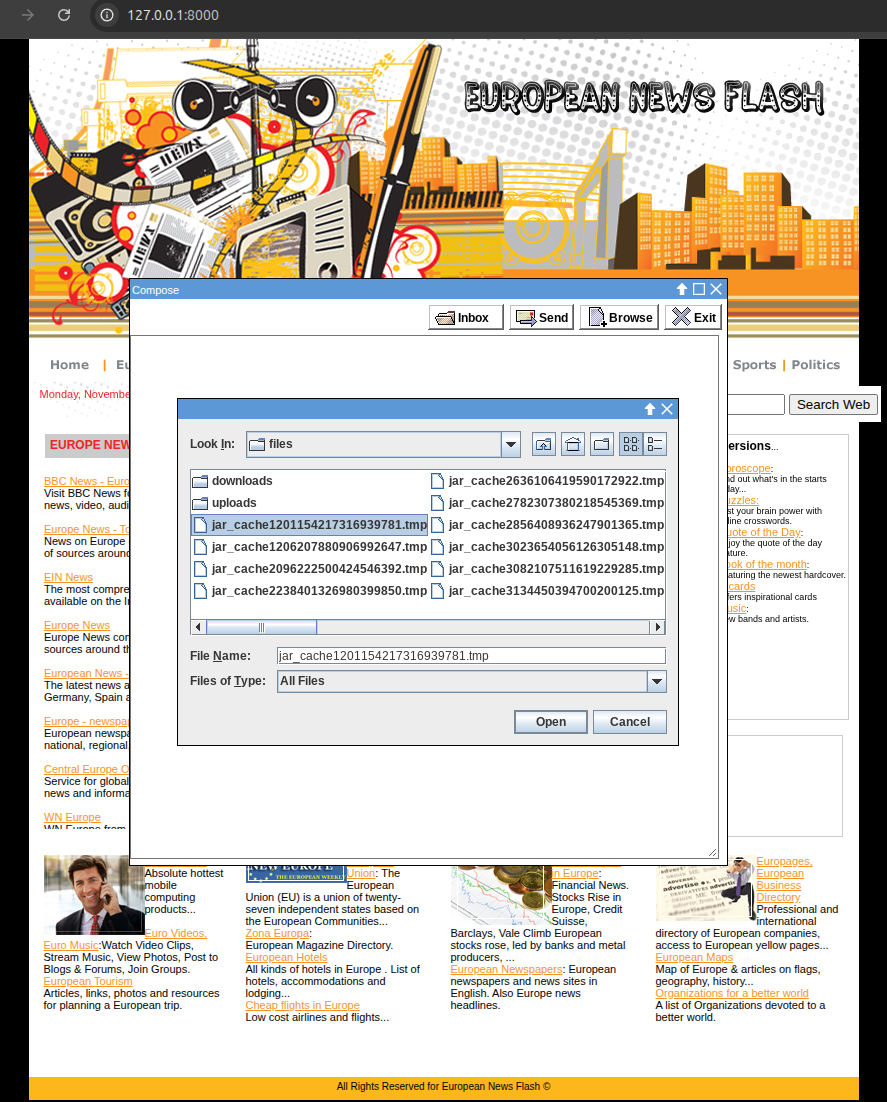
Comms reconstruction of europeannewsflash.com showing the file selector UI
. Nice feature! Very handy to upload those top secret PDFs back to the CIA. Note that in our comms reconstruction, file upload only works if you run CheerpJ as the browser extension, --cheerpj injection does not work well for it. Details.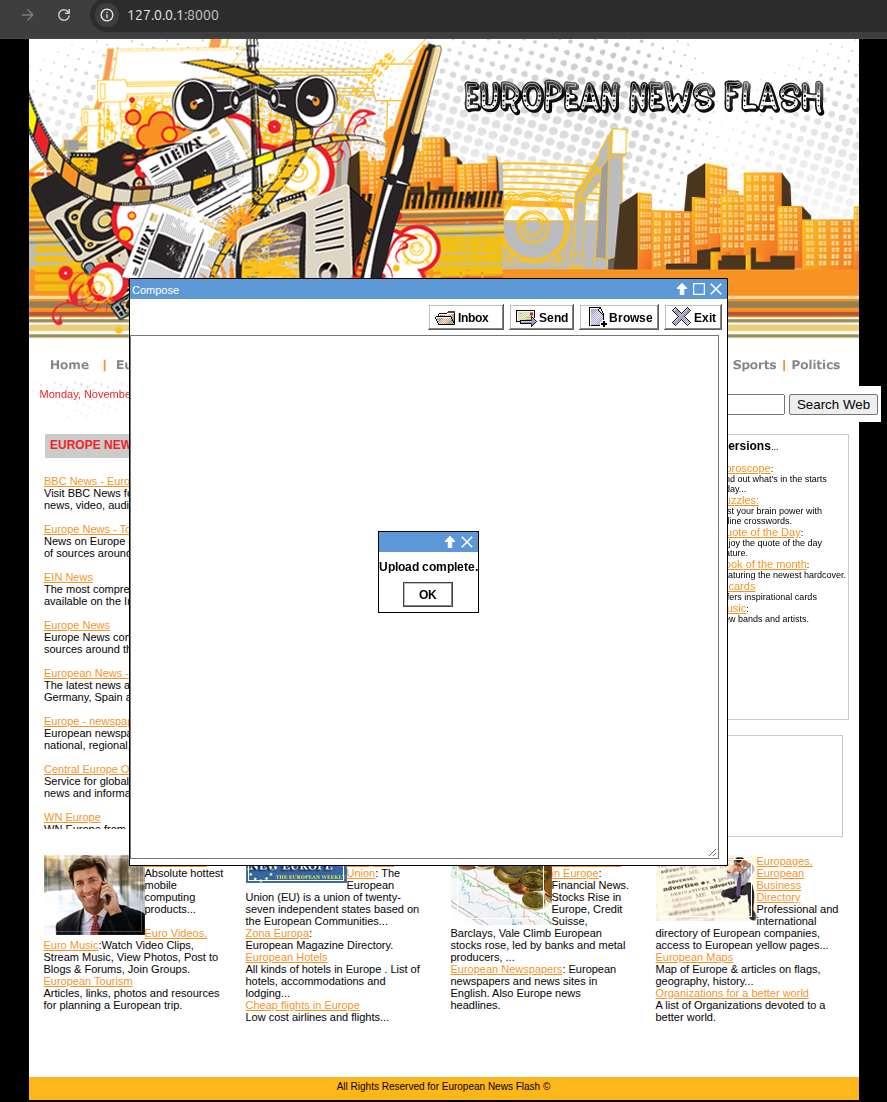
Comms reconstruction of europeannewsflash.com showing the "Upload complete" message
. This message shows up after you finish either sending a message or making a file upload. Details.
Comms reconstruction of europeannewsflash.com showing the "Bad login. Refresh the page to try again" message
. This message shows if your stupid asset puts the wrong password in the password box. Details.Sample domain: mynepalnews.com.
Reverse engineered code: github.com/cirosantilli/media/blob/master/cia-2010-covert-communication-websites/comms-reverse/jar/slideshow
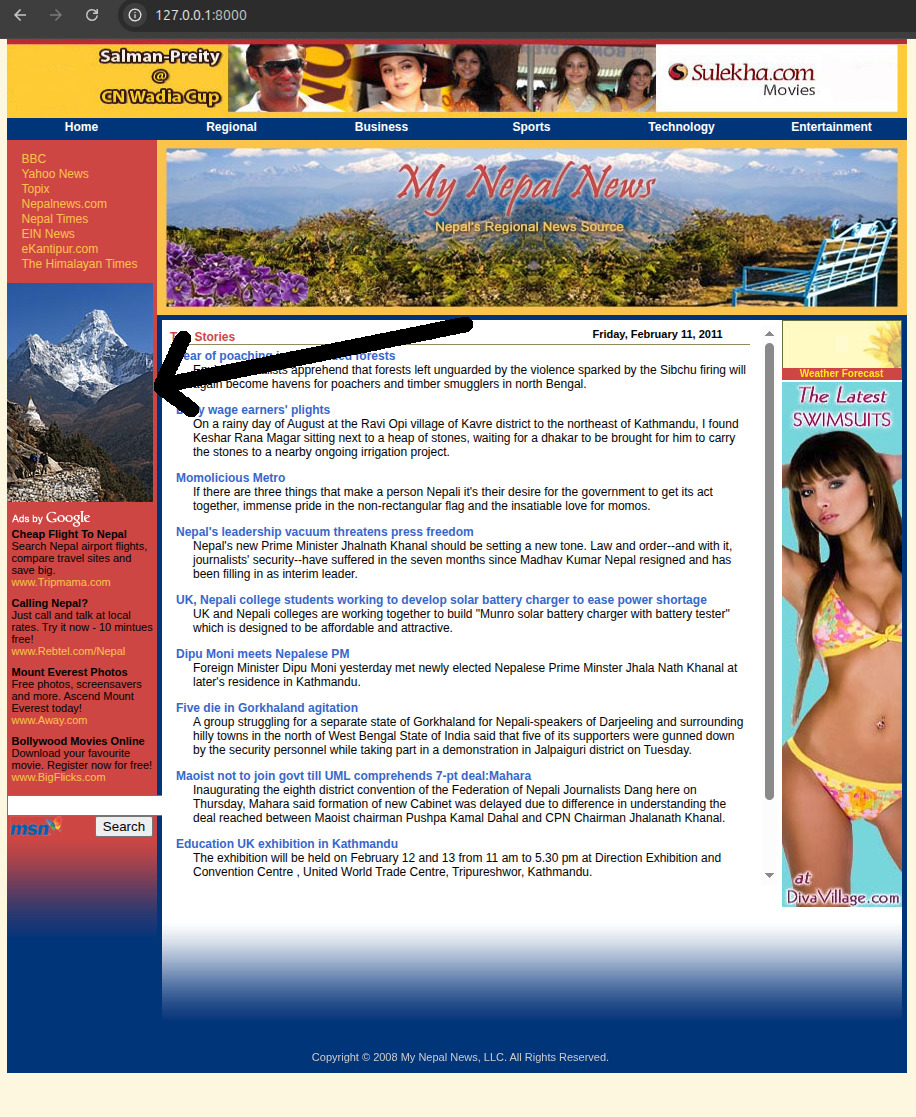


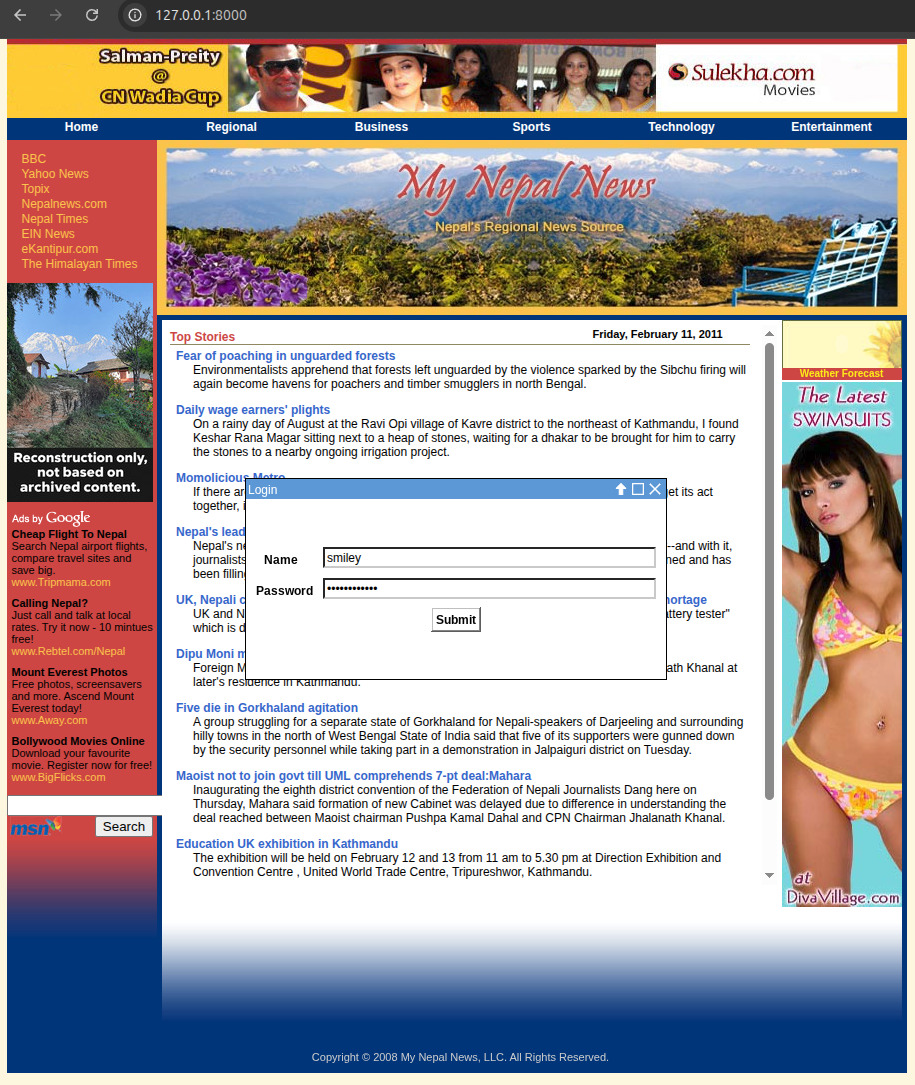
Comms reconstruction of mynepalnews.com showing the login prompt
. For this particular page, it opens after the user enters q, azsx and p. Codex managed to brute force reverse the azsx password for this one from it hash embedded in the archived JAR, so we are certain this is the actual sequence the asset would have entered. Such "geometric QWERTY keyboard mnemonics" were common. Details.
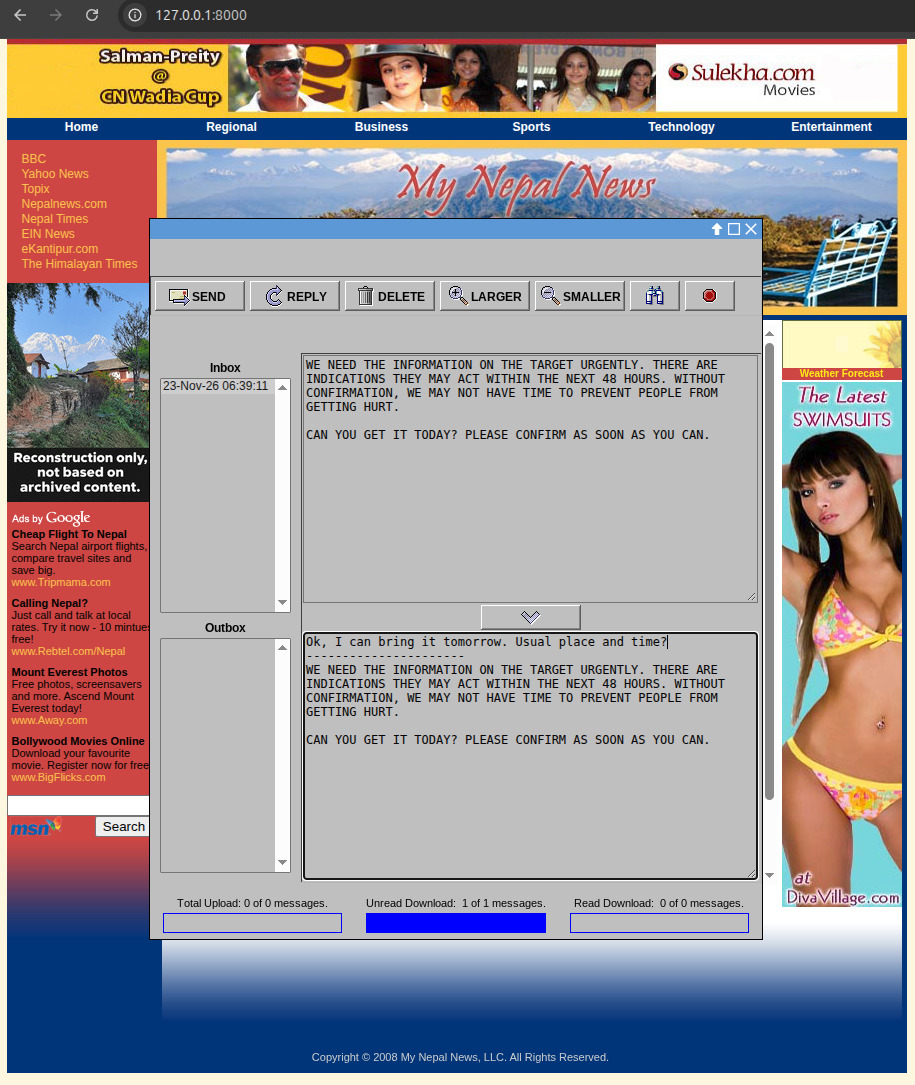
Comms reconstruction of mynepalnews.com showing the messaging interface
. This UI style had some cute elements, such as progress meters and the font size selectors. Despite progress meters, Codex' reverse engineering suggests it could not live load replies, you'd still have to refresh the page and re-login to see messages. Details.
The first image is present in the JAR and is accurate. Further images would have been sent from the server and have been lost to time. We have picked random-on-theme images for our comms reconstructions of some sites, while on the rest the server just keeps sending the same archived image so you don't see anything move.
The login fields are not visible in this type of UI, and require specific sequence of keypresses to be revealed. It's a cute piece of spycraft. The sequence is as follows, hardcoded and different for each JAR:The password cannot contain the start of finish characters.
- click the applet with the mouse to give it focus. Focus seems to be given by default when you open the page on most cases, but can be lost if you click elsewhere.
- enter one start character stored plaintext in the JAR
- enter a usually short UI-reveal password. This is stored hashed in the JAR for the majority of JARs. But because they are so short Codex manged to brute-force guess many of them correctly, we maintain a list at jar-activation-sequences.json.
- the finish key is stored in plaintext in the JAR
Once the correct sequence is entered, the login UI opens after about 10 seconds on our default reconstruction settings. This slowness is a result of the fact that according to Codex' reverse engineering, the UI open speed is be tied to the speed at which the slideshow switches slides. The server tells the client for how long each slide should show. Therefore this speed can be configured by a server sent parameter, exposed as
--jar-slideshow-interval on our reconstruction.py CLI, but our default felt like a reasonable slideshow update rate.This UI seems not to open directly on Wayback Machine even with the CheerpJ browser extension with due to some browser incompatibility issues which increased browser security measures.
The slideshow works by the app sending POST requests to
/servlet/release on the server each time it wants a new slide. The server then replies by sending back an application/octet-stream which sends back a Java-specific object serialization format as bytes. Therefore it is overwhelminly likely that this type of server was written in Java.The following command:produces a quick list of the currently known UI reveal passwords with a classification by Codex:
jq -r 'map(select(.sequence != "")) | group_by(.mnemonic_type)[] | (.[0].mnemonic_type | if . == "" then "unknown" else . end), (group_by([.domain, .sequence])[] | " \((.[0].domain + (" " * 34))[:34])\(.[0].sequence)\(if length > 1 then " (\(length) captures)" else "" end)"), ""' jar-activation-sequences.json (blank)
cellar-notes.com uknh
first-tee-golf.com csi
hydradraco.com ile
newsandsportscentral.com lac
the-news-scene.com mar
world-news-online.net adrlatlcc
domain_fragment
golf-on-holiday.com golf
half-court.net court
rastadirect.net rasta
geometric
awfaoi.org bnm
dk-dcinvestment.com oiu
echessnews.com vbg
inews-today.com zxcv
mynepalnews.com azsx
segomonews.com poki
sunrise-news.com njki
zafernews.com asd
number
azerinews.org 5768
lesummumdelafinance.com 346
newsintheworld-ru.com 63274
willtoworship.com 0818
number_pattern
fightwithoutrules.com 384756
lanoticiasdehoyelinforme.com 234
sixty2media.com 135
stara-turistick.com 864579
repeated_key
avoilurefixe.com 000
newsandweathersource.com sss (2 captures)
word_en
bcenews.com begin
dayenews.com tree
everythingcricket.org ball
financial-crisis-news.com start
icwb-news.com bill
mynewscheck.com football
news-and-sports.com lotus
newsresolution.net start
ride-captain.com tuna
stickshiftnews.com cars
theentertainbiz.com airforce
themvconnection.com fruit
whirlybirdinflight.com helo
word_es
surya-brahma.com chequeThe server endpoint path for this type of website is of the form
/servlet/*, e.g. /servlet/release for mynepalnews.com.Much like for JAR password-only , this setup also uses public key encryption, but it instead uses Diffie-Hellman key exchange and then encrypt further communcation with International Data Encryption Algorithm.
Four of the 78 known slideshow domains have 376 classes: especialesmonedas.com, half-court.net, inkfreenews.com, and segomonews.com. These four use literal activation sequences. The other 74 use hashed sequences.
This is a small variant of JAR slideshow. Rather than a slideshow of images, it just shows one scrolling message. Other than that, the UI is identical: click applet, harcoded first char, hardcoded hashed password, hardcoded last char, then identical login prompt and UI opens.
Sample domain: 2011.
Reverse engineered code: factored out with JAR slideshow under: github.com/cirosantilli/media/blob/master/cia-2010-covert-communication-websites/comms-reverse/jar/slideshow
Comms reconstruction of inews-today.com showing the JAR scroller
. See worldofonlinenews.com and its archived
world.jar.Similar to JAR bandwidth meter but has no
bw.properties.See factorforcenews.com and its archived
factorspeed.jar.These applets use
Client.properties to configure an encrypted content channel. Some display a slideshow. The applets classified as JAR slideshow have a keyboard-activated login.See worldfinancetoday.net and its archived
slides.jar.The applet requests display content from the server and calls JavaScript on the page to update what the visitor sees. On
aeronet-news.com, applet.configs points the applet to /servlet/News and names the JavaScript callbacks. The page's preld function preloads images and divchck inserts the supplied HTML into a page element.See aeronet-news.com and its archived
aeronet.jar.The most advanced reverse engineering effort prior to Codex had been by GitHub user quat1024, an undergratuate student at Ohio State University, Minecraft modding extraordinaire and furry afficionado. Minecraft is written in Java, which may partly explains his Java skills.He managed to deobfuscate the strings present inthe JARs using Enigma, possibly github.com/FabricMC/Enigma, a Java reverse engineering tool. Cool findings on web.archive.org/web/20110208072027/http://newsupdatesite.com/update.jar include:
.
./c
./c/b
./c/b/b.class
./c/b/c.class
./c/b/d.class
./c/b/a
./c/b/a/a.class
./c/b/a/b.class
./c/b/a/c.class
./c/b/a/d.class
./c/a
./c/a/a.class
./c/a/b.class
./c/a/c.class
./b
./b/a
./b/a/a
./b/a/a/e.class
./b/a/a/f.class
./b/a/a/a.class
./b/a/a/b.class
./b/a/a/g.class
./b/a/a/c.class
./b/a/a/d.class
./META-INF
./META-INF/MANIFEST.MF
./a
./a/cre
./a/a
./a/a/b
./a/a/b/a.class
./a/a/a
./a/a/a/e.class
./a/a/a/applet.configs
./a/a/a/b
./a/a/a/b/e.class
./a/a/a/b/f.class
./a/a/a/b/b.class
./a/a/a/b/g.class
./a/a/a/b/c.class
./a/a/a/b/d.class
./a/a/a/b/a
./a/a/a/b/a/a.class
./a/a/a/b/a/b.class
./a/a/a/b/a/c.class
./a/a/a/c.class
./a/a/a/d.class
./a/a/a/a
./a/a/a/a/a.class./META-INF/MANIFEST.MFManifest-Version: 1.0
Ant-Version: Apache Ant 1.7.1
Created-By: 1.5.0_17-b04 (Sun Microsystems Inc.)web.archive.org/web/20110207204640/http://flyingtimeline.com/aircraft.jar is very similar looking.
META-INF/MANIFEST.MF is identical:Manifest-Version: 1.0
Ant-Version: Apache Ant 1.7.1
Created-By: 1.5.0_17-b04 (Sun Microsystems Inc.)web.archive.org/web/20110202185659/http://differentviewtoday.com/bwm.jar is a bit different with tree:and:
META-INF/MANIFEST.MF
a/a.class
b/a/a/a.class
b/a/a/b.class
b/a/a/c.class
b/a/b/a.class
b/a/b/b.class
b/a/b/c.class
b/a/b/d.class
b/a/b/e.class
b/a/bw.properties
b/a/c.class
c/a/a/a.class
c/a/a/b.class
c/a/a/c.class
c/a/a/d.class
c/a/b.class
c/a/c.class
c/a/d.class
c/a/e.class
c/b/a.class
c/b/b.class
c/b/c.classMETA-INF/MANIFEST.MF
Manifest-Version: 1.0
Ant-Version: Apache Ant 1.6.5
Created-By: 1.5.0_12-b04 (Sun Microsystems Inc.)This is the only type of JS comms which we are able to properly do a usable comms reconstruction of, because it contains all the client UI code nicely archived. The other types, JS polling XML and JS polling TXT receive their UI from the server, so we will never know how they looked like exactly.
Sample domain in English: classymotors.net.
Sample domain with an archived login button: iranfootballsource.com. This is the only domain so far which has an archived login OK button image, here a world cup. We see from this that the button is was intended to be just an image. Other archives so far just show the
img alt fallback value as text, but it is just an archival limitation.This type of JS comms uses the exact same encryption algorithm as JAR password-only , embedded into the JAR itself. Furthermore, it also has the same type of URL path for server endpoints
/cgi-bin/*.cgi, e.g. http://www.classymotors.net/cgi-bin/car_rate.cgi. This strongly suggests a shared origin.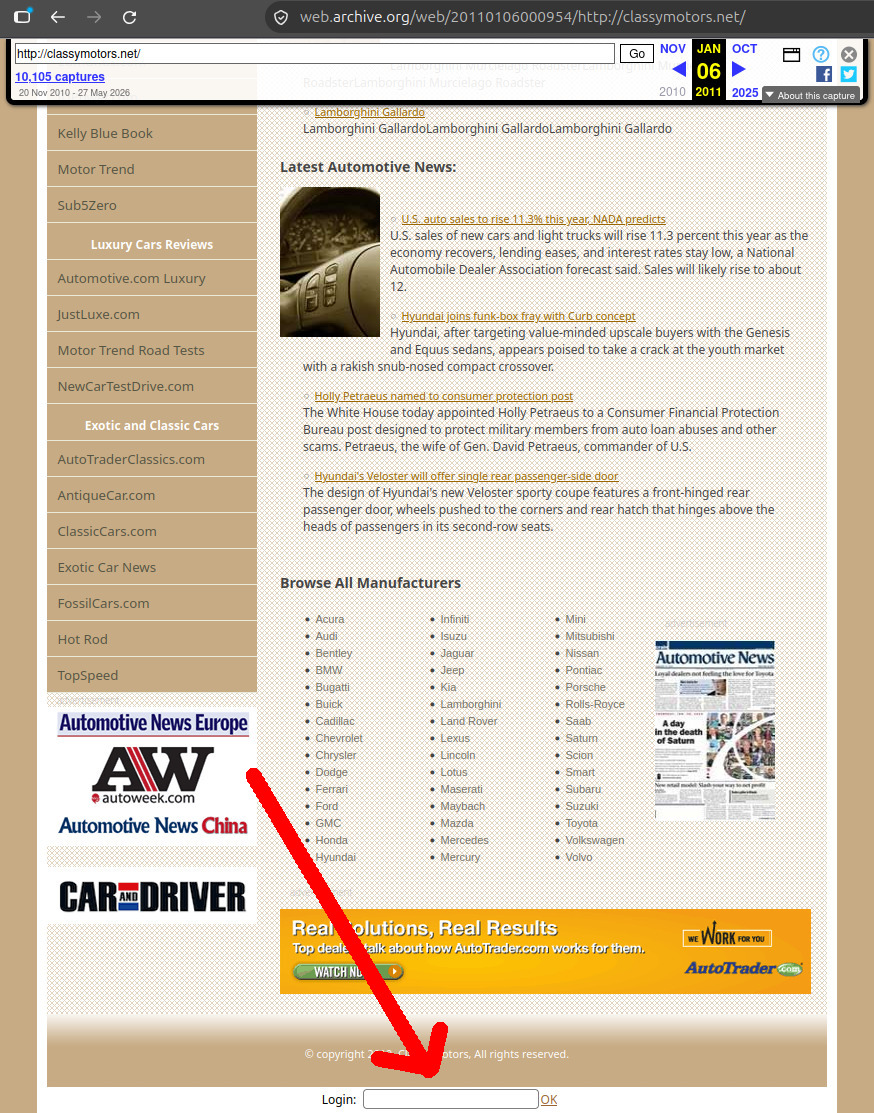

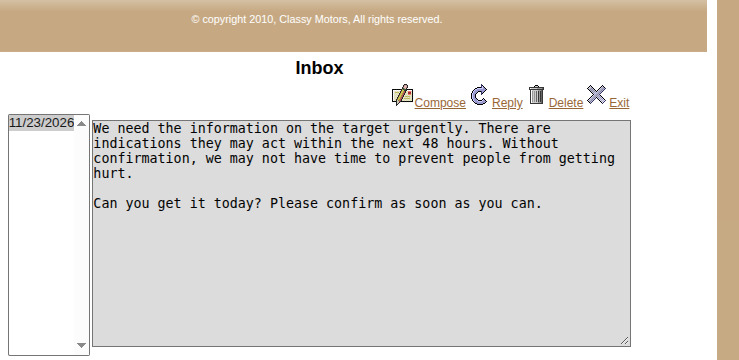
Comms reconstruction of classymotors.net showing the messaging UI
. This UI shows up after you submit the correct password. It is is remarkably similar to the JAR password-only UI, except there was no file upload. That would be asking way too much of 2010's JS capabilities! Details.
Keeping this here mostly for historical purposes. Codex just kicks ass for this.
There are two types of JavaScript found so far. The ones with SHA and the ones without. There are only 2 examples of JS with SHA:Both files start with precisely the same string:
- iraniangoals.com: web.archive.org/web/20110202091909/http://iraniangoals.com/journal.js Commented at: iraniangoals.com JavaScript reverse engineering
- iranfootballsource.com: web.archive.org/web/20110202091901/http://iranfootballsource.com/futbol.js
- kukrinews.com: web.archive.org/web/20100513094909/http://kukrinews.com/news.js
- todaysnewsandweather-ru.com: web.archive.org/web/20110207094735/http://todaysnewsandweather-ru.com/blacksea.js
var ms="\u062F\u0631\u064A\u0627\u0641\u062A\u06CC",lc="\u062A\u0647\u064A\u0647 \u0645\u062A\u0646",mn="\u0628\u0631\u062F\u0627\u0632\u0634 \u062F\u0631 \u062C\u0631\u064A\u0627\u0646 \u0627\u0633\u062A...\u0644\u0637\u0641\u0627 \u0635\u0628\u0631 \u0643\u0646\u064A\u062F",lt="\u062A\u0647\u064A\u0647 \u0645\u062A\u0646",ne="\u067E\u0627\u0633\u062E",kf="\u062E\u0631\u0648\u062C",mb="\u062D\u0630\u0641",mv="\u062F\u0631\u064A\u0627\u0641\u062A\u06CC",nt="\u0627\u0631\u0633\u0627\u0644",ig="\u062B\u0628\u062A \u063A\u0644\u0637. \u062C\u0647\u062A \u062A\u062C\u062F\u064A\u062F \u062B\u0628\u062A \u0635\u0641\u062D\u0647 \u0631\u0627 \u0628\u0627\u0632\u0622\u0648\u0631\u06CC \u06A9\u0646\u064A\u062F",hs="\u063A\u064A\u0631 \u0642\u0627\u0628\u0644 \u0627\u062C\u0631\u0627. \u062E\u0637\u0627 \u062F\u0631 \u0627\u062A\u0651\u0635\u0627\u0644",ji="\u063A\u064A\u0631 \u0642\u0627\u0628\u0644 \u0627\u062C\u0631\u0627. \u062E\u0637\u0627 \u062F\u0631 \u0627\u062A\u0651\u0635\u0627\u0644",ie="\u063A\u064A\u0631 \u0642\u0627\u0628\u0644 \u0627\u062C\u0631\u0627. \u062E\u0637\u0627 \u062F\u0631 \u0627\u062A\u0651\u0635\u0627\u0644",gc="\u0633\u0648\u0627\u0631 \u06A9\u0631\u062F\u0646 \u062A\u06A9\u0645\u064A\u0644 \u0634\u062F",gz="\u0645\u0637\u0645\u0626\u0646\u064A\u062F \u06A9\u0647 \u0645\u064A\u062E\u0648\u0627\u0647\u064A\u062F \u067E\u064A\u0627\u0645 \u0631\u0627 \u062D\u0630\u0641 \u06A9\u0646\u064A\u062F\u061F"Good fingerprint present in all of them:
throw new Error("B64 D.1");};if(at[1]==-1){throw new Error("B64 D.2");};if(at[2]==-1){if(f<ay.length){throw new Error("B64 D.3");};dg=2;}else if(at[3]==-1){if(f<ay.length){throw new Error("B64 D.4")Some reverse engineering was done at: twitter.com/hackerfantastic/status/1575505438111571969?lang=en.
Notably, the password is hardcoded and its hash is stored in the JavaScript itself. The result is then submitted back via a POST request to
/cgi-bin/goal.cgi.TODO: how is the SHA calculated? Appears to be manual.
The JavaScript of each website appears to be quite small and similarly sized. They are all minimized, but have reordered things around a bit.
For example consider: web.archive.org/web/20110202190932/http://feedsdemexicoyelmundo.com/mundo.js
First we have to know that the Wayback Machine adds some stuff before and after the original code. The actual code there starts at:and ends in:
ap={fg:['MSXML2.XMLHTTPck++;};return fu;};Further analysis would be needed.
Codex did some SWF reverse engineering for us creating the analysis script: jar.py and should be pointed to a dump directory of the websites such as CIA 2010 websites dump. The analysis below was done as of commit b9eb31618c36421133e4875bc1cd7d7ac7763a32.
Unfortunately, the SWF are much less interesting than the JAR files.
According to Codex' analysis, it is just a lean client, and doesn't even contain its own UI which seems to be downloaded from the server. As such, we will never know what it actually looked like.
One thing that they do do is to load a gallery or things that it loops through, presumably images, and loop through them automatically. These are loaded one by one from the server, and it keeps doing server requests after that.
Codex mentions that the SWF could also download another SWF to execute, which could in turn contain the login UI, possibly upon click. But it is all hidden.
A particularly interesting example is worlddispatch.net/servlet/news2. This is apparently a helper page for the SWF, but perhaps because the website became broken after it was abandoned, it was archived, and contains the following 10 bytes of a URL query string:Codex' reverse engineering identified what the parameters do exactly:
c=0&f=3424 Articles by others on the same topic
There are currently no matching articles.