Articles by others on the same topic

A nonzero vector is an eigenvector of a linear operator when for some eigenvalue . For a real vector space and , the line through is preserved: the image can point forward or backward, but cannot turn away from that line. When , the image is zero and has no direction. The zero vector is excluded because it satisfies the equation for every scalar and identifies no special direction.
Every nonzero scalar multiple of an eigenvector is an eigenvector for the same eigenvalue, since . Thus there is usually no preferred length or sign; choosing a unit vector is a convenient normalization. Eigenvectors for a fixed eigenvalue, together with zero, form its eigenspace.
For a fully computed example, consider the real symmetric matrixIts characteristic polynomial isFor , gives , so is an eigenvector. For , gives , so is an eigenvector. Direct multiplication checks both:The map stretches the line threefold and fixes the line pointwise. These eigenvectors are orthogonal because ; dividing each by gives an orthonormal basis. A general vector turns because its components along these two lines receive different scalings. For example, maps to and is not an eigenvector.
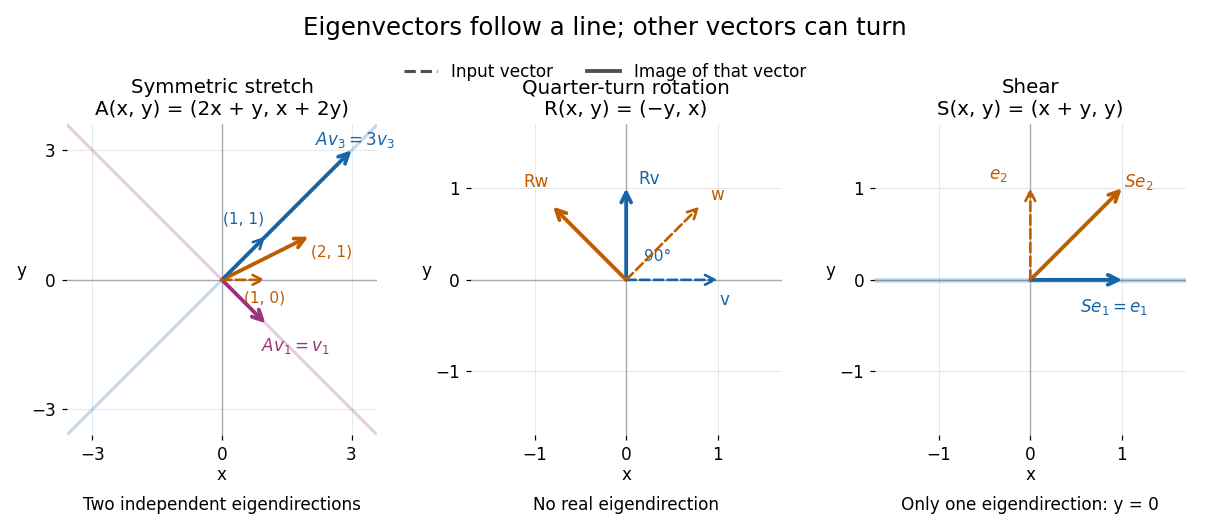

A contrasting example is the planar rotation through degrees:Every nonzero real vector turns to a perpendicular direction, so there are no real eigenvectors. Its characteristic polynomial is , which has no real roots. Over the complex numbers, however, and . The same matrix therefore has an eigenbasis in even though it has none in : the choice of field matters.