There are two cases:
- (topological) manifolds
- differential manifolds
Questions: are all compact manifolds / differential manifolds homotopic / diffeomorphic to the sphere in that dimension?
- Original problem posed, for topological manifolds.AKA: classification of compact 3-manifolds. The result turned out to be even simpler than compact 2-manifolds: there is only one, and it is equal to the 3-sphere.
- for differential manifolds:Counter examples are called exotic spheres.Totally unpredictable count table:is an open problem, there could even be infinitely many. Again, why are things more complicated in lower dimensions??
So simple!! You can either:
- cut two holes and glue a handle. This is easy to visualize as it can be embedded in : you just get a Torus, then a double torus, and so on
- cut a single hole and glue a Möbius strip in it. Keep in mind that this is possible because the Möbius strip has a single boundary just like the hole you just cut. This leads to another infinite family that starts with:
You can glue a Mobius strip into a single hole in dimension larger than 3! And it gives you a Klein bottle!
Intuitively speaking, they can be sees as the smooth surfaces in N-dimensional space (called an embedding), such that deforming them is allowed. 4-dimensions is enough to embed cover all the cases: 3 is not enough because of the Klein bottle and family.
Articles by others on the same topic

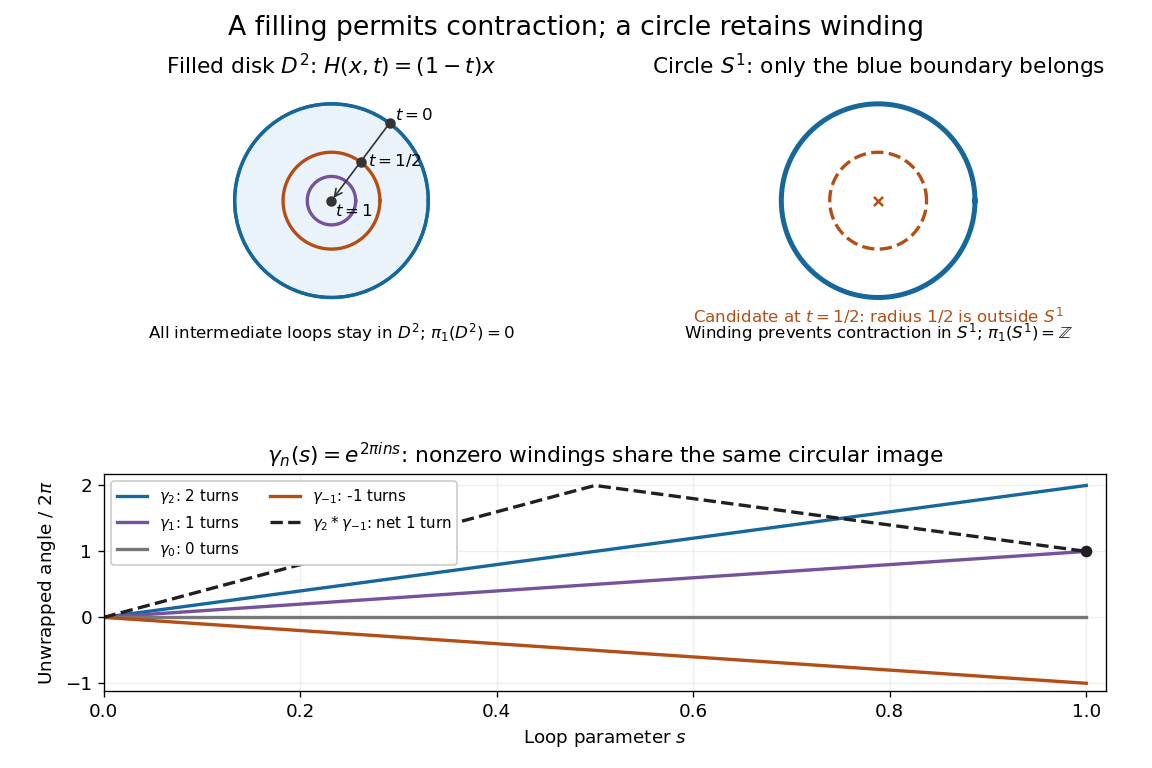
A homotopy between continuous maps is a continuous map satisfying and . Think of as time: continuity is required jointly in position and time. The target specifies where every intermediate point is allowed to go. See Hatcher, Algebraic Topology, Chapter 0, pp. 3–4.
For the filled disk , the formulais a contraction of a topological space: it starts at the identity map and ends at the constant map to zero. The Euclidean norm obeys , so the formula never leaves the disk. For , the midpoint of the deformation is , whose Euclidean norm is .
On the circle , the same formula fails: at every image has Euclidean norm , so lies outside . This checks one failed candidate; the nonzero winding number of a once-around loop proves that no contraction within the circle exists. The distinction is between allowing the filling and requiring the deformation to stay on its boundary.


Homotopy is a concept in topology, a branch of mathematics that studies the properties and structures of spaces that are preserved under continuous transformations. More specifically, homotopy provides a way to classify continuous functions between topological spaces based on their ability to be deformed into one another.