Articles by others on the same topic

Multiplication combines two factors into their product of numbers. For a natural number , is the sum of copies of ; with no copies the result is zero. This repeated-addition interpretation directly explains integer grouping, while multiplication of arbitrary real numbers also describes scaling by noninteger factors.
A rectangle of side lengths and has area . Split the second side into lengths and . The two areas are and , giving the visible identityRotating the same rectangle interchanges the sides without changing its area, explaining . These pictures illustrate distributivity and commutativity for ordinary positive numbers; matrix multiplication and other operations require their own rules.
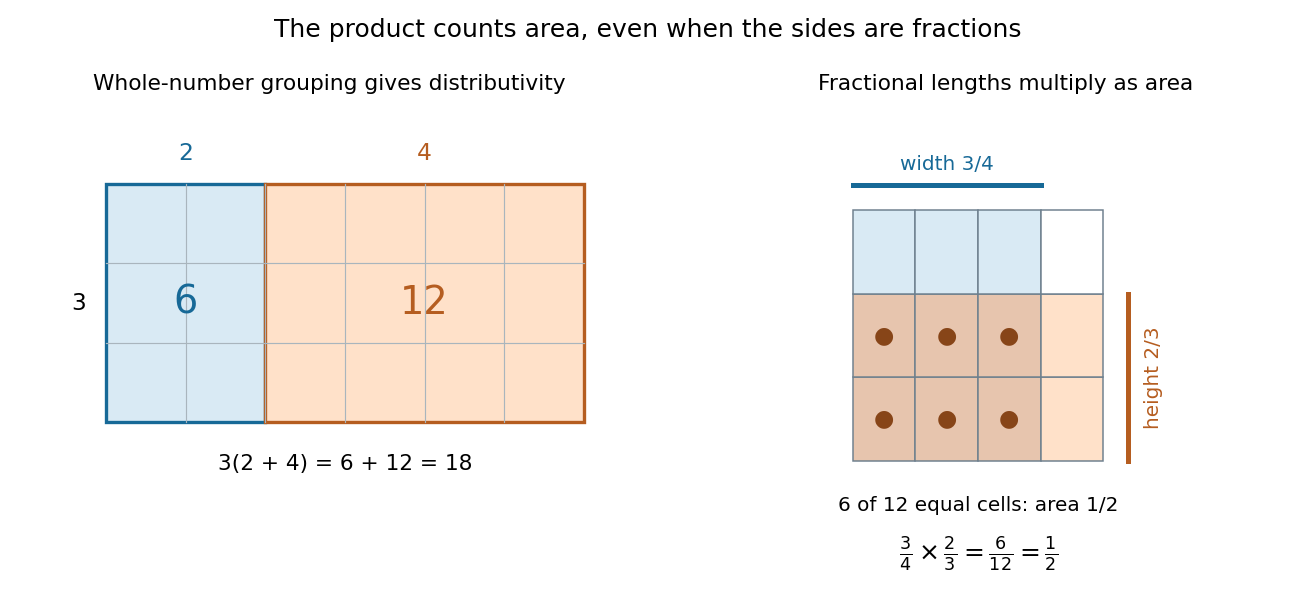
Partitioning a rectangle explains distributivity; partitioning a unit square gives an exact product of fractions
. Details. For a fractional example, take of a quantity and then of that result: the combined scale is . The two fractions are multiplicative inverses. In the unit square on the right, the overlap of a strip occupying of the width with one occupying of the height contains six of twelve equal cells. Its area is . The product stays exact even though the decimal expansion of repeats. [ref]
https://openstax.org/books/prealgebra-2e/pages/4-1-visualize-fractions. OpenStax, Prealgebra 2e, equal-part models of fractions


Multiplication is one of the four fundamental arithmetic operations in mathematics, alongside addition, subtraction, and division. It involves combining equal groups of items to find the total number of items. In simpler terms, multiplication can be thought of as repeated addition.