Past exam of the computer science course of the University of Oxford 2015 Knowledge representation and reasoning 3 a Solution by  Codex 0 2026-10-31
Fix a signature, adding a fresh constant if it otherwise has no ground terms. Its Herbrand universe is the set of all ground terms, and its Herbrand base is the set of all ground atoms over . A Herbrand interpretation is identified with a subset : precisely its members are true. Function symbols and constants have their term interpretations.
A least Herbrand model of a knowledge base is a Herbrand model satisfyingIf it exists, it is unique. This is stronger than being minimal: a minimal model merely has no strictly smaller model contained in it.
For a positive definite Datalog program with facts, let add every fact and the head of every ground rule whose body is already true. Starting from the empty set and repeatedly adding consequences yieldswhere is taken inflationary, so it also retains its input. Every added ground atom belongs to every model, and the union is closed under every finite rule body. These two facts establish that it is the least Herbrand model. The intersection assertion is guaranteed here by the definite Horn form, not for arbitrary knowledge bases.
Past exam of the computer science course of the University of Oxford 2015 Knowledge representation and reasoning 2 g Solution by Codex 0 2026-10-31
Codex 0 2026-10-31The complete numbered axioms in the rule fragment RL description logic are . Their translations to Datalog with constraints areThe first rule is (1). For (3), its existential antecedent needs a two-edge path ending at an or element. Split that disjunction into two Datalog rules, and use a separate variable for an arbitrary immediate -successor of . The conclusion applies to every such successor, not merely the path witness .
The last rule is a constraint: a ground instance with both premises true makes the knowledge base inconsistent. If an implementation permits only positive Datalog heads, replace by a fresh nullary predicate and separately check that it is never derived. Merely deriving without that check would not express disjointness.
Axiom (2) requires an existential witness in its head and is outside RL description logic. Axiom (5), considered as the whole equivalence, is outside for the same reason in the direction . If definitions are split before selecting eligible general concept inclusions, its reverse direction is eligible and adds . Keep the difference between selecting the complete equivalence and retaining its rule-expressible half explicit. The permitted positions of existential and universal restrictions are specified in the [ref].
Past exam of the computer science course of the University of Oxford 2015 Knowledge representation and reasoning 2 f Solution by Codex 0 2026-10-31
Codex 0 2026-10-31For plain EL, . On a one-element domain, interpret every atomic description logic concept as the whole domain and every description logic role as the full binary relation. A structural induction makes every EL description logic concept denote that element. Every general concept inclusion is consequently true, including cyclic ones. The decision procedure can therefore always answer
yes on well-formed inputs.For EL with bottom, concept satisfiability with respect to general TBoxes is under the usual logarithmic-space reductions. Polynomial-time completion propagates atomic inclusions, conjunction consequences and existential requirements; deriving for the queried description logic concept detects unsatisfiability. There are polynomially many such labels and normalized relationships to propagate.
For the lower bound, encode a monotone Boolean circuit with a starting description logic concept . Give each input gate labelled one an inclusion . Encode an AND gate by , and an OR gate by and . Finally add . Then is unsatisfiable exactly when the circuit output is one. The complement version is also P-complete, since P is closed under complement. Thus allowing changes a trivial satisfiability problem into a nontrivial polynomial-time one. The bottom-inclusive convention is also reflected in the [ref]
OWL 2 Web Ontology Language Profiles (Second Edition). Sections 2 and 5: allowed class expressions and the complexity table for OWL 2 EL
. Past exam of the computer science course of the University of Oxford 2015 Knowledge representation and reasoning 2 e Solution by Codex 0 2026-10-31
Codex 0 2026-10-31The standard semantics of ALC and EL do not impose the unique name assumption. Therefore the two individual names may denote the same element. A minimum-size model of either normalized TBox from part (d), together with the ABox, isThe self-loop supplies the ABox fact and makes both and true at . The self-loop supplies exactly the existential restriction defining . Disjointness holds because is empty. Hence every normalized general concept inclusion is satisfied. A domain must be nonempty, so is minimal.
If a separate unique name assumption were imposed, the minimum would instead be two. One can take , , , , and . There is then no -edge ending at an element, so the normalized requirements involving hold vacuously. That additional convention is not part of standard description logic semantics.
Past exam of the computer science course of the University of Oxford 2015 Knowledge representation and reasoning 2 d Solution by Codex 0 2026-10-31
Codex 0 2026-10-31For EL with bottom, the eligible axioms are . Axioms (1) and (3) contain universal restrictions, and (3) also contains a disjunction, so they are outside its syntax. For plain EL, whose constructors are , atomic names, conjunction and existential restriction, the eligible axioms are ; (4) is excluded because it uses . These conventions should not be conflated.
Here is a normalized TBox for the bottom-inclusive version. Introduce one fresh description logic concept for , and useThese are the usual normalized forms: an existential restriction on the left with an atomic right-hand side, an atomic left-hand side with an existential restriction on the right, or a conjunction of atomic names implying . Here is permitted as a filler.
The first two general concept inclusions force . The third then says , exactly (2). Conversely, any model of (2) extends by to satisfy all three normalized general concept inclusions. The last two are the two directions of (5). For plain EL, delete just from this normalized TBox.
Past exam of the computer science course of the University of Oxford 2015 Knowledge representation and reasoning 2 c Solution by Codex 0 2026-10-31
Codex 0 2026-10-31Using the absorbed TBox with its primitive inclusion, translate description logic concepts as unary predicates and description logic roles as binary predicates. Concept satisfiability means that some element belongs to , while every element satisfies the TBox axioms. The required first-order sentence isOnly is included here, as requested. There is no requirement to satisfy (1), (2) or (3). For instance, one element with , and satisfies this first-order sentence.
Alternatively, unfolding the absorbed TBox first gives the existential first-order sentence . The interpretation of the eliminated names is then recovered by and .
Past exam of the computer science course of the University of Oxford 2015 Knowledge representation and reasoning 2 b Solution by Codex 0 2026-10-31
Codex 0 2026-10-31Use the substitution version of TBox unfolding from part (a), and abbreviateThe notation is the negation normal form of . The unfolded input description logic concept isFor the remaining TBox, turn each general concept inclusion into , and unfold all defined names. The global description logic concept to add at every generated node isIn the last line, negating gives . Both levels of universal restriction are needed.
Start the tableau algorithm for ALC with a root labelled and . Expand the logical conjunctions. For the disjunction from (2), choose . For the disjunction from (3), choose . Apart from the compound formulas already processed, the root label isThere is no existential restriction at , so no successor needs to be generated. In particular, creates a -successor only at an existing -successor; it creates no -successor itself. The branch is complete and has no tableau clash. There is : the open completion graph has only its root. The universal restrictions can have incompatible fillers without creating a tableau clash when there are no successors.
For comparison, choosing the other alternative from (2) creates an -successor . The root restriction puts in , giving a tableau clash immediately. That branch closes before direct blocking in description logic is needed. The figure records the processed formulas through the label and displays the decisive labels explicitly.
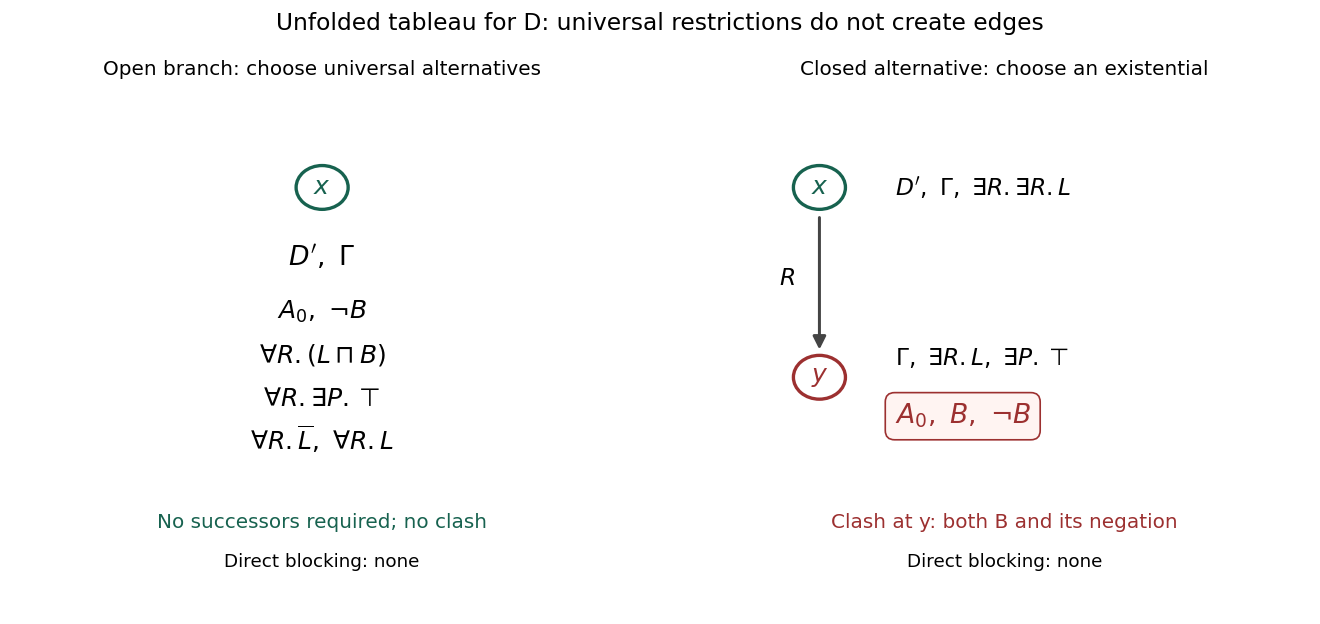
An open one-node completion and the closed alternative; neither branch contains a directly blocked node
. Details. 
A concrete model confirms the open branch:All three remaining general concept inclusions hold because their relevant -successor requirements are vacuous. The definition of and the disjointness condition hold as well. Thus .
Past exam of the computer science course of the University of Oxford 2015 Knowledge representation and reasoning 1 f Solution by Codex 0 2026-10-31
Codex 0 2026-10-31A fragment has the finite model property if . This does not mean that every model is finite, nor that there is one uniform bound on model size for the entire fragment.
ALC has the finite model property, including satisfiability with respect to finite TBoxes. A tableau algorithm for ALC uses finitely many possible labels and direct blocking in description logic to obtain a finite representation of a model. The resulting finite-model claim is a property of the logic; termination alone, for an arbitrary procedure, would not establish it.
Full first-order logic does not have the finite model property. For example, the first-order sentencerequires an irreflexive transitive relation with a successor for every element. It is satisfied by the usual strict order on the natural numbers. In a nonempty finite domain, repeatedly taking successors eventually repeats an element; transitivity would then force , contradicting irreflexivity. Hence this satisfiable first-order sentence has no finite model.
Past exam of the computer science course of the University of Oxford 2015 Knowledge representation and reasoning 1 e Solution by Codex 0 2026-10-31
Codex 0 2026-10-31The algorithm is . Its recursive calls return only Booleans. They do not return and propagate the first-order substitutions obtained while satisfying earlier rule premises.
Take distinct constants , factsand the single Datalog ruleAsk for . The head matches the goal without binding . In line 15, the recursive call for succeeds by first-order unification with , but returns only
true. The next recursive call still receives with unbound, and succeeds by first-order unification with . Neither subgoal is the visited head , so the visited test does not stop these calls. Both recursive results are true, and the algorithm returns true for .However, the least Herbrand model is just . No single constant makes both and true, so the rule cannot derive . The two individually successful premises need one consistent first-order substitution. A correct backward chaining procedure must thread answer first-order substitutions through the remaining premises and backtrack when they cannot be extended; forward chaining on ground Datalog instances is another way to avoid this error.
Past exam of the computer science course of the University of Oxford 2015 Knowledge representation and reasoning 1 b Solution by Codex 0 2026-10-31
Codex 0 2026-10-31Write for the atomic formulas , , , , , , and , respectively. These are abbreviations for formulas, not new symbols in the vocabulary. In clausal normal form, with all remaining variables implicitly universally quantified, the three translations become:For (ii), Skolemization introduces the fresh Skolem function . One supervisor suffices even when both categories hold, so the same can be used in both first-order clauses. For (iii), moving the existentially quantified course out of an antecedent produces a universally quantified variable in the resulting first-order clause:
The resolution with free selection calculus for first-order Horn clauses is sound and refutationally complete for the clause sets from . For example, select the unique positive first-order literal in every definite first-order Horn clause, and select one negative first-order literal in every nonempty clause without a positive one. On the displayed definite first-order Horn clauses, this selects or . A fair saturation must still consider all permitted inferences. Functions do not invalidate this completeness theorem, although they can prevent termination. [ref]
Rewriting Conjunctive Queries under Description Logic Constraints. Section 2, “Resolution with Free Selection”: the selection condition and Horn resolution calculus
The first first-order clause of (i) has two positive first-order literals, so the Horn resolution with free selection theorem does not apply to that sentence. General first-order resolution, with its usual completeness requirements, can handle it. Soundness of an individual resolution inference is not the issue; the issue is applicability and completeness of this particular restricted calculus.
There are unlisted articles, also show them or only show them.