
Köhler theory Created 2026-10-20 Updated 2026-10-24
The equilibrium water-vapor saturation ratio above a solution droplet combines a curvature effect, which raises vapor pressure, with dissolved-solute reduction of water activity. Its maximum defines a critical supersaturation for activation. In a dilute hygroscopicity approximation using droplet diameter and dry diameter , , where . Then . These approximate forms assume the stated diameter convention and dilute solution; composition and surface tension must be consistent.[ref]
A single parameter representation of hygroscopic growth and cloud condensation nucleus activity by M. D. Petters and S. M. Kreidenweis. Equations describing hygroscopic growth and critical activation supersaturation
M. D. Petters Created 2026-10-20 Updated 2026-11-05
M. D. Petters coauthored a single-parameter description of aerosol hygroscopic growth and cloud-condensation activity with S. M. Kreidenweis. The hygroscopicity parameter summarizes how dissolved material changes a droplet's water activity.
Combining that parameter with dry particle diameter estimates the critical supersaturation for activation. The construction connects chemical composition with droplet formation through a measurable, compact model.[ref]
A single parameter representation of hygroscopic growth and cloud condensation nucleus activity by M. D. Petters and S. M. Kreidenweis. Research topic and author attribution in the primary publication
Past exam of the atmospheric physics course of the University of Cambridge 2012 Paper 1 2 a Solution 2026-10-20
A convex liquid surface has additional surface free energy. The resulting Kelvin equation for a pure spherical water droplet isHere gamma is surface tension and is molar mass. Smaller droplets therefore need a higher environmental vapour pressure to avoid evaporating; forming pure-water embryos by homogeneous condensation has a large nucleation barrier.
An atmospheric droplet normally forms on a cloud condensation nucleus. Dissolved salt reduces water activity and hence equilibrium vapour pressure, opposing the curvature effect. Köhler theory combines them:Using the radius form, with radius and diameter conventions in Köhler activation kept distinct, the Köhler activation radius is , with . Supersaturation above this maximum activates a wet aerosol into a growing cloud droplet. Solubility, particle size and wettability determine the threshold; not every particle activates. Cooling by ascent commonly supplies the necessary modest supersaturation. [ref]
A single parameter representation of hygroscopic growth and cloud condensation nucleus activity by M. D. Petters and S. M. Kreidenweis. 2007, curvature/solute competition and critical activation; radius convention explicitly used here
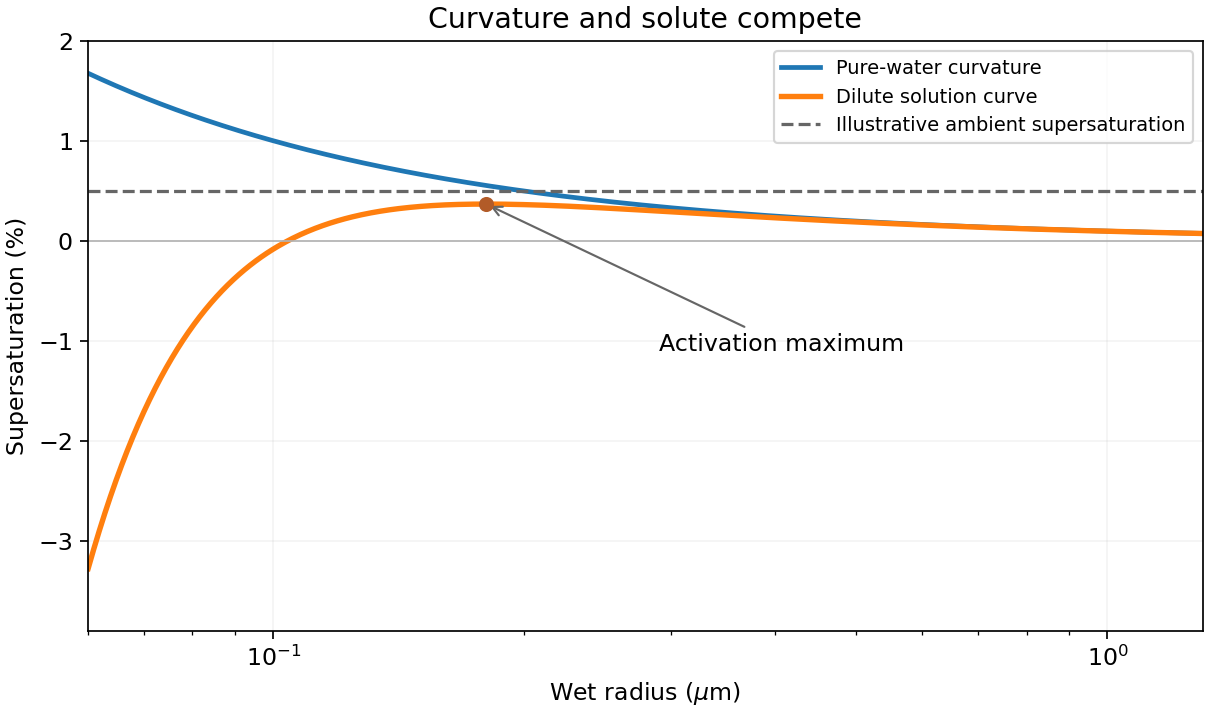
Köhler activation
. Source. Details. 
Activation as a cloud condensation nucleus depends primarily on dry particle size, soluble composition and hygroscopicity, together with wetting and surface-tension effects. In Köhler theory, droplet curvature raises the equilibrium vapor pressure, while dissolved solute lowers water activity. Each particle therefore has a critical supersaturation; larger or more hygroscopic particles generally activate at a lower value. A size distribution cannot be replaced by an undifferentiated total aerosol count.[ref]
A single parameter representation of hygroscopic growth and cloud condensation nucleus activity by M. D. Petters and S. M. Kreidenweis. Atmospheric Chemistry and Physics 7 (2007), pp. 1961–1971, dry diameter, hygroscopicity parameter and critical supersaturation
Actual droplet number also depends on the supersaturation attained in the cloud updraught. Adding particles increases competition for condensing water vapor and can lower the peak supersaturation, leaving some particles unactivated. Updraught speed, entrainment and the aerosol size distribution therefore make the number of activated droplets a nonlinear function of the available nuclei. Suitable nuclei need sufficiently low activation thresholds, and additional aerosol does not guarantee one additional droplet per particle.
S. M. Kreidenweis Created 2026-10-20 Updated 2026-11-05
S. M. Kreidenweis coauthored a hygroscopicity framework with M. D. Petters for relating aerosol water uptake to cloud-condensation activity. The framework balances solute effects with the curvature contribution to droplet vapor pressure.
A particle's dry diameter and hygroscopicity jointly affect its activation threshold. Thus two equally sized particles need not form cloud droplets at the same supersaturation if their compositions differ.[ref]
A single parameter representation of hygroscopic growth and cloud condensation nucleus activity by M. D. Petters and S. M. Kreidenweis. Research topic and author attribution in the primary publication