Surface tension is the tensile force per unit length across a line drawn in a liquid interface. For a clean interface with isotropy, it has the same value in every tangential direction: each side pulls the other along the surface, perpendicular to the line. A straight segment of length therefore transmits a force of magnitude from one interface. Here we assume constant , with fixed temperature and composition. The same coefficient measures the reversible work required to create surface area:The equality of units follows from ; the equality of the mechanical coefficients follows from the moving-rim argument below. [ref]
https://openstax.org/books/college-physics-2e/pages/11-8-cohesion-and-adhesion-in-liquids-surface-tension-and-capillary-action. OpenStax, College Physics 2e, §11.8: surface tension and the sliding wire
[ref]https://arxiv.org/html/2011.11403v2. Tomas Bohr and Bernhard Scheichl, Surface Tension and Energy Conservation in a Moving Fluid, equations (5) and (13)
For a concrete example, take an ideal flat soap film spanning a rectangular wire frame with a straight sliding rim of length . Pull the rim outwards in the plane of the film, perpendicular to the rim. Each of the film's two liquid–gas interfaces pulls the rim back towards the film with force , so the outward holding force is . The two faces are two interfaces, each with its own surface tension. With the assumed toy value and , the required force is ; one interface would contribute . This value of is a stipulated model parameter, rather than a measured value for a particular soap solution.
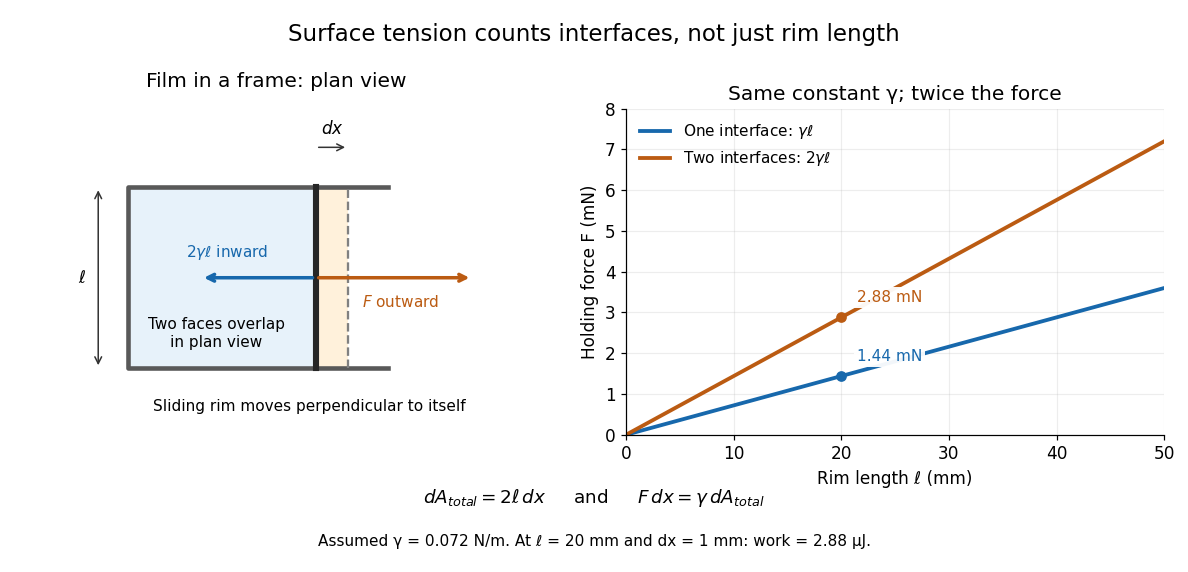
Why does an interface resist being enlarged? Its molecules have a different environment from those in the bulk liquid; changing that environment has an energy cost. In the constant-surface tension model, reducing surface area lowers surface energy. This connects an easily measured rim force to the shape of a droplet, the Young–Laplace equation for its pressure, and the restoring mechanism of capillary waves. It is useful because one coefficient links forces, energy and geometry. [ref]
https://davidtong.org/pdfs/teaching/fluid-mechanics/fluids3.pdf. David Tong, Fluid Mechanics, §4.1.3, pp. 121–123
The moving-rim argument also explains the factor of two without memorizing a special formula. An outward displacement creates surface area on each face, hence . Slow pulling without viscous dissipation requires work , giving . For one interface, the same argument gives . A surface tension gradient instead produces Marangoni stress; the constant- assumption excludes that additional effect.
For a liquid interface with constant surface tension , the mechanical surface energy is the energy associated with its surface area :The additive constant does not affect the work needed to change surface area. For several interfaces with the same surface tension, means their total surface area; the two faces of a thin soap film must both be counted. [ref]
https://arxiv.org/html/2011.11403v2. Tomas Bohr and Bernhard Scheichl, Surface Tension and Energy Conservation in a Moving Fluid, equation (13)
With assumed , creating of one interface requires of reversible work. In the sliding-rim example illustrated under surface tension, moving a rim outwards by creates across the two faces and requires . Independently, multiplying its holding force by the displacement gives the same work.
This makes the preference for a round isolated droplet precise. At fixed volume , the three-dimensional isoperimetric inequality giveswith equality for a sphere. Thus a sphere minimizes surface energy among sufficiently regular closed shapes enclosing the same volume, when surface tension is uniform and other energy contributions are negligible. This is an application of the isoperimetric inequality, rather than a proof of it. Walls, wetting, and gravity can change the shape by adding constraints or other energy contributions. [ref]
https://math.hmc.edu/funfacts/isoperimetric-inequality/. Francis E. Su et al., Isoperimetric Inequality, Math Fun Facts
The differential rule integrates directly to because surface tension is constant. At fixed liquid volume, decreasing surface area can drive viscous fluid flow; the released surface energy can supply viscous dissipation. This mechanical bookkeeping is useful for predicting which deformations can release energy. If surface tension depends on temperature or composition, distinguish this mechanical area-work relation from the complete interfacial thermodynamic free energy and internal energy.
The line where the interfaces of three phases meet, for example where a liquid film meets a solid and the surrounding gas. Continuum assumptions at this line can differ from the bulk lubrication approximation.
The Bond number compares hydrostatic stress over a length with capillary stress. For a gas bubble of radius and negligible density, . Small Bond number is the usual sufficient criterion for capillarity to resist gravity-scale deformations. For the clean-bubble terminal speed, the capillary number is .
For a broad, thin oil lens below a flat ice-water interface, define the effective interfacial energy from the relevant surface tensions. At fixed oil volume , the energy is . Setting its derivative to zero gives for , and the positive second derivative proves a minimum. A contact angle measured through the oil gives . Oil-ice tension alone does not determine this effective quantity. Complete wetting or rough underside pockets invalidate this finite, flat-lens approximation. With densities and , a lens below requires .
The contact angle is measured through a liquid between its interface and a solid substrate at their contact line. In a gently sloping two-dimensional film on a horizontal substrate, its small-angle value is the limiting magnitude of the height slope. A zero contact angle means a tangential approach to the substrate; it does not imply bounded curvature, as the limiting zero-flux thermocapillary film profiles illustrate.
The capillary number compares viscous stresses with surface tension. Its velocity and viscosity conventions must be specified; a porous-medium displacement can use the Darcy velocity and the viscosity of the displaced fluid.
Capillary pressure is the pressure jump produced by a curved interface. For constant surface tension it is proportional to the interface curvature according to the Young–Laplace equation.
A surfactant is an interfacially active substance that changes surface tension. A concentration gradient therefore generates tangential Marangoni stress.
The material derivative of surface concentration combines tangential and normal area change, surface diffusion, and relaxation towards a reservoir concentration . The rate represents exchange; setting recovers transport without exchange. The concentration is measured per interfacial area, so stretching dilutes it.
A spherical inviscid bubble moving slowly through a viscous liquid has a dipolar surfactant perturbation. The associated Marangoni stress reduces the tangential velocity from its clean-bubble value towards zero. In the linear regime, with , the consistent Newtonian fluid stress tensor gives .
The dipolar normal traction is balanced by buoyant hydrostatic pressure and the concentration-dependent normal capillary stress, in addition to the constant gas pressure and equilibrium Laplace pressure. A degree-one shape perturbation translates a sphere rather than deforming it; the balance fixes the terminal speed. A uniform gas pressure alone cannot balance this mode.
Linear steady transport on a translating sphere gives . The components of its unit normal vector are degree-one spherical harmonics. The condition ensures the concentration perturbation is small relative to .
Outward interfacial flow from a thinning region dilutes surfactant there and raises its surface tension. The resulting Marangoni stress pulls fluid back toward the thinning region, opposes further stretching, and slows rupture.
For strong Marangoni stress and large , the unstable band has . Its rate is asymptotically . Maximizing this quadratic in gives the displayed finite-wavelength maximum. The growth timescale is not alone a bubble lifetime: initial disturbance size and thickness evolution also enter.
An insoluble surfactant remains on an interface. Without surface diffusion, its material concentration changes only through the local surface-area dilation rate.
Surface diffusion transports particles along an interface down a concentration gradient. On an isotropic smooth interface with constant diffusivity , its flux is and its concentration source is , using the surface gradient and surface Laplacian.
For concentration per unit surface area, conservation on a moving material interface givesThe material derivative follows the surface particles. The two dilution terms are tangential expansion and curvature-induced area change from normal velocity ; the last term is surface diffusion.
For radius and tangential velocity with symmetric traceless , the surface divergence is . At small surface Péclet number , neglecting advection of the concentration perturbation givesThe result follows because this quadratic is a degree-two spherical harmonic with surface Laplacian times itself and zero spherical mean.
The Marangoni effect is interfacial flow driven by a surface-tension gradient. Tangential stress balances the surface gradient .
For a clean spherical gas bubble with negligible internal dynamic viscosity and thermal conductivity, a weak temperature gradient produces the displayed migration velocity, where . The exterior Papkovich–Neuber representation can use only the scalar potential . Its surface normal velocity equals , and its tangential traction balances minus the surface surface tension gradient from the temperature dipole around an insulating sphere. For the usual the bubble moves toward warmer liquid. Small Reynolds number, Péclet number, capillary number, and fractional surface-tension variation justify the approximation; surfactants can oppose the temperature-driven Marangoni stress.
Across a fluid interface, the jump in normal traction is the surface tension times curvature, while the tangential traction jump is the surface gradient of surface tension. For one common normal convention,
For an almost spherical inviscid bubble in exterior Stokes flow , let and . The quadrupolar surfactant distribution on a spherical interface makes the tangential velocity satisfyThe Marangoni stress approaches the stress needed to suppress surface motion as grows. The quadrupolar shape perturbation isThese expressions require small deformation and small surface Péclet number; large alone does not justify a small concentration perturbation.
Chemophoresis is the motion of a particle or droplet driven by a gradient in chemical concentration. For a surfactant-coated bubble, adsorption converts the chemical gradient into a Marangoni stress.
The Rayleigh–Plateau instability makes a sufficiently long cylindrical fluid thread unstable to axisymmetric radius perturbations. Surface tension lowers area by amplifying wavelengths longer than the circumference-scale threshold.
A thin liquid lining inside a rigid cylindrical tube has pressure perturbation at leading order in . Lubrication theory gives flux , so mass conservation gives the displayed growth rate. Long waves with grow, while short waves are stabilized by curvature. The maximum occurs at .
For insoluble surfactant with and positive base tension, let , and . The coupled film-height and advected-surfactant amplitudes give the displayed growth equation. The unstable band remains . Weak surfactant elasticity gives ; strong elasticity gives . The Marangoni stress reduces tangential surface motion; strong elasticity reduces lubrication mobility to the value for an effectively immobile interface.
The Young–Laplace equation relates the pressure jump across a stationary interface to its curvature and surface tension. Choose a unit normal vector pointing from the inside region to the outside region, and define to be positive for a convex sphere. In mechanical equilibrium, with constant surface tension and no additional normal viscous stresses,Here are the signed principal curvatures in this convention. Their sum is twice the corresponding signed mean curvature; stating the convention prevents a factor-of-two ambiguity. The Young–Laplace equation is a local normal stress balance for one interface. [ref]
https://arxiv.org/html/2011.11403v2. Tomas Bohr and Bernhard Scheichl, Surface Tension and Energy Conservation in a Moving Fluid, equations (8)–(9)
A spherical liquid droplet of radius in a gas has one interface, with . An ideal thin soap bubble has two liquid–gas interfaces. Adding their pressure jumps givesFor the soap bubble, now means the inner gas pressure minus the outer gas pressure. The second formula assumes equal surface tensions on both faces and film thickness negligible relative to , so their radii can be identified. Retaining distinct radii gives . A gas bubble inside bulk liquid has only one interface and therefore uses . [ref]
With the assumed constant toy surface tension , a droplet with has excess pressure ; at it has . A thin soap bubble assigned the same and has excess pressure . These are differences from the surrounding pressure, rather than absolute pressures. Halving the radius doubles the capillary pressure; doubling the interface count also doubles it at fixed radius and surface tension.
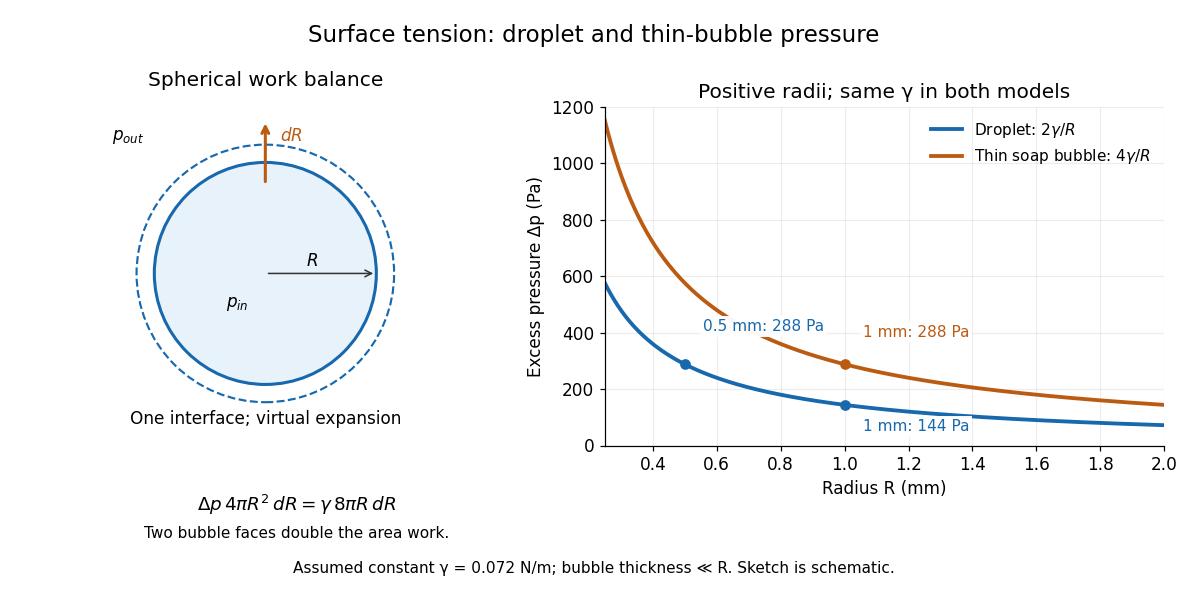
Smaller droplets need larger excess pressure; two bubble interfaces double it
. Left: a virtual outward displacement of a sphere balances pressure work against increased surface energy. Right: excess pressure in pascals versus positive radius in millimetres for one and two interfaces, using the assumed constant toy . Details.The spherical case has a short work argument. A virtual increase in radius gives and . At mechanical equilibrium, the net pressure work balances the increase in surface energy:For a thin soap bubble, both interfaces gain approximately the same surface area, doubling the right-hand side and giving . This is a virtual work balance between neighboring spherical configurations, rather than an assumption that a fixed-volume droplet actually expands. The general Young–Laplace equation replaces the spherical area-to-volume ratio by local curvature, making geometry directly measurable through pressure.
The Gibbs--Thomson relation shifts the equilibrium chemical potential or composition at a curved interface by an amount proportional to its mean curvature. Small droplets therefore have a larger equilibrium solubility than flat interfaces.
Curvature depresses the equilibrium melting temperature of solid convex into liquid. Here is the sum of principal curvatures, equal to twice a common convention for mean curvature, and is absolute temperature. The coefficient uses solid-liquid surface energy, mass density and latent heat. This stabilizes fine corrugations of a solidification front.
The capillary length measures when gravity and surface tension are comparably important in shaping a liquid interface. For a liquid of uniform mass density , beneath a gas whose mass density is negligible, with uniform gravitational acceleration and constant surface tension ,A deformation of height and horizontal length scale has hydrostatic pressure variation of order and small-slope capillary pressure of order . Equating these gives : surface tension smooths small features, whereas gravity matters for broad ones. For two resting fluids, replace by their positive mass density difference in this static balance. This change alone does not give the two-fluid wave dynamics, because both fluids can have inertia. [ref]
https://ocw.mit.edu/courses/18-357-interfacial-phenomena-fall-2010/04759cfc15c79928ca9f72a18b3864dd_MIT18_357F10_lec_all.pdf. John W. M. Bush, Interfacial Phenomena, chapters 5–6: curvature and hydrostatic pressure
With the stipulated illustrative parameters , , and , the capillary length is . These parameters define the ideal calculations below; they are not a measurement of a particular sample.
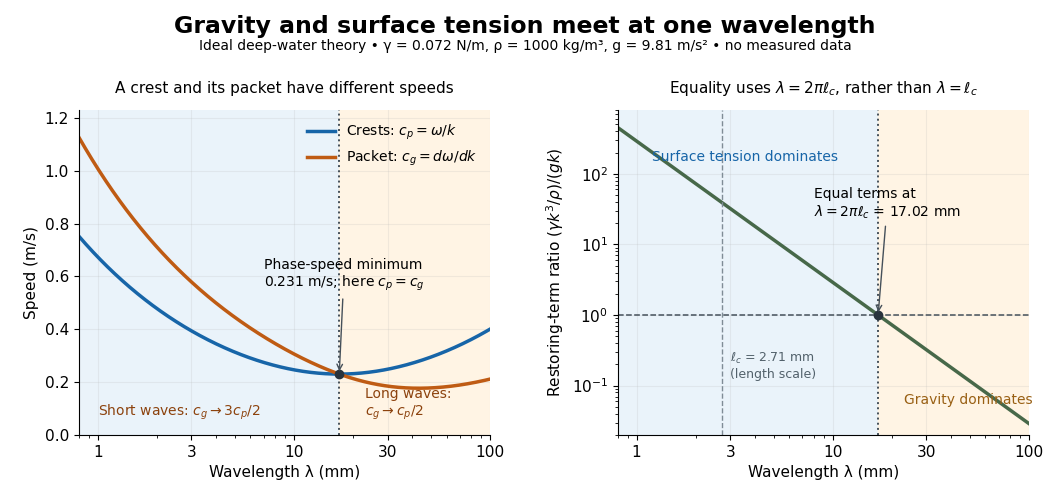
For a sinusoid with wavenumber , the relevant horizontal scale is , while its wavelength is . Thus the Bond number for this scale and the reciprocal restoring-term ratio areEquality is at , hence for these parameters. Using instead produces a different numerical Bond number; state the length convention. The capillary length itself is not the equality wavelength. This distinction helps choose whether a measured ripple should be modeled as a surface gravity wave, a nearly pure capillary wave, or a gravity-capillary wave. [ref]
https://davidtong.org/pdfs/teaching/fluid-mechanics/fluids3.pdf. David Tong, Fluid Mechanics, §4.1.3, equations (4.23)–(4.24) and the wavelength factor
A dynamic meniscus is a curved transition region joining a moving thin film to a bulk fluid reservoir.
A capillary wave is a wave along a fluid interface whose restoring stress is predominantly supplied by surface tension. A curved free surface requires a pressure jump by the Young–Laplace equation; increasing its corrugation also costs surface energy. In the ideal limit, inertia carries the interface through its flat position and the resulting oscillation propagates. When gravity also contributes appreciably, use the combined gravity-capillary wave model. Within the capillary wave regime, shortening a ripple makes it travel faster. [ref]
https://davidtong.org/pdfs/teaching/fluid-mechanics/fluids3.pdf. David Tong, Fluid Mechanics, §4.1.3: the capillary restoring pressure
The laser-diffraction measurement of capillary waves below turns this mechanism into a test: set the frequency, measure the wavelength independently with light, and ask whether the dispersion relation follows. The theory is useful both for predicting how ripple wave packets separate and for inferring surface tension from their motion.
A gravity-capillary wave has restoring contributions from both gravity and surface tension. Consider an initially resting, horizontally unbounded liquid layer of constant depth , with uniform mass density , incompressible flow, inviscid flow and irrotational flow. The upper gas exerts constant pressure and has negligible inertia. Assume a clean interface with constant surface tension : no surfactant stresses, imposed current or wind. The wave amplitude must satisfy and , so linearized boundary conditions apply. Deep water means , rather than a particular depth in metres. [ref]
https://www.ocw.mit.edu/courses/18-354j-nonlinear-dynamics-ii-continuum-systems-spring-2015/6163837c5efa5d6ed969e535ec8f890c_MIT18_354JS15_lectureNotes.pdf. Brenner, Peacock, Stocker, Reis and Dunkel, MIT Nonlinear Dynamics II, §23.1, pp. 105–106
Let be the undisturbed free surface, with liquid below it. Potential flow gives a velocity potential with , and incompressible flow gives the Laplace equation. The linearized kinematic boundary condition for a free-surface graph and the Unsteady Bernoulli equation, including gravity and the Young–Laplace equation, giveHere is the interface displacement; the signed small-slope pressure jump is . A wave crest has , so its capillary pressure is positive. Choose a right-travelling Fourier mode of positive wavenumber and angular frequency :The factor decays into the deep liquid, satisfies the Laplace equation, and makes at . Substituting in the dynamic boundary condition leavesThis derivation displays the two restoring contributions with the same sign. Dimensional analysis also checks the result: has units , so both and have units . [ref]
https://www.ocw.mit.edu/courses/18-354j-nonlinear-dynamics-ii-continuum-systems-spring-2015/6163837c5efa5d6ed969e535ec8f890c_MIT18_354JS15_lectureNotes.pdf. MIT Nonlinear Dynamics II, §23.1, equations (547)–(551): boundary conditions and dispersion
At finite depth, a flat impermeable bottom at requires . Replacing by the normalized vertical factor makes the surface ratio . Eliminating the mode amplitudes then givesThus the same model supplies its own depth check: use the deep-water formula only when is sufficiently close to one for the required accuracy. For example, reduces by about relative to deep water, while reduces it by about . These percentages are calculations from this factor. [ref]
In deep water the phase velocity magnitude follows a wave crest, while the group velocity magnitude follows the wave envelope of a narrow wave packet. Differentiating the positive-frequency dispersion relation givesFor , the surface gravity wave limit has . For , the deep-water capillary-wave dispersion relation has : a wave crest slips backward relative to the faster wave envelope, even while both advance. Neither speed is the oscillating fluid element's own velocity. [ref]
There is a particularly neat coincidence at the crossover. Differentiate : its unique minimum is at , exactly where the restoring terms are equal. ThereforeFor the stipulated parameters in capillary length, the minimum is . At , direct substitution gives , and . This short wavelength is capillary dominated, but its group velocity is still slightly below the pure-capillary ratio because gravity has not vanished.
Zhu, Miao, Xu and Cao's 2007 experiment drove a triangular metal frame electromagnetically with a sinusoidal generator. In a roughly -deep, temperature-regulated pool, it produced nearly plane capillary waves. A laser illuminated the surface obliquely; the moving ripples acted as a reflection diffraction grating. One split beam monitored laser stability, while a CCD recorded diffraction orders on a screen away. An air-supported optical table reduced ambient vibration. [ref]
https://www.eg.bucknell.edu/~phys310/skills/papers/paperX_full.pdf. Zhu et al., Measurement of the dispersion relation of capillary waves by laser diffraction, American Journal of Physics 75 (2007), §II.A, p. 896; DOI 10.1119/1.2750379
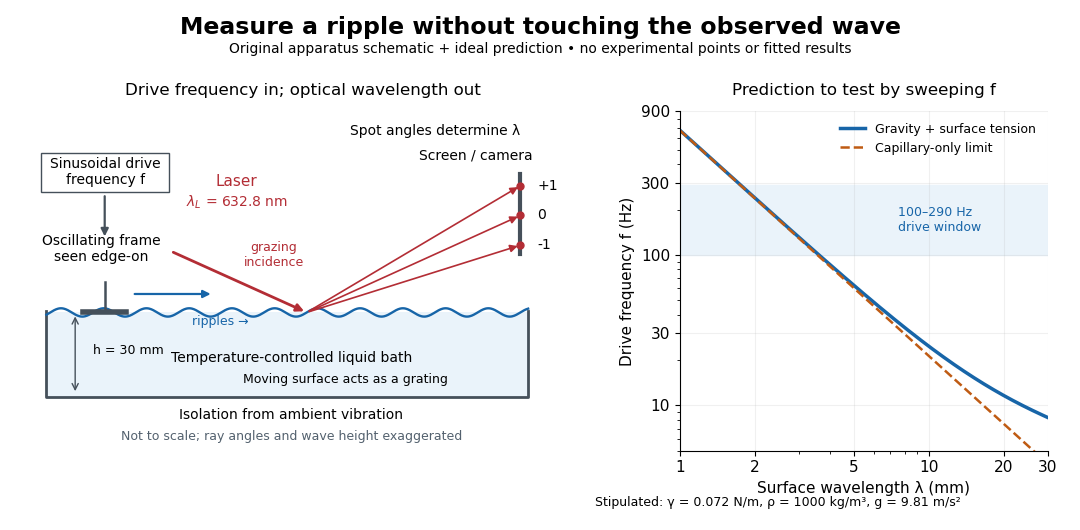
The frequency sweep was – in steps, using distilled water and kerosene at . For each setting they averaged at least three measurements of first-order spot separation. Known optical geometry and the grating equation yielded ; generator readings yielded . Agreement with the predicted log–log slope tests the capillary law, and its intercept gives surface tension if mass density is known. The authors identify surface contamination as a major error source; noncontact optical detection reduces additional disturbance. [ref]
https://www.eg.bucknell.edu/~phys310/skills/papers/paperX_full.pdf. Zhu et al., §§II.B–III, equations (6)–(8), pp. 897–898
The optical measurement can be understood from the grating equation. Let be the laser wavelength, the incident grazing angle above the mean surface, and the outgoing grazing angle of diffraction order , with the sign of chosen so thatThus calibrated spot positions determine outgoing angles, which determine the ripple wavelength , independently of the mechanical dispersion relation. This optical geometry treats the surface as a reflection diffraction grating at the laser wavelength. [ref]
The inferred surface tension in the full deep-water model isThis formula makes useful experimental controls explicit. Measure mass density at the sample's temperature; check depth with ; keep the driven wave amplitude small enough that ; and distinguish from angular frequency . For the stipulated parameters, the – window corresponds to calculated wavelengths about – and – at . Depth corrections are negligible here, but the gravity contribution is about – of the capillary contribution. These are ideal predictions, not digitized results from the experiment.
Omitting gravity would infer , biasing surface tension upward. In the capillary limit, the differential estimate also shows why careful spot-spacing calibration matters. A clean surface and weak viscosity are modeling assumptions: appreciable damping, surfactant stresses or large wave amplitudes call for additional physics. The experiment tests the short-wave regime; its drive window does not establish the crossover or the long-wave surface gravity wave limit.
For a capillary wave on deep water with surface tension and density , the dispersion relation isIts group velocity is in the direction of the wavevector.
If an initially flat one-dimensional surface receives velocity on and zero velocity elsewhere, its linear capillary-wave response is
Along , if , the stationary wavenumber obeys . The one-dimensional stationary-phase formula then givesOnly the integrated initial velocity survives in this long-wave far field.
For a conserved scalar order parameter, a sinusoidal interface perturbation of wavenumber creates a harmonic chemical-potential field extending a distance into each phase. Surface tension then produces a relaxation rate proportional to .
Articles by others on the same topic



Surface tension is a physical property of liquids that arises from the cohesive forces between liquid molecules. It is defined as the energy required to increase the surface area of the liquid by a unit area. At the molecular level, surface tension occurs because molecules at the surface of a liquid experience a net inward force: they are attracted more strongly to the molecules beside and below them than to the air above. This results in a "skin-like" effect on the surface of the liquid.