
Surface tension is the tensile force per unit length across a line drawn in a liquid interface. For a clean interface with isotropy, it has the same value in every tangential direction: each side pulls the other along the surface, perpendicular to the line. A straight segment of length therefore transmits a force of magnitude from one interface. Here we assume constant , with fixed temperature and composition. The same coefficient measures the reversible work required to create surface area:The equality of units follows from ; the equality of the mechanical coefficients follows from the moving-rim argument below. [ref]
https://openstax.org/books/college-physics-2e/pages/11-8-cohesion-and-adhesion-in-liquids-surface-tension-and-capillary-action. OpenStax, College Physics 2e, §11.8: surface tension and the sliding wire
[ref]https://arxiv.org/html/2011.11403v2. Tomas Bohr and Bernhard Scheichl, Surface Tension and Energy Conservation in a Moving Fluid, equations (5) and (13)
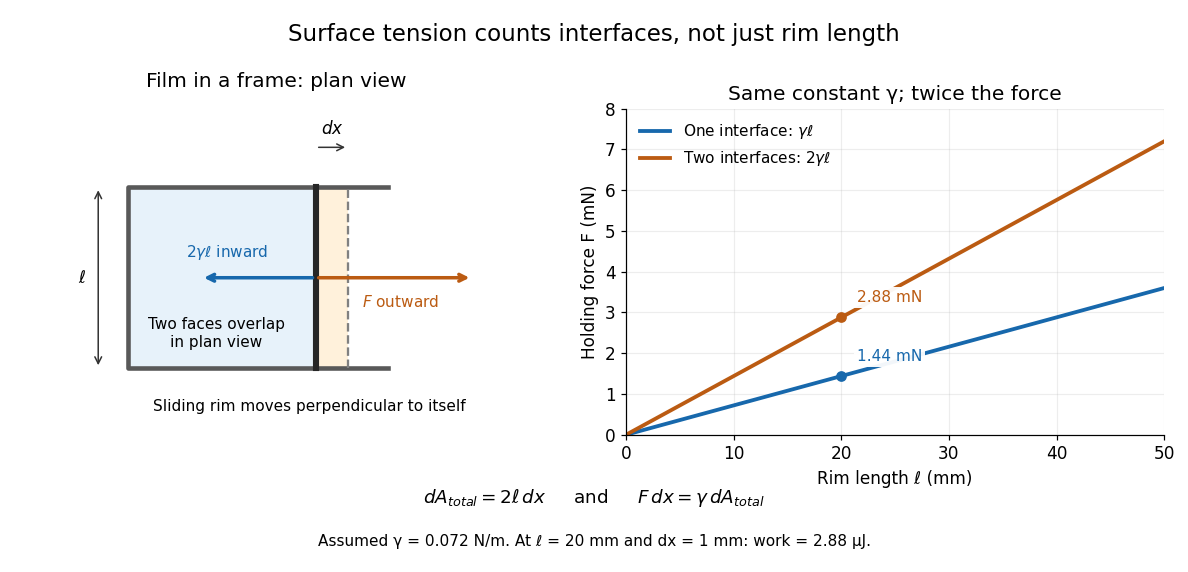
For a concrete example, take an ideal flat soap film spanning a rectangular wire frame with a straight sliding rim of length . Pull the rim outwards in the plane of the film, perpendicular to the rim. Each of the film's two liquid–gas interfaces pulls the rim back towards the film with force , so the outward holding force is . The two faces are two interfaces, each with its own surface tension. With the assumed toy value and , the required force is ; one interface would contribute . This value of is a stipulated model parameter, rather than a measured value for a particular soap solution.
Why does an interface resist being enlarged? Its molecules have a different environment from those in the bulk liquid; changing that environment has an energy cost. In the constant-surface tension model, reducing surface area lowers surface energy. This connects an easily measured rim force to the shape of a droplet, the Young–Laplace equation for its pressure, and the restoring mechanism of capillary waves. It is useful because one coefficient links forces, energy and geometry. [ref]
https://davidtong.org/pdfs/teaching/fluid-mechanics/fluids3.pdf. David Tong, Fluid Mechanics, §4.1.3, pp. 121–123
The moving-rim argument also explains the factor of two without memorizing a special formula. An outward displacement creates surface area on each face, hence . Slow pulling without viscous dissipation requires work , giving . For one interface, the same argument gives . A surface tension gradient instead produces Marangoni stress; the constant- assumption excludes that additional effect.


Surface tension is a physical property of liquids that arises from the cohesive forces between liquid molecules. It is defined as the energy required to increase the surface area of the liquid by a unit area. At the molecular level, surface tension occurs because molecules at the surface of a liquid experience a net inward force: they are attracted more strongly to the molecules beside and below them than to the air above. This results in a "skin-like" effect on the surface of the liquid.
New to topics? Read the docs here!