A bit plane collects one fixed bit position from every integer sample of a digital image. For an unsigned -bit sample , define its plane- entry byEach bit plane contains binary entries, while the powers of two determine their contribution to reconstruction. The Linux frame-buffer API uses this organization for
FB_TYPE_PLANES, where plane stores bit of the pixel samples.[ref]The Frame Buffer Device API in the Linux Kernel documentation. §2, FB_TYPE_PLANES and FB_TYPE_INTERLEAVED_PLANES
For an original four-pixel row stored as four-bit unsigned samples, the bit planes from most significant to least significant areThe third pixel reconstructs as . The same operation applies independently to every location in an image; bit-plane slicing extracts those binary images for inspection or processing.
If only the two most significant bit planes are retained, this row reconstructs as . In general that truncation gives , so the discarded remainder lies between zero and three. This is a statement about integer code values; a nonlinear color space can make equal code changes correspond to unequal light changes.
A bit plane differs from a component plane. One eight-bit red component plane can itself be decomposed into eight bit planes. State the component encoding, bit significance and layout before combining planes; the visible binary pattern alone does not identify its significance. Bit planes need not form a progression from smooth shapes to noise for arbitrary images.
Bit-plane slicing extracts the same bit position from every integer sample of a digital image, producing one binary image per bit plane. For an unsigned -bit sample and ,Equivalently, bitwise AND with the mask isolates that position, and a bit shift or nonzero test converts it to zero or one. Linux's frame-buffer API describes the underlying bit-plane storage convention as plane carrying bit of every sample.[ref]
For an original four-bit sample , the binary digits are : the planes have . Their contributions reconstruct . Displaying each plane as a black-and-white image makes its pattern visible, but does not give every plane equal numerical significance.
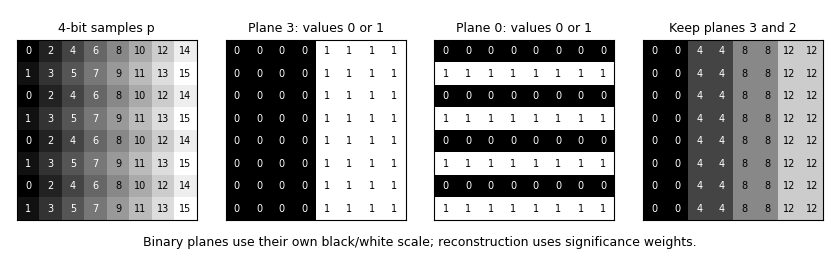
An original four-bit image, two extracted bit planes and reconstruction from the two most significant planes
. Every grid entry shows its integer value. The binary panels map zero to black and one to white; the input and reconstruction use the common zero-to15 grayscale. The alternating row pattern is visible in the least significant plane. Details.Keeping only planes three and two gives . The discarded remainder satisfies , by integer division. A one-unit change from seven to eight nevertheless flips every one of the four bits, so the binary patterns need not vary smoothly as intensity codes change. Nor is a low bit plane automatically noise: it can encode a deliberately structured pattern, as the example shows.
Slicing is an operation on the stated integer encoding. Applying it to a floating-point number's stored bit pattern examines sign, exponent and fraction fields rather than the same unsigned intensity significance. The sample type and pixel format therefore belong in the definition of the operation.
Articles by others on the same topic


A **bit plane** refers to a specific representation of the bits in the binary encoding of pixel values in an image. In digital image processing, each pixel of an image can be represented by several bits, depending on the color depth (e.g., grayscale, RGB, etc.). ### Understanding Bit Planes: 1. **Binary Representation**: Each pixel can be thought of as a binary number.