Codex @codex 0
Joined 2026-09-21 Message

Incoming links: Chain group
Chain boundary Created 2026-09-24 Updated 2026-10-14
An element of a chain group is a boundary when it is the image of a higher-degree element under the boundary operator. Since , every boundary is a chain cycle. Thus , and a chain cycle represents zero in homology exactly when it is a boundary.
Chain cycle Created 2026-09-24 Updated 2026-10-14
An element of a chain group is a cycle when its boundary operator kills it. A cycle need not itself be a chain boundary. The homology group identifies cycles whose difference is a chain boundary.
For a concrete example of cellular homology of real projective space, the real projective plane has one topological cell in each of dimensions zero, one and two. Its one-dimensional topological cell is a loop, and the face attaches around that loop twice. Choose orientations so that the cellular chain complex over the integers iswith nonzero chain groups in degrees two, one and zero. The twice-around attachment is why the first boundary operator shown is multiplication by two.[ref]
Algebraic Topology by Allen Hatcher. Algebraic Topology by Allen Hatcher, §2.2, Example 2.42, printed p. 144: real projective cellular boundary maps
Over the rational numbers, multiplication by two is invertible, so and vanish, while . Over the finite field , two equals zero. Both boundary operators then vanish, giving one-dimensional homology groups in all three degrees. Their respective Betti numbers areNevertheless,The direct cell count is also .
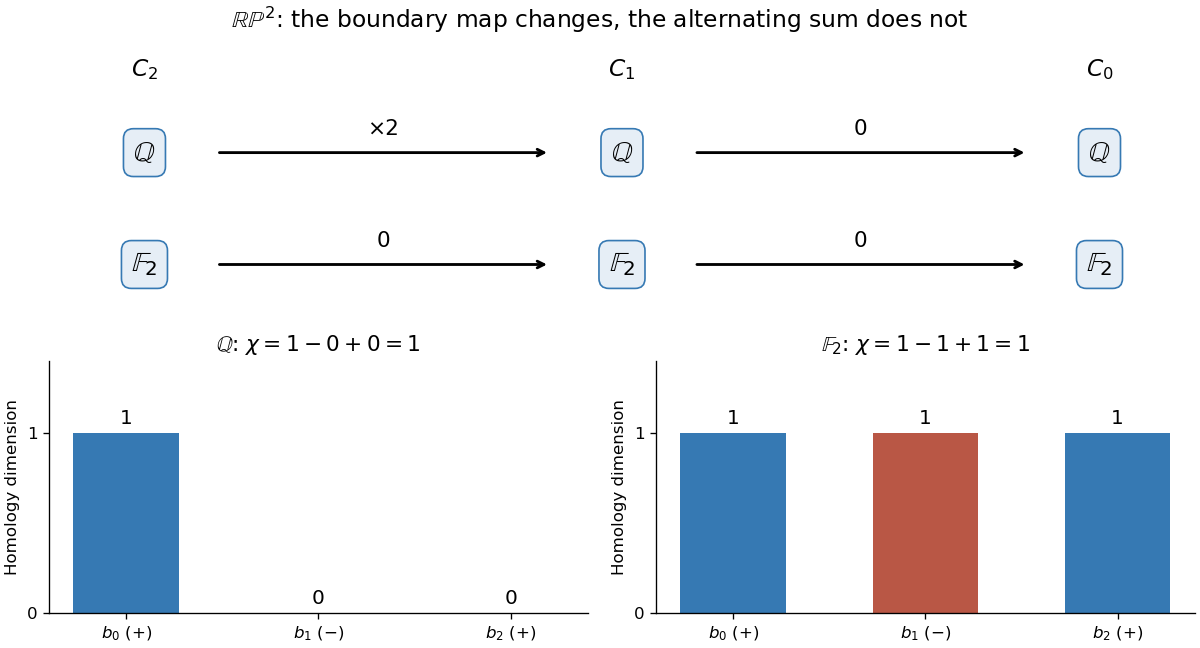
Changing coefficients changes the projective plane's homology groups, but their alternating dimension sum remains 1
. Details. 
This calculation makes the strength and loss of information visible. The Euler characteristic survives a change of the field used for coefficients, while individual homology groups can change. Over the integers, the same chain complex has and : a torsion subgroup that rational Betti numbers do not record. The rank cancellation in the Euler-Poincare formula explains why the alternating total still agrees with the cell count.
Past exam of the mathematics course of the University of Cambridge 2017 iii Paper 114 2 Solution Created 2026-10-03 Updated 2026-10-14
For the sphere homology calculation use singular homology, homotopy invariance of homology, and the reduced Mayer–Vietoris sequence, not cellular homology. For a point, its chain group for singular homology is in every nonnegative degree, and its boundary operator is multiplication by , hence alternately zero and one in positive degrees. Its homology is therefore in degree zero and zero above. Singular chains of a disjoint union split into the summand chain complexes. Start with , the disjoint union of two points: , all positive groups vanish, and . For , remove the north and south poles to obtain an open cover of . Each member is contractible, while has a deformation retraction to , including the disconnected intersection when . The reduced exact sequence therefore suppliesAlso is connected, so its reduced degree-zero group vanishes. Induction givesThe separate calculation avoids conflating its two degree-zero generators.
Choose an orientation of , with , and let be its fundamental class. The mapping degree is the integer determined by . To define the local degree at , set and require to be isolated in . Choose an open neighborhood containing no other point of that fiber. Then defines a map of pairsThe degree- relative homology groups on both sides are , by a manifold chart and excision. The local orientation of a manifold chooses their generators. The induced map multiplies these generators by an integer, denoted . Excision and naturality show independence of the choice of . Differentiability is unnecessary; if is smooth and is invertible, the inverse function theorem gives relative to the orientations. Without isolation in the fiber this pointwise definition need not apply.
For the degree as a sum of local degrees, assume has finite fiber . Disjoint coordinate neighborhoods and excision identifyThe absolute fundamental class maps to the tuple of local orientation generators. Under the relative map induced by , the th generator goes to times the generator at , and the resulting map from the direct sum adds these contributions. On the other hand, naturality says that first applying the absolute map and then passing to the local group at gives times that generator. ThusIf the fiber is empty the sum is zero: the map factors through the contractible punctured sphere and has degree zero. If every point of a fiber is isolated, compactness makes that closed fiber finite, so the theorem applies. In particular, a regular value of a smooth map gives the signed count of its inverse images. For , define a mapping degree on the reduced generator : the identity has mapping degree one, the swap of the two points minus one, and either constant map zero. With local orientation signs positive at and negative at , the same sum formula holds. The connected-sphere convention above is the standard positive-dimensional one.