For the symmetric group , take the transpositions and . Products of permutations apply the rightmost factor first. ThenThe last permutation sends , , and : two swaps fail to commute by an entire three-cycle.
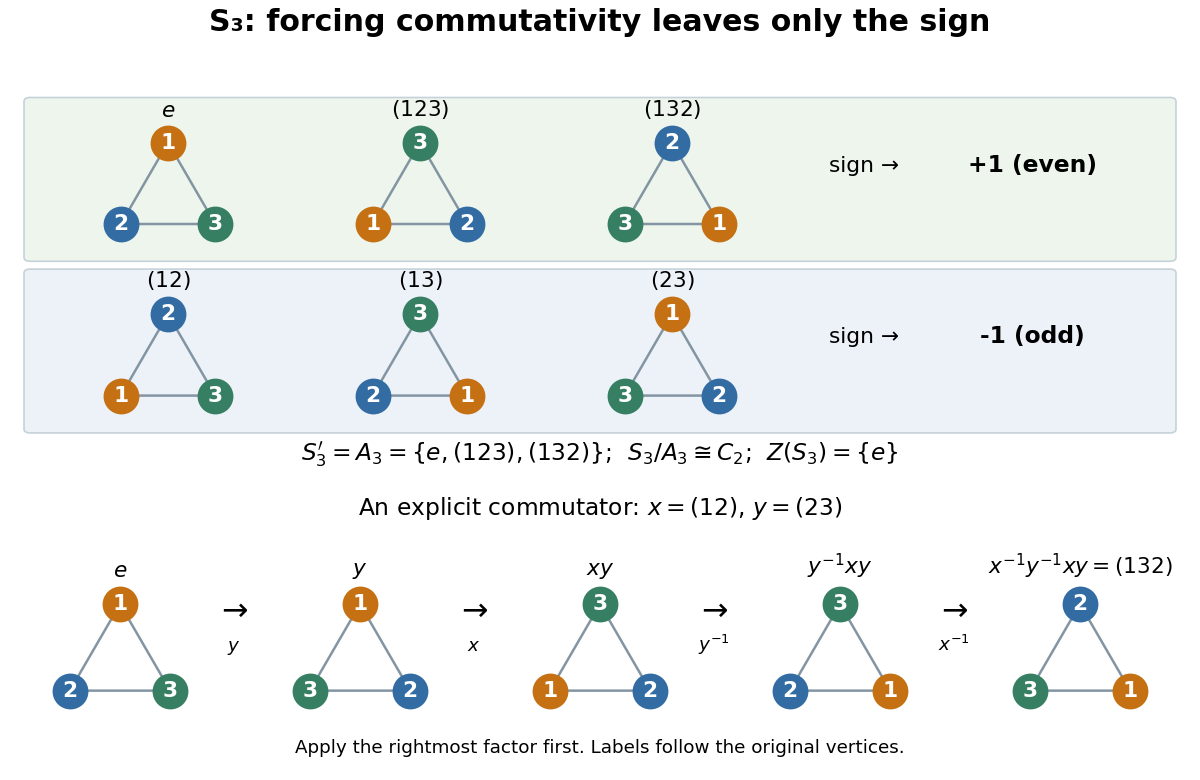

Every group commutator has sign of a permutation , so , the alternating group of even permutations. Conversely, the displayed group commutator generates . Therefore . The two cosets are the even permutations and the odd permutations, and their multiplication is just multiplication of signs:This is the first isomorphism theorem applied to the sign of a permutation. Once commutativity is forced, all three transpositions become indistinguishable, and both three-cycles become the identity element. The surviving information is exactly whether the permutation is even or odd. Compare the very different center of a group .
Articles by others on the same topic
There are currently no matching articles.