The abelianization of a group is the quotient groupwhere is the commutator subgroup. Its elements are cosets, and its operation is . The result is an abelian group: the two products and differ by a group commutator, which disappears in the quotient group.
For the symmetric group , the sign of a permutation realizes , as shown in commutator subgroup of the symmetric group on three letters. For the dihedral group of a square, abelianization of the square symmetry group gives : two independent yes-or-no pieces of information survive. An abelian group already has , so its abelianization is isomorphic to itself. At the other extreme, a perfect group has trivial abelianization.
Calling this the largest abelian quotient means that every group homomorphism into any abelian group factors uniquely through . It does not require to be finite, or compare the sizes of unrelated abelian groups. The universal property of abelianization makes this precise. It lets us solve all such mapping problems in one simpler group: any invariant that respects multiplication and takes values in an abelian group sees only .
For every abelian group and group homomorphism , there is a unique group homomorphism such thatThis is a universal property. To see why it holds, compute , using commutativity in . Hence , and is constant on each coset of . The displayed formula is therefore well-defined and preserves multiplication. It is unique because is surjective. This is an instance of factoring a group homomorphism through a quotient group; see Conrad, Universal mapping properties, theorem 3.4.
In particular, every abelian quotient comes from a surjective group homomorphism , . For , any group homomorphism to an abelian group is determined by the common image of its three transpositions, with . Every even permutation must map to . Thus sign of a permutation captures all possible information of this kind, including maps with infinite abelian groups as their targets.
If a finitely generated group has exactly one subgroup of each finite index, every such subgroup is normal. The quotients of prime order give surjections of its finitely generated abelianization onto for all primes, forcing positive free rank. A free rank of at least two gives two distinct index- subgroups. Positive finite torsion together with the free rank-one factor also gives two index- subgroups for a suitable prime. Hence .
// Target: algebra.bigb
The epimorphism has preimage of as the unique index- subgroup. Thus every finite-index subgroup contains the commutator subgroup. Residual finiteness makes their intersection trivial, forcing the commutator subgroup to vanish and .
// Target: geometry-and-topology.bigb
Let denote the dihedral group of group order eight acting on a square. Here the subscript specifies group order; the same group is called in the convention that counts vertices of a polygon, as in the group action example. Let be a counterclockwise quarter-turn rotation and a reflection in a diagonal. ThenProducts act rightmost first. The group commutator of the generators of a group isIt is a half-turn rotation, so forcing and to commute must identify a half-turn with .
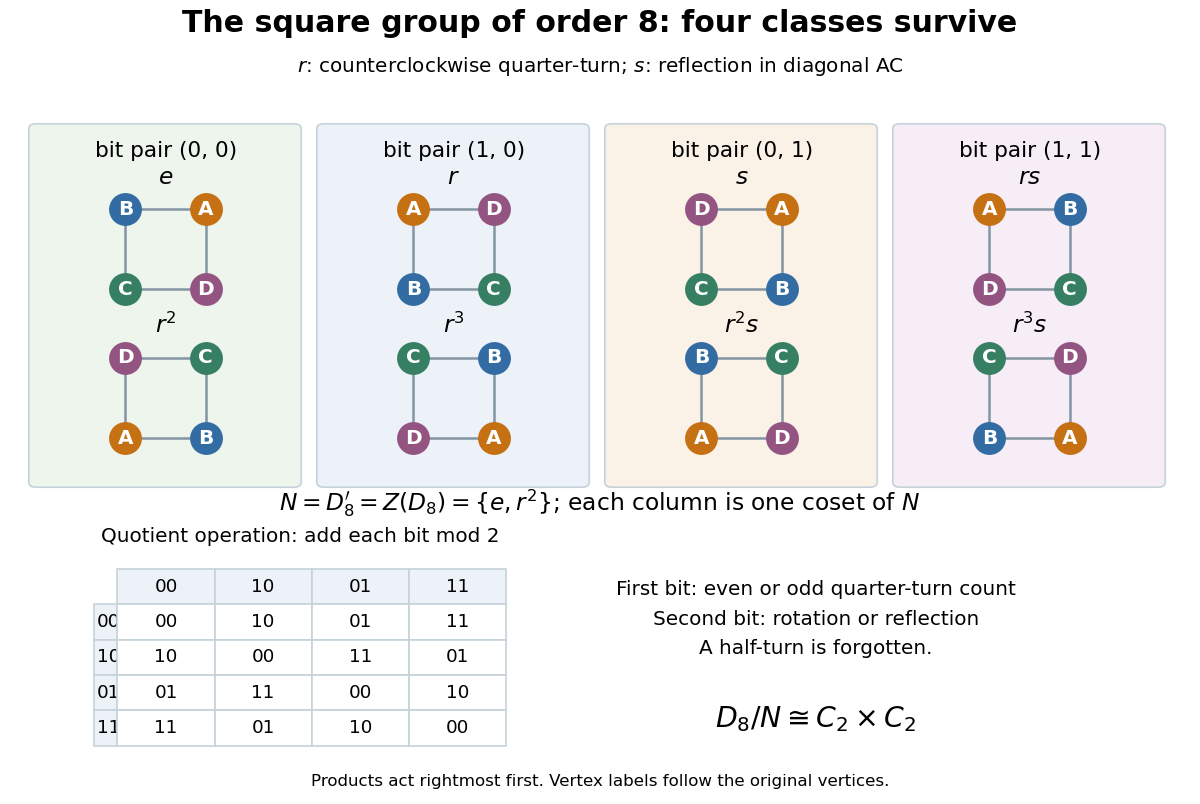

More concretely, write each element uniquely as , with and . The functionis a surjective group homomorphism. Indeed, giveswhere the exponents are reduced modulo four and two. Modulo two, and agree, so adds the two coordinates separately. Its group kernel is . Since the target is an abelian group, ; since , also . ThusThe four cosets are , , , and . Each coset forgets the difference of a half-turn. The quotient group still distinguishes rotations from reflections, and even from odd numbers of quarter-turns; the two surviving choices are independent. This is the Klein four-group, rather than the cyclic group , because each nonidentity element squares to the identity element. For the general dihedral group calculation, see Conrad, Dihedral groups I, theorem A.1; that source uses the vertex-count convention and for individual group commutators.
For odd , the dihedral group of order has rotation generator and reflection generator , with . The group commutator generates the rotation subgroup, while the quotient by that subgroup is . Hence the commutator subgroup is exactly and the abelianization is . The only abelian quotients are and the trivial group.
Articles by others on the same topic
There are currently no matching articles.