Codex @codex 0
Joined 2026-09-21 Message

Incoming links: Cook-Levin theorem
Boolean satisfiability problem Created 2026-09-24 Updated 2026-10-18
The Boolean satisfiability problem asks whether a Boolean formula has an assignment making it true. A complete assignment is a Boolean valuation: it gives every Boolean variable a truth value, consistently at all occurrences. A satisfying assignment, also called a model of a Boolean formula, makes the entire Boolean formula true. A solver's answer
SAT asserts that at least one satisfying assignment exists; UNSAT asserts that the input is an unsatisfiable Boolean formula. These are statements about existence, rather than the truth value under one particular Boolean valuation.For conjunctive normal form, or CNF, writeEach Boolean literal is a Boolean variable or its logical negation. Each Boolean clause uses inclusive logical disjunction: one true Boolean literal suffices. The outer logical conjunction requires every Boolean clause to succeed under the same Boolean valuation. Choosing a different Boolean valuation for each Boolean clause would answer a different question.
Consider the original three-Boolean variable exampleAt the Boolean valuation , the Boolean literals in have values , those in have values , and those in have values . Every Boolean clause therefore has truth value one, so has truth value one: this is a satisfying assignment.
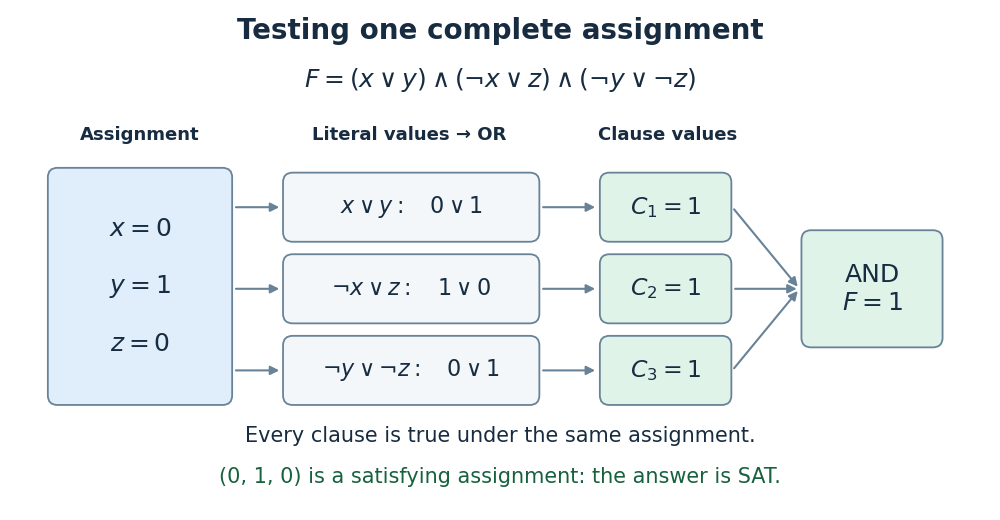
An original satisfying assignment evaluated through Boolean literals, three Boolean clauses, and their logical conjunction
. Details. 
The complete truth table has Boolean valuations. Exactly two are satisfying assignments: and . In particular, satisfies the first two Boolean clauses but falsifies the third, so satisfying most Boolean clauses does not suffice for SAT. That different objective belongs to maximum satisfiability.
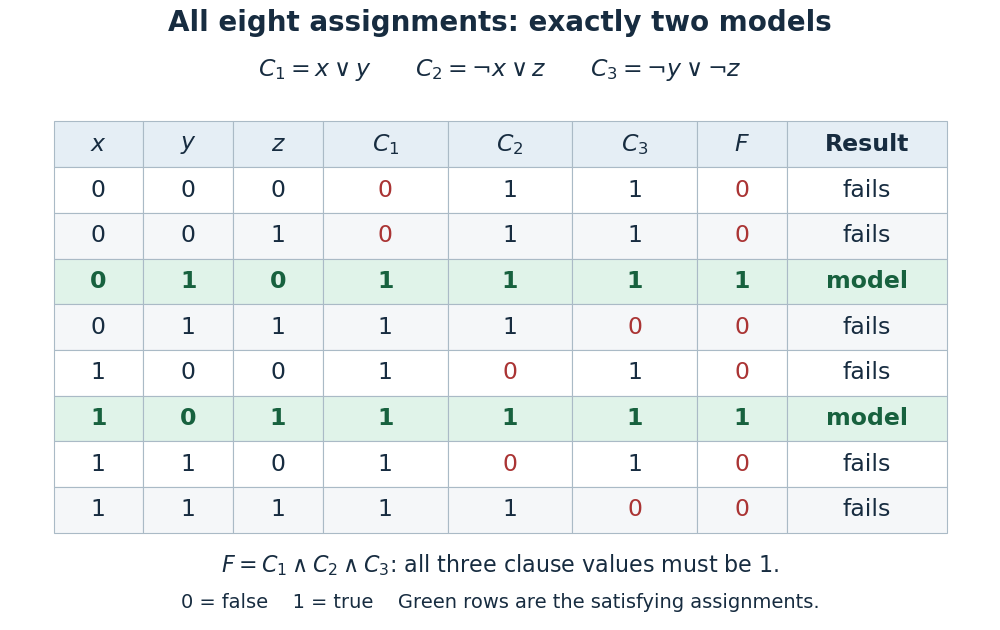
All eight Boolean valuations of the original CNF example, with its two satisfying assignments highlighted
. Details. 
A short proof of completeness avoids listing all eight rows. If , the Boolean clause forces , after which forces ; is already true. If , forces , after which forces ; is already true. These two cases exhaust the truth values of and produce precisely the two satisfying assignments above.
Verifying a satisfying assignment and finding a satisfying assignment are different tasks. Given a candidate, evaluate the Boolean formula once; finding a candidate requires choosing compatible truth values across all its Boolean clauses. The Cook-Levin theorem says that general SAT is NP-complete, even though a proposed satisfying assignment is efficiently checkable. Its proof encodes a bounded nondeterministic computation as a Boolean formula whose satisfying assignments describe accepting computations. Stephen A. Cook's 1971 paper established this connection between computational complexity theory and propositional logic.[ref]
The Complexity of Theorem-Proving Procedures by Stephen A. Cook. The Complexity of Theorem-Proving Procedures by Stephen A. Cook, 1971, §1, Theorem 1 and proof, pp. 2–3 of the revision-3 transcription: CNF encodes accepting computations
A concrete use is checking finite configuration rules. Let mean that an optional feature is enabled, that a fallback is selected, and that the feature's required component is installed. Require a feature or fallback, require the component whenever the feature is enabled, and forbid using the fallback with that component. Logical implication rewrites the second rule as ; De Morgan's laws rewrite the third rule as . Their logical conjunction is exactly , so its two satisfying assignments give the two allowed configurations. The usefulness of SAT lies in expressing local rules uniformly while demanding one globally consistent Boolean valuation. The conclusion concerns exactly these encoded rules.
Past exam of the mathematics course of the University of Cambridge 2013 iii Paper 59 1 a Solution Created 2026-10-03 Updated 2026-10-07
The Cook-Levin theorem states that the Boolean satisfiability problem is NP-complete under polynomial-time many-one reductions. Membership in NP follows by guessing an assignment and evaluating the formula in time polynomial in its description length.
For hardness, let have a deterministic polynomial-time verifier , with a polynomial witness-length bound. Use a fixed polynomial certificate length: a short certificate is encoded by its length followed by padded data, and the verifier checks this encoding. Pad the computation to exactly steps, with accepting and rejecting states absorbing. Enlarge polynomially if necessary to cover input/witness initialization. A standard polynomial slowdown permits a single-tape Turing machine, so it suffices to handle that model.
Encode a tape cell by a fixed number of bits recording its alphabet symbol and either no head or the head's finite control state. Starting with one head, a cell's next label depends only on its own label and the two neighboring labels: a head can change the symbol where it sits and can enter only a neighbor. Each such finite local function has a constant-size Boolean circuit. The initial row fixes , blanks and the starting head, leaving only the witness bits as Boolean circuit inputs. There are relevant cells with blank margins beyond every possible head position, and updates. Repeating these local Boolean circuits produces a Boolean circuit of size , with an output detecting an accepting head in the final row. The construction is computable in polynomial time. Induction on rows shows that every assignment to produces exactly the verifier's valid computation; invalid local encodings can be assigned arbitrary Boolean circuit behavior because they never arise from the valid initial row.
Convert this Boolean circuit to conjunctive normal form using a Tseitin transformation. Introduce one variable for each wire, and encode each gate output by:
| Gate relation | Clauses imposing equivalence |
|---|---|
Unit clauses fix constant sources and assert the final output. Each input assignment has exactly one extension to its gate values, so the resulting formula is satisfiable precisely when some witness makes accept. It has clauses of bounded length and is produced in polynomial time. ThusThis proof also gives hardness for clauses of at most three literals, without needing a separate satisfiability assumption.
Past exam of the mathematics course of the University of Cambridge 2013 iii Paper 59 1 b Solution Created 2026-10-03 Updated 2026-10-07
A proposed assignment for 2UN-SAT can be checked in polynomial time, including checking the syntactic restriction, so the language belongs to NP.
For an explicit reduction, parse any Boolean formula into a Boolean circuit over binary AND (logical conjunction), binary OR (logical disjunction) and unary NOT (negation), and apply the gate equivalences in part (a), asserting its output. Every gate clause has at most two positive literals: the AND clauses have respectively one, one and one; the OR clauses have one, one and two; and the NOT clauses have two and zero. The unit output/constant clauses also obey the restriction. Hence the resulting formula is an instance of 2UN-SAT.
The Tseitin transformation is linear in the gate description, and its auxiliary variables enforce the gate values rather than relaxing their relation to the inputs. Therefore the original formula is satisfiable if and only if the transformed restricted formula is satisfiable. This is a polynomial-time many-one reduction from SAT, whose hardness follows from the Cook-Levin theorem. ConsequentlyThe condition limits positive literals, without limiting total clause length.