A data converter translates between an analog quantity and a digital representation. An analog-to-digital converter assigns a code to a measured input; a digital-to-analog converter produces an analog output from a code. The finite code set imposes quantization, while signal sampling determines which times are represented. These are distinct limitations.
For an original ideal model, take an unsigned -bit converter covering with step . Code identifies one interval. Reconstructing at its midpoint gives and . This bounds the error of an ideal uniform quantizer; the probabilistic uniform quantization error model requires further assumptions about the inputs.[ref]
MT-001: Taking the Mystery out of the Infamous Formula by Walt Kester. Pages 1–3, ideal converter levels and quantization error
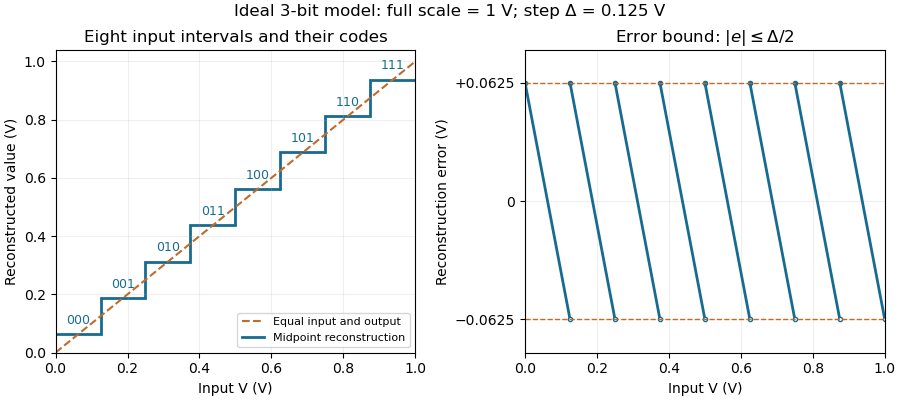

An experiment can slowly sweep a known input and record the transition locations between codes. Unequal step sizes, missing codes and gain or offset errors then become distinguishable from the ideal quantization limit. A changing input adds separate questions about settling and the acquisition time. Quoting only the number of bits therefore does not characterize the complete measurement system.
A digital-to-analog converter maps a digital code to a physical analog output, usually an electric potential difference or electric current. For an ideal unipolar -bit voltage-output converter with reference , one common convention isIts step is and its highest code produces , not the reference itself. Endpoint conventions differ between devices.
A three-bit converter with a 1 V reference gives levels V. Sweeping the code slowly and measuring each settled level tests offset, gain and unequal step sizes. Rapid code changes add settling and transient errors. Holding each output until the next update creates a staircase; reconstructing a smooth waveform also requires suitable filtering and a sampling rate compatible with its bandwidth. Finite levels impose quantization even before analog noise and nonlinearity are considered.[ref]
MT-001: Taking the Mystery out of the Infamous Formula by Walt Kester. Pages 1–3, ideal finite resolution and quantization-error model
Articles by others on the same topic
There are currently no matching articles.