On Euclidean space, every Killing vector field is a constant translation generator plus a constant infinitesimal rotation generator:Here is a constant vector and is an antisymmetric matrix. The second covariant derivative of a Killing vector vanishes for the Euclidean metric, so the components are affine functions of Cartesian coordinates; the Killing equation makes the linear coefficient antisymmetric.
In the Euclidean plane with metric tensor , two useful examples areThe notation denotes a coordinate basis vector; denotes a differential one-form. The corresponding flow of a vector field maps areFor translation, all arrows have the same direction and length. For rotation, arrows are tangent to circles, have length , and vanish at the origin. The rotation flow keeps fixed, and its nonstationary integral curves of a vector field are circles. Both flows preserve the Euclidean metric. See Carroll's original notes, section 5, equations (5.45)-(5.46).
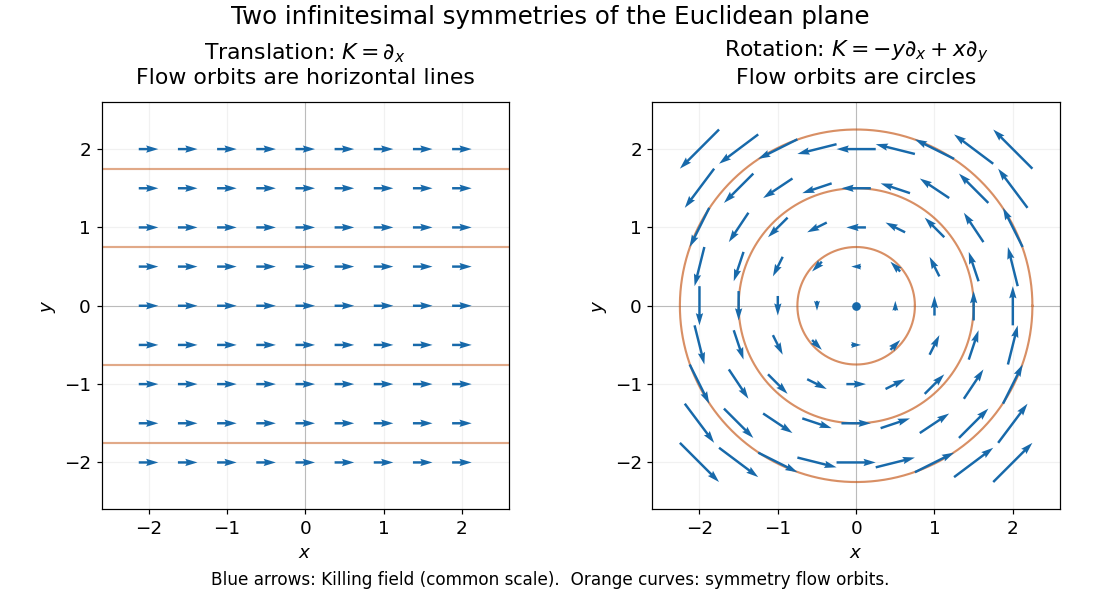
Euclidean Killing vector fields: translation arrows and straight flow orbits, rotation arrows and circular flow orbits
. Details. 
The circular integral curves of a vector field are symmetry orbits, whereas geodesics of the Euclidean plane are straight lines. A Killing vector field does not require its own orbits to be geodesics. The geodesic conserved quantity from a Killing vector pairs the field with the velocity of a separate geodesic; it does not require the velocity to equal the Killing vector field.
An infinitesimal rotation in one coordinate plane plus a constant translation has integral curves of a vector field that rotate about a shifted centre in that plane and move uniformly in the remaining directions. Nonzero transverse drift gives helices; zero drift gives circles, with zero radius allowing straight or stationary curves.
Articles by others on the same topic
There are currently no matching articles.