For a natural number , the factorial satisfies and for . The following description includes the zero base case explicitly; a negative or nonintegral input is outside its precondition:For , the arguments on descent are . Each positive-argument invocation postpones one multiplication until its recursive call returns. At the deepest point, the call stack has five stack frames: four suspended callers and the active zero base case. The invocation at zero returns to the invocation at one, rather than finishing the entire computation. Returns then giveA stack frame retains the caller's argument and where to resume. When the invocation at three receives , it uses its own , obtains , and returns that value to the invocation at four. The recursive calls share a definition, but their local variables belong to separate invocations.
F(n):
    require n is an integer and n >= 0
    if n == 0:
        return 1
    child_result = F(n - 1)
    return n * child_result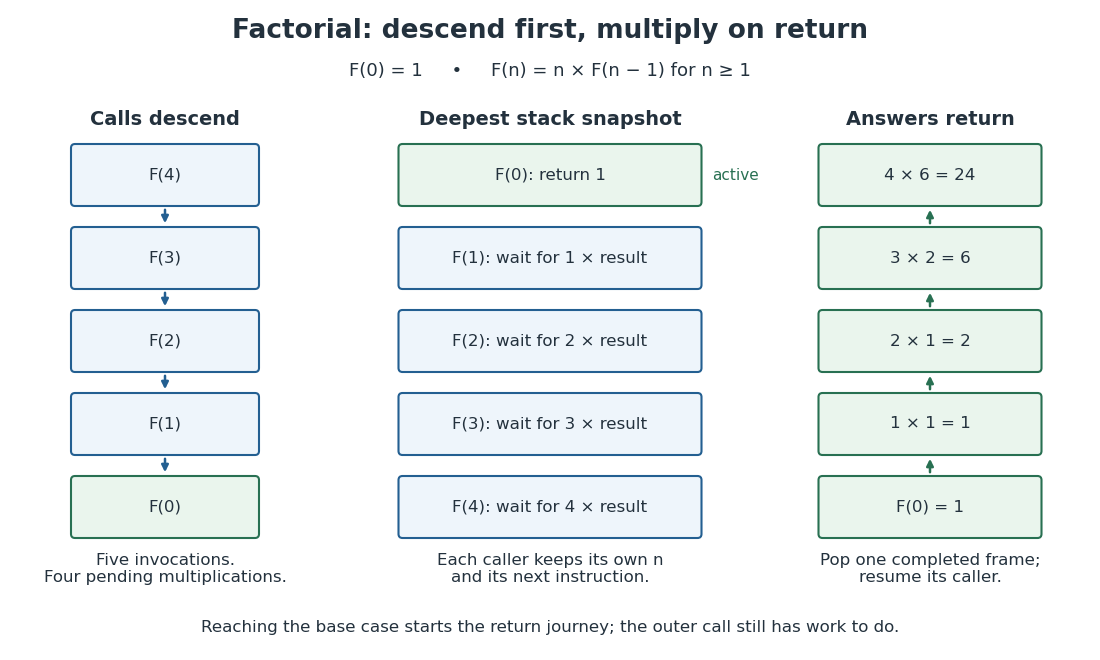

The natural number measure decreases by one on every recursive call, so algorithm termination follows. For algorithm correctness, use mathematical induction: the zero base case returns ; assuming the child's answer is , the caller returns . This also explains why keeping the caller's matters.
There are exactly invocations and multiplications, including one invocation and no multiplications when . Ordinary execution of this recursive process uses at most active stack frames, hence frames for in Big O notation. If each test, call, subtraction and multiplication is counted as constant cost, its time complexity is . That is an arithmetic-operation model: exact arbitrary-length integer multiplication has growing cost, and neither the factorial output nor every stack frame's numeric contents occupies a universally fixed number of bits.
Articles by others on the same topic
There are currently no matching articles.