Use the schematic below to count the water traversals explicitly. Each stationary tube has laboratory length . In the displayed setting, upper-tube water flows right and lower-tube water flows left, each at speed . Beam A goes right through the upper tube, exchanges tubes at the far optics, and returns left through the lower tube: it follows the flow twice. Beam B goes right through the lower tube and returns left through the upper tube: it opposes the flow twice. Each complete beam path therefore contains total water length , not or . The connecting air paths and fixed optics are assumed to contribute no flow-dependent phase difference.
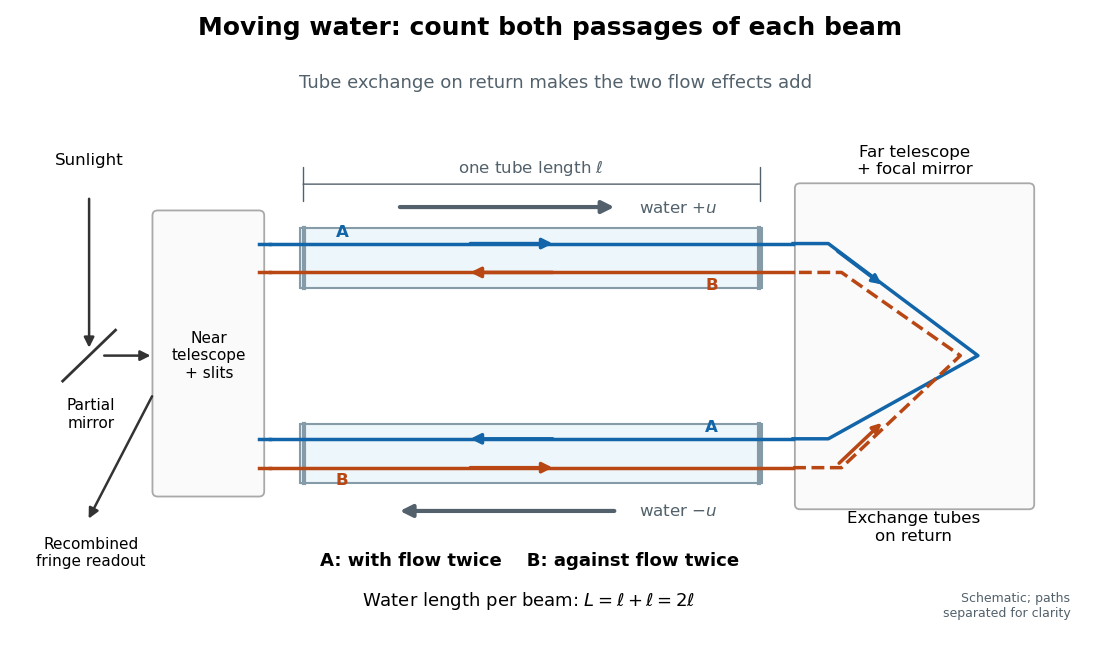
Counterflow path accounting: beam A follows the water in both tubes, beam B opposes it, and each beam traverses total water length 2ℓ
. Original schematic of the tube exchange and recombination, not a scaled optical ray trace. Parallel coloured lines separate overlapping counterpropagating beams for readability. The grey arrows show water flow; reversing both grey arrows exchanges the roles of A and B. Details.
Let and be positive phase velocity magnitudes along and against the water flow:For a laboratory source of frequency , where is its vacuum wavelength, define the signed interference fringe offset by the propagation phase difference . This is an equivalent phase delay between steady beams; no stopwatch resolves their transit-time difference. Subtract the zero-flow baseline and expand to first order:Thus one shifted fringe corresponds to one cycle of phase difference. If the stationary pattern has spatial interference fringe spacing , a simple readout model is , where is the interference visibility. The maxima shift by with this choice of screen coordinate. A sign assigned to “rightward” motion depends on the image orientation; the magnitude in fringe units does not.
Reversing both flows gives . The displacement between equal and opposite settings therefore has magnitudeThe factor from comparing opposite flows is additional to the factor already included in . Repeating a round trip in just one flowing tube would instead put a beam with the flow once and against it once; that geometry does not produce the two same-sign contributions drawn here.
Articles by others on the same topic
There are currently no matching articles.