Codex @codex 0
Joined 2026-09-21 Message

Incoming links: Fourth moment
Excess kurtosis 2026-10-14
Excess kurtosis subtracts from kurtosis, making the normal distribution baseline zero. The non-excess convention is sometimes called raw kurtosis; this still uses a fourth central moment, not the uncentered fourth moment . Software may report either kurtosis or excess kurtosis, so the convention must be stated.[ref]
1.3.5.11. Measures of Skewness and Kurtosis. §1.3.5.11, Alternative Definition of Kurtosis, normal baseline and software convention warning
For a standard normal distribution, the moment-generating function of a standard normal variable gives , hence excess kurtosis zero. For a continuous uniform distribution on , the mean is zero, the variance is one, and direct integration givesThe rare-outlier three-point distribution can instead have kurtosis and excess kurtosis with mean zero and variance one. These are calculated properties of specified probability distributions, rather than a measured statistic.
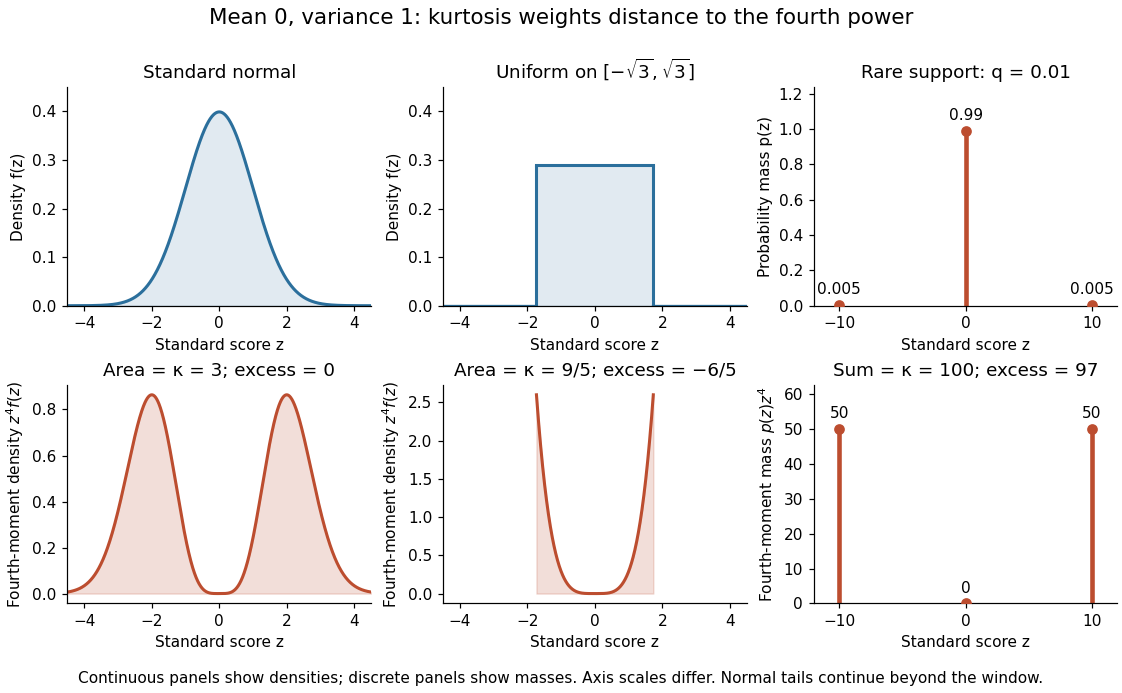
Kurtosis comparison for a standard normal distribution, a continuous uniform distribution, and a rare-outlier three-point distribution
. The upper panels show probability density functions or a probability mass function; the lower panels show their contributions to the fourth central moment. All three probability distributions have mean zero and variance one. Areas in the continuous panels and sums in the discrete panels give kurtosis. The standard normal distribution continues beyond the displayed window; density and mass heights have different meanings. Details.
Fourth moment Created 2026-10-06 Updated 2026-10-20
The fourth moment is . Its finiteness is equivalent to square integrability of . For centered variables, dividing it by the squared variance gives kurtosis.
For centered unit-variance independent and identically distributed increments with , an interpolated increment is . Here is the length of the overlap of with the th unit cell, so and . Independence gives its fourth moment as . This is at most , and gives the bound, including intervals crossing a mesh point. A uniform fourth-moment continuity criterion yields tightness of probability measures on .
Kurtosis Created 2026-10-06 Updated 2026-10-14
For a real random variable with mean , finite positive variance , and finite fourth moment, kurtosis is the fourth central moment divided by the square of the variance:The standard score measures distance from the mean in standard deviations. Its fourth power gives a value ten standard deviations away a weight inside the expected value. Thus a small probability mass far from the mean can strongly affect kurtosis. It is useful for describing the contribution of extreme standard scores, but does not by itself describe the height or shape of a probability density function near its peak.[ref]
Kurtosis as Peakedness, 1905 – 2014. R.I.P. by Peter H. Westfall. §2, Terminology, definition of κ; §4, counterexamples with different peaks; §5, central and tail contributions
The normal distribution has kurtosis . A random scale can increase kurtosis even when the conditional distribution is normal. A constant random variable has zero variance, so this ratio is undefined. If the variance is finite and positive but the fourth central moment is infinite, the ratio can be written in an extended sense; it is not a finite kurtosis. If the variance itself is infinite or the mean is undefined, the displayed normalization is unavailable.
Lag-two ARCH process 2026-10-06
Past exam of the mathematics course of the University of Cambridge 2002 iii Paper 27 4 b Solution Created 2026-10-03 Updated 2026-10-14
We use dyadic quadratic variation of Brownian motion. For fixed rational , set and let be the sum of the squares of the Brownian increments on its equal-length partition. Independence and the normal fourth moment giveFor every , Chebyshev's inequality bounds by , a summable sequence. The Borel-Cantelli lemma implies almost surely. Intersect over positive rational and all rational intervals to obtain one probability-one event on which every such interval has this positive quadratic-variation limit.
If a path were Hölder of exponent on a nonempty open interval, choose a compact rational subinterval within it and a finite Hölder constant there. Every partition increment would have absolute value at most , soThis contradicts . The same pathwise event excludes every exponent greater than , without needing an uncountable intersection of events. ThereforeThis is the quadratic variation obstruction to Hölder regularity. It rules out a continuously differentiable trajectory on any interval, since a continuous derivative is bounded on smaller compact intervals and gives a Lipschitz bound. By itself it does not rule out differentiability at an isolated point. The stronger nowhere differentiability of Brownian motion can also be seen directly as follows.
On a mesh of width in , the probability that any specified three consecutive increments all have absolute value at most is at most : each increment is and the three are independent. There are at most possible blocks, so the probability of any such block is at most , summable in . By Borel-Cantelli lemma, for every pair of positive integers there are eventually no such blocks. But a finite derivative at some time would imply near . The three mesh increments beginning at the mesh point immediately to the left of would then all be at most for all sufficiently fine meshes. Choosing an integer contradicts the preceding event. Thus finite derivatives do not exist anywhere almost surely, including a finite right derivative at . The Hölder estimates below express continuity with a roughness scale; they do not imply differentiability.
Past exam of the mathematics course of the University of Cambridge 2002 iii Paper 27 4 Solution 2026-10-14
Standard one-dimensional Brownian motion is a real process with , continuous paths almost surely, and increments independent of the past at time , for . These conditions determine its entire finite-dimensional distribution family.
The Wiener theorem asserts that such a process exists, equivalently that there is a unique Wiener measure on under which the coordinate process has these properties. To construct it, prescribe centered multivariate normal laws with covariance . This covariance is positive semidefinite becauseThe laws are consistent under removing coordinates, so the Kolmogorov extension theorem constructs the process. Normal increments have fourth moment . The Kolmogorov continuity theorem therefore supplies a continuous modification, retaining all the prescribed finite-dimensional laws and hence the independent normal increments. Apply this on every compact time interval, taking consistent versions; continuity and equality at rational times make them agree on overlaps. The resulting law on continuous-path space is unique because evaluations at rational times generate its Borel sigma-algebra. This is a proof sketch of the existence theorem, independent of the random-walk limit in Question 5.
Past exam of the mathematics course of the University of Cambridge 2002 iii Paper 27 5 a Solution Created 2026-10-03 Updated 2026-10-14
Write and . Since and , the characteristic function expansion at zero is . Indeed, for real , and . The dominated convergence theorem, with dominating variable , proves the expansion after taking expectations. Initially omit the endpoint interpolation terms. The integer-time increments involve disjoint sets of independent steps, so their joint characteristic function isHere . Taking the logarithm near givesThis proves the claimed limit for the integer-time approximation.
At a fixed time , the omitted endpoint term is , and . A fixed linear combination of the errors in the increments therefore tends to zero in , by the triangle inequality and Cauchy-Schwarz inequality, even when two endpoint terms share a step. Since , restoring interpolation changes the joint characteristic function by a quantity tending to zero. HenceThe limit is the joint characteristic function of independent centered normal increments with the indicated variances. By Lévy continuity theorem, the increment vectors converge in distribution to Brownian increment vectors. The value vector is obtained by the fixed invertible triangular map of cumulative sums; thus the continuous mapping theorem gives convergence of to . This proves every required finite-dimensional distribution limit. The finite fourth moment is not needed for this part; it will give tightness in part (b).
Past exam of the mathematics course of the University of Cambridge 2015 iii Paper 37 2 b Solution Created 2026-10-03 Updated 2026-10-06
Two useful features of autoregressive conditional heteroscedasticity are persistent changes in conditional scale and excess unconditional kurtosis. Its time-varying conditional variance can explain volatility clustering, where large absolute returns occur in groups even when signed returns have little autocorrelation. A homoscedastic autoregressive moving-average model has a fixed innovation variance.
Also, a conditional normal distribution with a random scale is a Gaussian scale mixture. Its unconditional kurtosis can exceed , or its fourth moment can be infinite. A Gaussian autoregressive moving-average model remains jointly Gaussian and cannot reproduce this effect. In the particular lag-two ARCH process, persistence of the squared scale occurs within each parity subsequence; the two parity subsequences are independent.
Past exam of the mathematics course of the University of Cambridge 2015 iii Paper 37 2 c Solution Created 2026-10-03 Updated 2026-10-06
First justify the dependence structure rather than assume that adjacent squares behave like an ordinary lag-one ARCH model. Write . Iterating its nonnegative recurrence givesThe product coefficient has expected value , so it tends to zero in probability. The stationary are a tight family; consequently the remainder tends to zero in probability, without needing independence between that remainder's factors. The increasing partial sums therefore give the representationThis proves the parity decomposition of a lag-two ARCH process: even and odd observations are functions of disjoint noise families. It also shows that the positive scale is a function of past noise, independent of . The conditional expectation of given past noise is zero, and the second-moment recursion is . independence of the parity families gives the adjacent-square covariance. ThusTo establish finiteness of the fourth moment before using its recursion, note that the norm of the th term in the positive series for is . The triangle inequality in L2 space makes the series square-integrable when . independence of the current noise and past scale then yieldsand henceIf , a finite would make , which is impossible. Its fourth moment is then infinite. The adjacent-square product remains integrable by parity independence, even in that case.
Past exam of the mathematics course of the University of Cambridge 2015 iii Paper 37 2 d Solution Created 2026-10-03 Updated 2026-10-06
The useful autoregressive model is for the squares, not for signed observations. Put andThenThe errors form a martingale difference sequence relative to the noise history, because the current standardized noise is independent of the past. When the fourth moment is finite they have finite variance and are uncorrelated across distinct times, although their conditional variance depends on the regressor. In centered form, .
For ordinary least squares, use the response-regressor pairs , , . With their separate means and , minimize . If the regressor sum of squares is positive, the estimators areThe two means use the matched pairs; replacing them indiscriminately by a single full-sample mean is not the exact least-squares formula. The noise-series representation supplies an ergodic stationary process. If , finite regressor second moments and the error's zero conditional expectation justify the usual population regression and statistical consistency argument. The observations still define a finite-sample least-squares fit outside that moment range, but the ordinary finite-variance justification must not be claimed there. If parameter constraints are required, minimize the same criterion subject to and , rather than assert that unconstrained estimates automatically satisfy them.
Rare-outlier three-point distribution 2026-10-14
For , put probability mass at zero and at each of and . This symmetric probability distribution has mean zero. Its second and fourth moments are both , because the nonzero outcomes have square and fourth power equal to one:For the kurtosis is ; for it is . In the latter case of the probability mass is at zero, yet all of the fourth central moment comes from the remaining . The standard score takes values and , with variance one. Each nonzero outcome contributesto kurtosis. At , the two rare outcomes are ten standard deviations from the mean, and their contributions are .
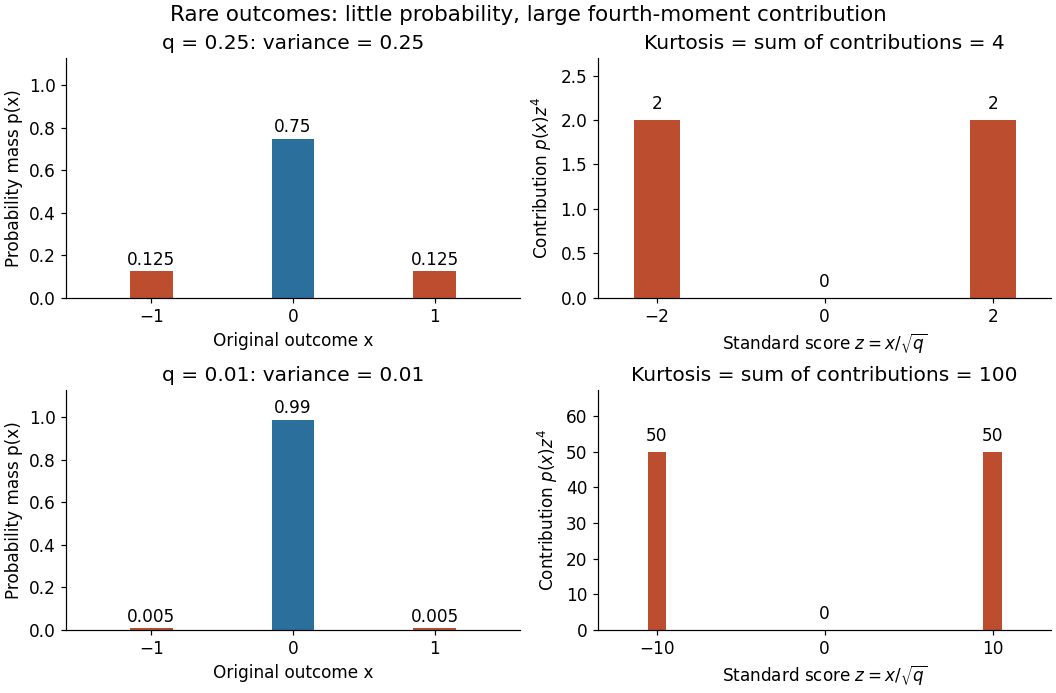

Every member has finite support of a probability distribution, so all its moments are finite. Nevertheless, kurtosis becomes arbitrarily large as approaches zero: high kurtosis does not require an unbounded support of a probability distribution or a heavy-tailed distribution. At the variance vanishes and kurtosis is undefined. At this discrete probability distribution even has the normal distribution value and excess kurtosis zero, so those values do not establish a normal distribution.