The later angular test used an evacuated chamber with a radon source and scattering foil fixed in place. A diaphragm served as a collimator; a zinc sulfide screen and attached optical microscope rotated about the foil on a graduated platform. Particle scintillation counts sampled successive angles. Foil-out counts supplied background subtraction, with corrections for source radioactive decay and finite beam width. Shielding reduced interfering radiation, but screen glow limited large angles. This tested the Rutherford differential cross-section.[ref]
The Laws of Deflexion of Alpha Particles through Large Angles by Hans Geiger and Ernest Marsden. The Laws of Deflexion of α Particles through Large Angles, transcription PDF pp. 3–7, Variation of Scattering with Angle, Fig. 1 and Tables I–II
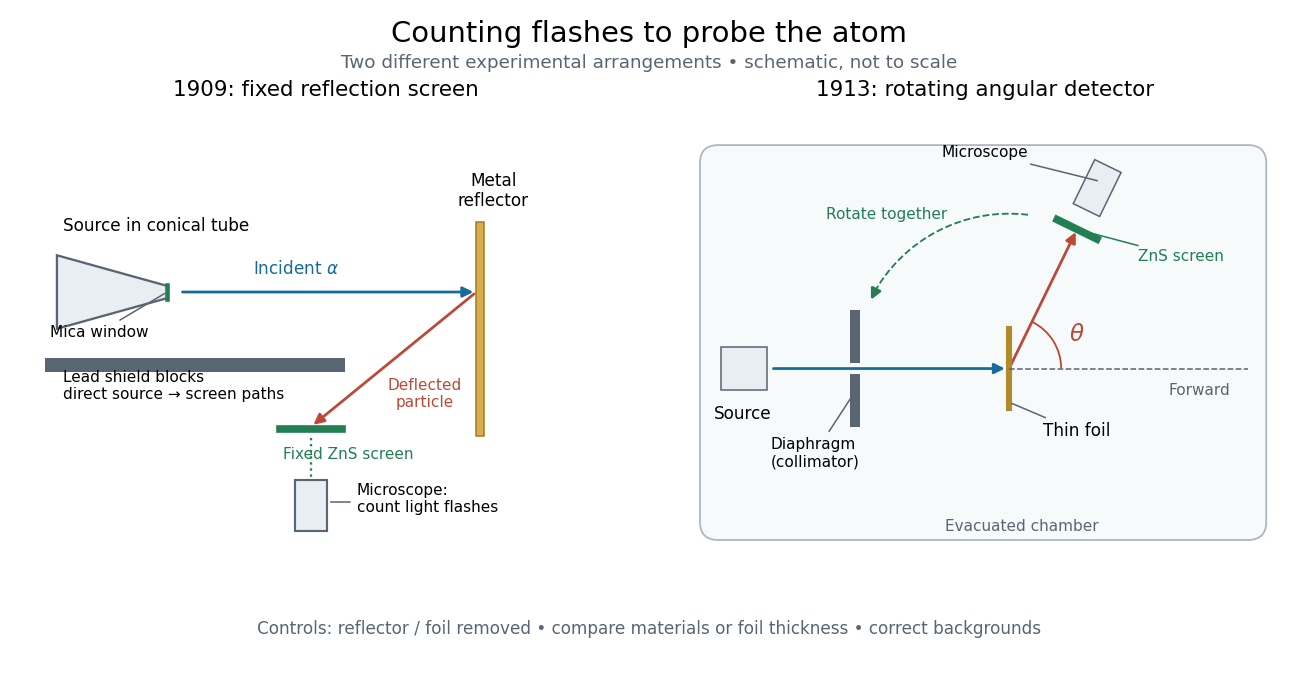
Fixed backscattering screen and later rotating angular detector
. Original schematic distinguishing the 1909 shielded reflection arrangement from the 1913 evacuated angular arrangement. Arrows indicate example particle paths, not calculated trajectories; component sizes and distances are schematic. The later screen and microscope rotate together while the source and foil remain fixed. Details.
Articles by others on the same topic
There are currently no matching articles.