The additive group gives a useful way to see what a word metric measures. Let and , and choose the four-move generating set of a group . Its Cayley graph is the square lattice. Each move changes exactly one coordinate by one, so the word length is the L1 norm, and the word metric is Manhattan distance:At least this many moves are necessary, and moving horizontally then vertically attains the bound. Bridson gives this square lattice as a basic Cayley graph example.[ref]
Now allow all eight neighbouring lattice points as moves:Each coordinate changes by at most one per move. Use diagonal moves until the smaller displacement is exhausted, then use axis moves: the resulting word length is the maximum norm, and the word metric is Chebyshev distance. From to , an -route has five steps, while the -route has three.
The closed word metric balls consist of lattice points inside a diamond for , and inside an axis-aligned square for . For every nonnegative integer radius ,The diamond has lattice points at word length ; the square has choices for each coordinate. At radius three the counts are and . These are discrete closed balls for Manhattan distance and Chebyshev distance; an Euclidean distance bound would instead select lattice points inside a Euclidean disk.
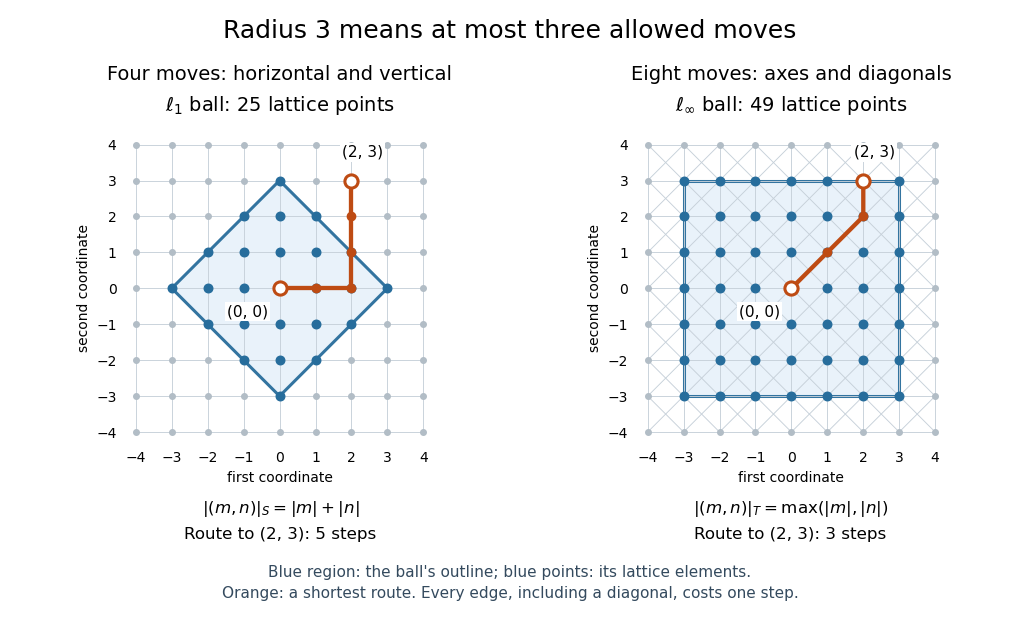
Radius-three word metric balls in the integer lattice: a diamond with 25 points and a square with 49 points, with routes to
. Details. 
Articles by others on the same topic
There are currently no matching articles.