The Life blinker alternates between horizontal and vertical lines of three live cells. Start with and every other cell dead. The two endpoints each have one live neighbor and die; the center has two and survives. The dead cells and each have three live neighbors and are born. No other dead cell has three. ThereforeThe same neighbor-count argument with horizontal and vertical exchanged gives the second step. Since , the period is exactly two, rather than merely a divisor of two.
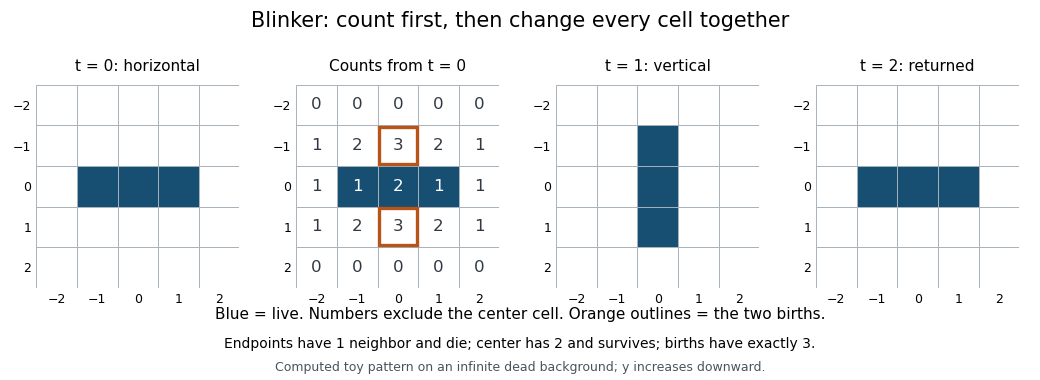

The Life blinker is a minimal hands-on check of synchronous updating. Mark both endpoints for death and both births before changing anything. Removing an endpoint early would make a prospective birth see only two neighbors; adding a birth early would alter other counts. A correct implementation reproduces both sets above exactly, rather than merely keeping the live population equal to three.
Articles by others on the same topic
There are currently no matching articles.